Prior Approval Secured After Surface Water Risk Redesign
The Project:
A developer was seeking prior approval to convert an existing Class E commercial building in West Sussex into residential use.
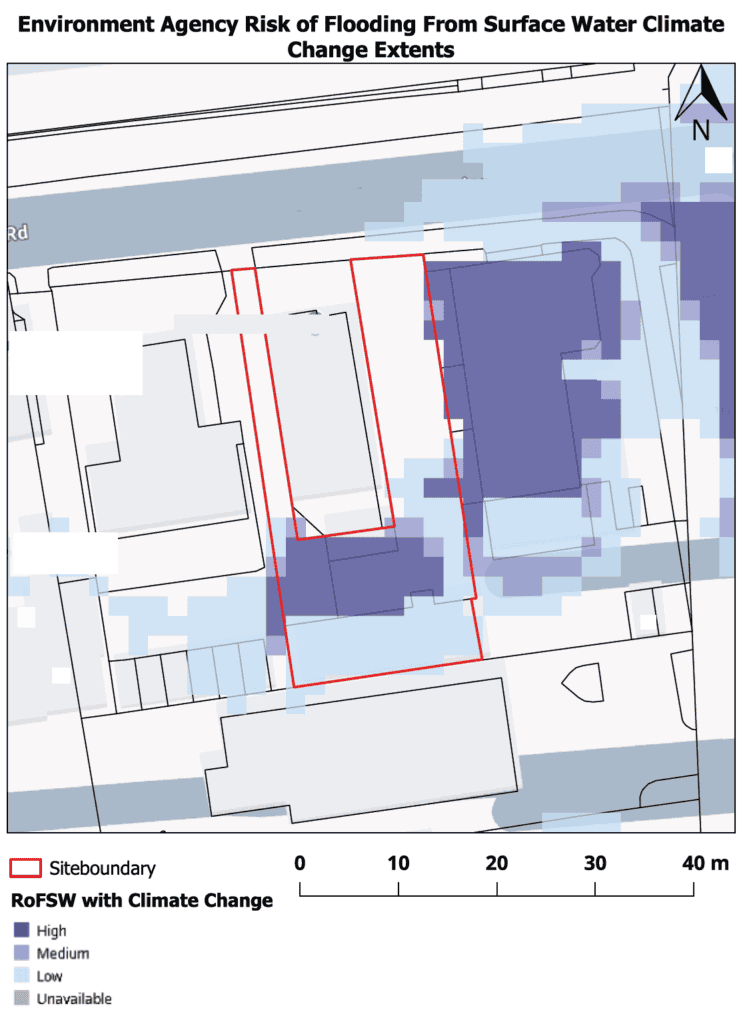
The site was in Flood Zone 1, so river and tidal flood risk was not the main constraint. The issue was surface water. Environment Agency mapping and more detailed review showed that parts of the site were affected by modelled surface water flooding, with the proposed change of use increasing the vulnerability of the building from commercial to residential.
The original proposal was for four one-bedroom flats. Following the flood risk review, the scheme was revised to two duplex residential units, allowing the design to respond more effectively to the mapped flood risk while retaining a viable residential conversion.
The Challenge:
The main challenge was that the proposed use was becoming more vulnerable, even though the site was in Flood Zone 1.
The initial layout included self-contained residential accommodation at ground floor level. That created several planning risks. The ground floor units had no internal access to higher accommodation, finished floor levels needed to be considered against mapped flood depths, and safe access and escape from the building was uncertain during an extreme surface water event.
On a straightforward reading, the site could have appeared low risk because it was outside Flood Zones 2 and 3. In practice, the surface water mapping changed the position. The Local Planning Authority still needed to be satisfied that future occupants would be safe, that flood depths could be managed, and that the development would not increase flood risk elsewhere.
Without a design response, the application was at risk of objection, redesign or refusal.
What We Did:
Unda prepared a site-specific Flood Risk Assessment to support the prior approval application. The assessment reviewed Environment Agency flood mapping, surface water depth data, local topography and the proposed layout.
The review confirmed that the site was in Flood Zone 1 and was not reliant on flood defences. It also confirmed that the relevant constraint was surface water flooding, with a maximum modelled depth of 0.3m on site for the present day and climate change scenarios.
That finding shaped the advice. Rather than treating the issue as a generic flood resistance problem, the design needed to deal with three practical questions: where people would sleep, whether residents could move internally to a safer level, and how they could leave the building safely during an exceedance event.
The scheme was therefore revised from four self-contained one-bedroom flats to two duplex units. This allowed the development to retain residential use while providing internal access between floors. Finished floor levels were raised to 8.54mAOD, giving at least 600mm freeboard above the 0.3m modelled surface water depth.
A floodable walkway was also introduced from the building entrance to land outside the surface water flood extent. This route was designed to remain above the relevant flood depth and extend approximately 15m before connecting to flood-free ground.
The mitigation strategy also included flood-resistant construction measures, raised electrical infrastructure, non-return valves and a flood warning and evacuation plan. Because the proposal involved conversion of an existing building, there was no increase in built footprint, impermeable area or surface water runoff.
The Outcome:
The revised Flood Risk Assessment demonstrated that the proposed residential conversion could be made safe for future occupants and would not increase flood risk elsewhere.
The change from four self-contained flats to two duplex units was central to the outcome. It resolved the concern around ground floor residential accommodation by providing internal access to the first floor, while the raised finished floor levels and floodable walkway addressed safe access and escape.
Prior approval was subsequently secured. The project was able to proceed with a proportionate mitigation strategy rather than a wholesale redesign or abandonment of the residential use.
This project shows why Flood Zone 1 does not always mean flood risk is straightforward, particularly where surface water flooding and a more vulnerable use are involved.
 Modern brick house with a spacious patio and outdoor dining area, featuring potted plants and garden furniture.
Map showing flood risk zones and site boundary for surface water risk redesign.
Modern brick house with a spacious patio and outdoor dining area, featuring potted plants and garden furniture.
Map showing flood risk zones and site boundary for surface water risk redesign. 