Wales’ £85m Flood Investment Explained
Estimated reading time 5 minutes
The Welsh Government has announced £85 million of funding for flood and coastal erosion risk management in Wales for 2026 – 27, describing it as the highest annual allocation ever delivered.
The headline figure is significant. It builds on more than £377 million committed during the current Senedd term and reinforces flood risk management as a core national infrastructure priority. But beyond the political framing, what does this £85m flood investment in Wales actually fund – and how far does it go in addressing long-term flood risk?
How Wales’ £85m flood funding is allocated
Of the £85m total flood defence funding, just under £43m is capital investment for new flood and coastal erosion risk management schemes across Wales. Funding is distributed through Risk Management Authorities, including local authorities and Natural Resources Wales.
The programme includes:
- Flood and Coastal Erosion Risk Management (FCERM) capital schemes
- The Coastal Risk Management Programme (CRMP)
- The Natural Flood Management Fund
- The Small Scale Works Grant
- Revenue funding for maintenance, monitoring and specialist flood risk staff
The Coastal Risk Management Programme alone represents a £291m, five-year investment in coastal flood defence across Wales. Across 15 schemes, it is expected to improve protection for nearly 14,000 properties.
One of the largest projects is the Rover Way to Lamby Way coastal defence scheme in Cardiff. The £35.2m project includes rock revetment, earth embankments, sheet piling and erosion protection. Once complete, it is expected to reduce coastal flood risk to 2,326 residential and 204 non-residential properties over the next 100 years, with 85% of construction funding provided by the Welsh Government.
Understanding what “reducing flood risk” means in practice requires clarity on protection standards and annual probability. The distinction between a 1 in 100 year flood event and annual flood probability is often misunderstood, as outlined in our explanation of flood return periods and annual probability. Public investment typically improves the standard of protection; it does not remove flood risk entirely.
Alongside engineered flood defence schemes, £5.26m has been allocated to 35 Natural Flood Management projects across Wales. These schemes include tree planting, leaky dams and habitat restoration, with more than 3,300 properties expected to benefit. This reflects a growing emphasis on catchment-scale interventions alongside traditional hard infrastructure.
The Small Scale Works Grant supports lower-cost, local flood alleviation measures, often addressing surface water and drainage constraints within urban areas.
Flood risk management funding supports a pipeline of schemes
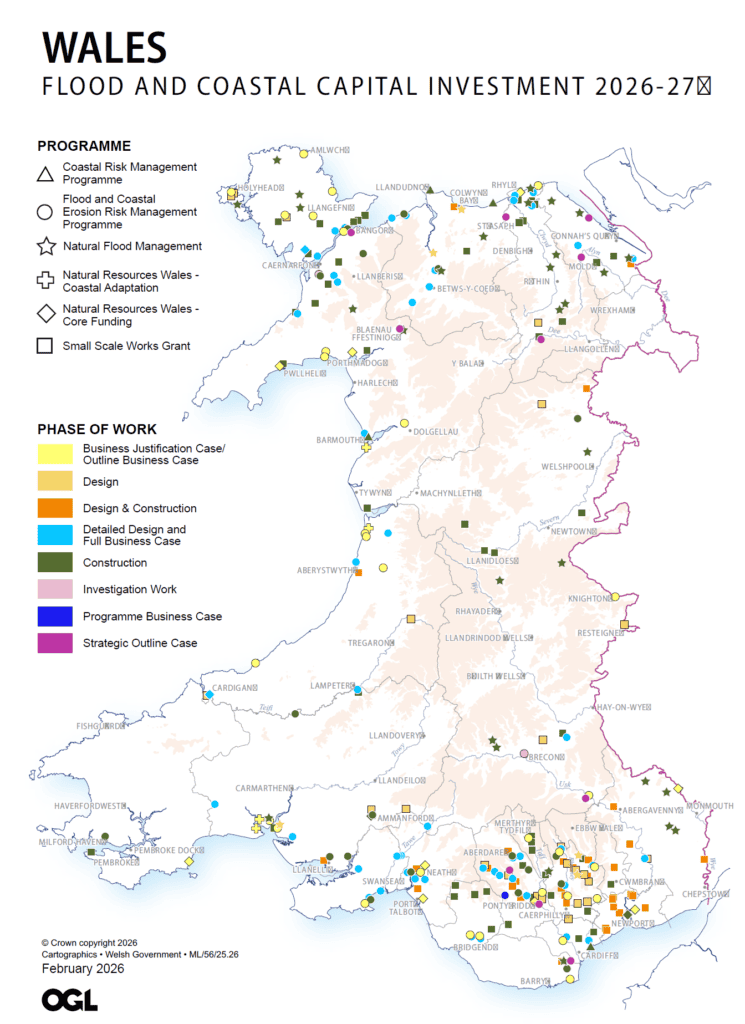
A detailed review of the 2026 – 27 programme shows that not all funding translates immediately into construction.
Many flood risk management schemes in Wales are currently at:
- Business Justification Case or Outline Business Case stage
- Detailed Design and Full Business Case stage
- Strategic Outline Case stage
Only a proportion of schemes are in active construction during this financial year.
This reflects the structured delivery model for flood defence funding in Wales. Schemes require hydraulic modelling, options appraisal, environmental assessment, permitting and formal business case approval before works can commence. The modelling that underpins these projects is increasingly data-intensive, drawing on approaches similar to those discussed in our overview of flood modelling software, tools and techniques.
In practical terms, the £85m allocation supports both physical flood defence construction and the development pipeline that enables future schemes to proceed.
Coastal, river and surface water risk across Wales
The 2026 – 27 flood risk management programme reflects the diverse nature of flood exposure in Wales.
There is a strong coastal emphasis through the Coastal Risk Management Programme, with major schemes in Cardiff, Conwy and Gwynedd. Valley authorities feature prominently in river and surface water flood alleviation schemes, while Natural Flood Management funding is distributed across multiple catchments.
Flood risk in Wales arises from tidal and coastal processes, fluvial flooding and intense rainfall-driven surface water events. Strategic public investment reduces risk at a community scale, but it does not remove flood zone classification or planning constraints.
For those operating within the Welsh planning system, this sits alongside the revised framework introduced under the new TAN 15 (2025) flood planning policy update. TAN 15 reshapes how flood zones are categorised and how development must demonstrate acceptability in areas of flood risk. Strategic flood defence investment does not override those policy tests.
What £85m flood investment in Wales actually delivers
Taken together, the 2026 – 27 allocation funds:
- Major coastal defence construction
- Ongoing river and surface water flood alleviation schemes
- Development and design of future flood defence projects
- Catchment-scale natural flood management interventions
- Asset maintenance, monitoring and flood warning capability
- A £500,000 workforce development programme to strengthen specialist flood risk skills
What it does not do is eliminate flood risk across Wales.
Flood risk management investment reduces the likelihood and consequences of flooding. It improves standards of protection and supports long-term resilience. However, exposure remains, and flood defence schemes operate within funding cycles, approval processes and evolving climate projections.
For developers, landowners and local authorities in Wales, public flood defence funding forms part of the wider context – but it does not remove the need for robust, site-specific assessment under Welsh planning policy. Where development proposals are affected by flood risk or TAN 15, a compliant and technically sound Flood Consequence Assessment in Wales remains essential to demonstrate acceptability, quantify consequences and define mitigation measures.
The £85m headline confirms continued national commitment to flood risk management in Wales. The longer-term measure of success will be how efficiently schemes progress from appraisal to construction, and whether investment keeps pace with changing patterns of coastal, river and surface water risk.
One of our experienced Flood Risk Consultants will get back to you within 60 minutes
Latest news




One of our experienced Flood Risk Consultants will get back to you within 60 minutes
