Flood Performance Certificates: What They Are and When They Start
Estimated reading time 16 minutes
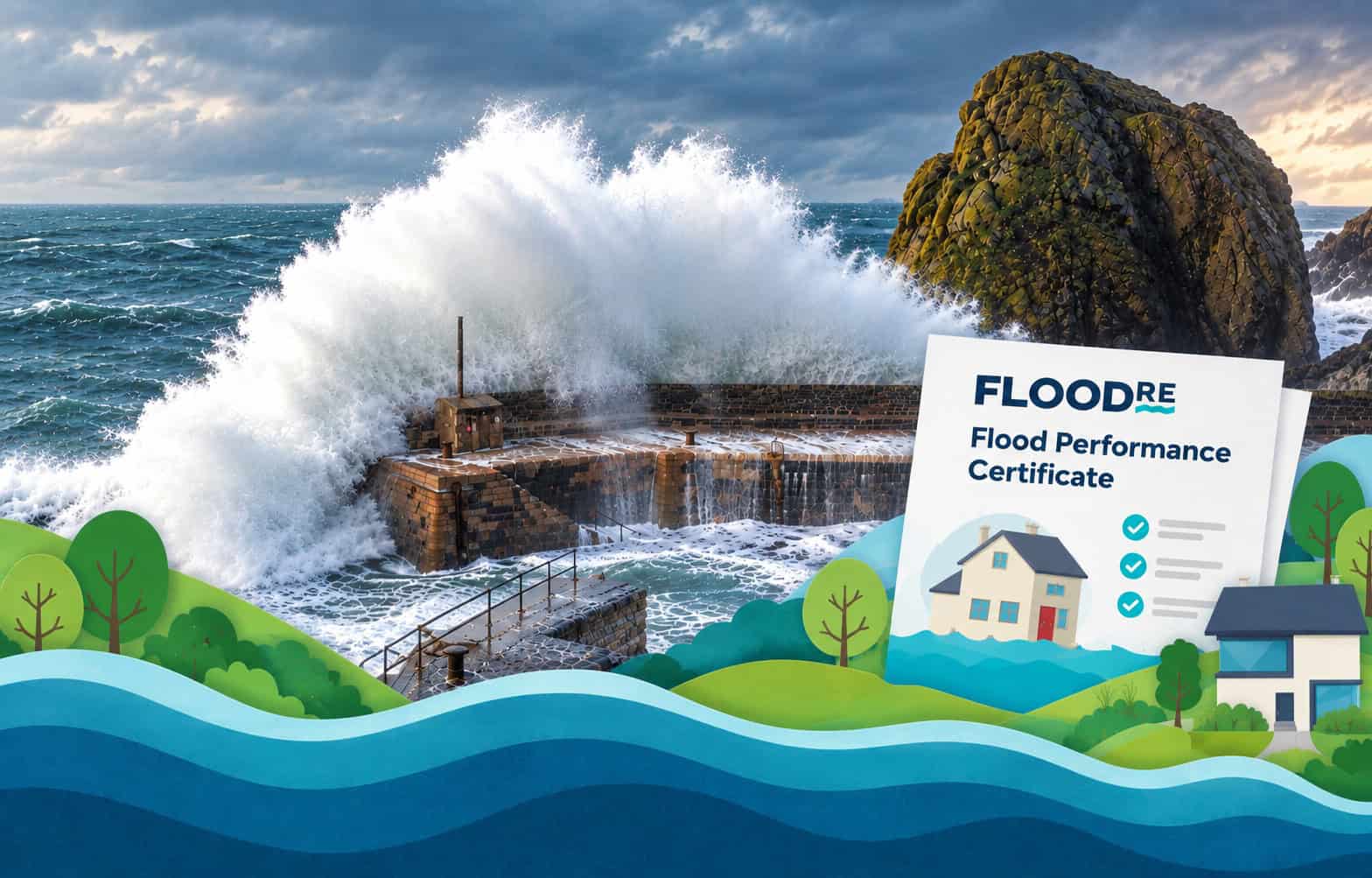
A flood performance certificate (FPC) is a planned rating of how well a home keeps floodwater out and how quickly it recovers when water gets in, in the way an Energy Performance Certificate rates energy use. Flood Re confirmed on 1 July 2026 that it will pilot the certificates, with the pilot due to start by the end of 2026 and discounts for certified homes built into insurance pricing from 2028.
Nobody can buy a flood performance certificate yet. What exists is a four-stage plan, a data standard published in July 2026 and a target date. That is enough to show what an FPC will measure, who will rely on it, and why it matters most to owners of homes built since 2009, which Flood Re has never covered.
Around 6.3 million properties in England are at risk of flooding from rivers, the sea or surface water, 4.6 million of them from surface water alone, on the Environment Agency's 2024 figures.
What is a flood performance certificate?
A flood performance certificate records how resilient one particular home is to flooding: what a flood of a given depth would do to it, which measures already protect it, and what would improve it. The aim is a single, trusted result that an owner, buyer, insurer or lender can read without commissioning their own survey.
The idea first appeared in a December 2020 blueprint by WPI Economics for Flood Re. It suggested an A to D rating combining the likelihood and the impact of flooding, an estimate of how long a household would be out of its home, and costed recommendations. Flood Re's FPC Roadmap, published in 2024, turned that into a delivery plan and left the final format open, including whether results are shown in bands.
The gap it fills is real. According to the Roadmap there is no such thing as a "resilient house" and an "exposed house", only homes with different combinations of features and adaptations, and property flood resilience measures only work in combination. The Roadmap's own example is a flood door fitted to a house with no non-return valves, where sewage can still come up the pipes. No system currently measures how well a set of measures performs in a specific home. Insurers cannot price it. Buyers cannot compare two houses on the same street, one with a flood door and one without, except by guessing. The measures themselves, and the CIRIA Code of Practice behind them, are covered in the guide to property flood resilience in the UK.
Until certificates exist, the nearest equivalent evidence for an insurer is a flood risk assessment for insurance: a property-level report on which sources of flooding affect the address, how deep water could get against the floor levels, and what the measures in place do.
When will flood performance certificates be available?
Not yet. The pilot is due by the end of 2026. Flood Re then aims to link certificates to discounted premiums from 2028. There is no date for a national scheme open to every home, and no decision that certificates would ever be compulsory.
The Roadmap splits the work into four stages: build a scoring model, standardise how homes are assessed, test the model, then run a certification system. By September 2026 the first two are largely done.
| Date | Milestone | Roadmap stage |
|---|---|---|
| December 2020 | Flood Re publishes the WPI Economics blueprint for FPCs | Concept |
| 2024 | Flood Re publishes the FPC Roadmap; a scoring model built with Middlesex University's Flood Hazard Research Centre has completed its first phase, in a pilot area in Kent | 1. Model |
| 1 July 2026 | Flood Re's ten-year reform package confirms FPCs will be developed and piloted, with premium discounts for households that hold one | 2. Standardise |
| 7 July 2026 | Data collection framework published, prepared for Flood Re by RAB Consultants with Sedgwick | 2. Standardise |
| By end of 2026 | Pilot phase due to start | 3. Test |
| From 2028 | Target for building FPC discounts into premium structures | 4. Certify |
| 2039 | Flood Re scheme ends; home insurance moves to risk-reflective pricing | Exit |
…we will start the pilot phase by the end of this year.
Jonathan Kassian, Head of Flood Resilience, Flood Re, July 2026 (reported by CIR Magazine)
The dates matter because of what follows them. The Flood Re scheme ends in 2039, and from then premiums will reflect each home's own flood risk, with no industry-funded pool behind the highest-risk homes and no flat price set by Council Tax band. That leaves roughly eleven years, from 2028 to 2039, in which a certificate can earn a discount while Flood Re is still there to cushion the change. The scheme's eligibility rules and its 2039 end date are explained in full in what Flood Re is and how it works.
How will a home be assessed for an FPC?
The July 2026 framework combines three kinds of information: the property's own characteristics, the flood hazard at the address, and any resilience measures already fitted. It then sets three tiers of assessment, so a straightforward house needs less work than one with a complicated or recent flood history.
- Homeowner information. The owner supplies basic details about the home and its existing protection. Flood Re has said this kind of self-assessment will also qualify for a discount.
- Desktop assessment. Where the picture is less clear, an assessor reviews flood mapping, levels and property data without a site visit.
- Enhanced assessment. Complex risks and homes that have recently flooded get a detailed evaluation, including a survey.
The hazard data is likely to draw on Environment Agency mapping, including the national flood risk dataset known as NaFRA2, which the Agency used for its 2024 national assessment of flood and coastal erosion risk. The Roadmap expects assessments to follow the training and Code of Practice the property flood resilience sector already uses, such as CIWEM's property flood resilience training.
The weak point is the first tier. A self-assessment is only as good as what the owner knows about their floor levels, airbricks and drains, and most owners have never measured any of them, let alone compared them with a modelled flood depth. Research cited in the 2020 blueprint found that 67% of people in the UK had never checked their own home's flood risk. Expect the pilot to test how far self-reported data can be trusted before a discount depends on it.
Flagged by an insurer before FPCs arrive?
A property-level flood report sets out the real sources and depths at the address, in a form an insurer or broker can review. Quotes are returned within 60 minutes.
Get a flood report quoteWhat resilience measures will an FPC recognise?
The Roadmap groups a home's resilience into three elements: features built into the property, such as a raised ground floor; resistance measures that keep water out; and recoverability measures that limit the damage when water does get in. Flood Re's ReThink campaign adds a fourth, preparedness: knowing what to do before, during and after a flood.
Ankle height
Keep water out with simple measures such as airbrick covers.
Knee height
Keep water out with flood doors and barriers, plus non-return valves and toilet bungs to stop waste water coming up.
Waist height
Water is hard to keep out, so limit the damage: waterproof tiling, raised sockets, a flood-resilient kitchen.
Depth decides which measures make sense, and the Roadmap sets out three bands. At ankle depth, around 15 cm, simple measures such as airbrick covers can keep water out. At knee depth, around 60 cm, flood resistance needs flood doors, demountable flood barriers and plumbing changes such as non-return valves. At waist depth, around 100 cm, keeping water out is rarely realistic, and flood recoverability takes over: tiled floors, raised sockets and a kitchen that can be hosed down.
Flood Re says recoverability measures can cut repair costs by as much as 73% in some cases.
That figure comes from Flood Re's own resilience guidance, and it explains why an FPC will not simply reward the home with the most barriers: a house that floods to a metre but can be cleaned, dried and lived in again within days may deserve a better result than one with an expensive door and plasterboard walls. The certificate has to judge how measures work together at the depths that home could face. It also has to separate measures that are always in place from ones that someone must fit after a flood warning, which the Roadmap flags as an open design question. A demountable barrier protects nothing if the household is on holiday when the warning comes. The CIRIA Code of Practice for property flood resilience (C790) already sets the standard for surveying and installing these measures, and the homeowner guide on how to protect your home from flooding goes through them one by one.
Will an FPC lower your flood insurance premium?
That is the intention, not a promise. Flood Re has said households that obtain an FPC, or complete an equivalent self-assessment, will be offered premium discounts, and 2028 is the target for building them into pricing. Flood Re reinsures behind the insurer, so how much reaches the customer depends on how each insurer prices the policy.
The certificate matters because of how Flood Re prices now. It charges insurers a fixed premium set by Council Tax band, as its published premium table shows, so value stands in for risk and nothing about a home's actual protection enters the price. An FPC gives the market property-level data for the first time. In effect it becomes a flood insurance certificate for the home, and a reason for an insurer to quote on the house in front of it.
The other changes in Flood Re's July 2026 reform package point the same way:
- Lower-income households. The contents-only premium Flood Re charges insurers for Council Tax Bands A and B falls from £58 to £25 from April 2027. Flood Re's reason is that in three of the last four years it spent more repairing homes in Bands G and H, fewer than 4% of UK homes, than in Bands A and B, which make up around 45%.
- Build Back Better. Flooded households can claim up to £10,000 on top of repairs to fit resilience measures. More than 70% of the home insurance market now offers it, and insurers that do not will face a lower cap on the claims they can pass to Flood Re.
- Scale. Flood Re says more than 742,000 households have benefited since it launched in 2016.
Build Back Better and FPCs fit together. A home rebuilt with resilience measures after a claim is exactly the kind of home a certificate would recognise, and the record of what was fitted becomes evidence for the next insurer. What those claims cost and how long they take is set out in the review of UK flood insurance claims, and what to do in the first weeks after water gets in is covered in what to do after a flood.
What will FPCs mean for buyers, sellers and mortgage lenders?
An FPC would give a buyer, a surveyor and a lender the same record of a home's protection. None of them can get that today. Each currently has to make their own judgement about the measures in a house, so resilience often draws attention to the flood risk without getting any credit for reducing it.
Lenders have the longest view of all, and the Roadmap spells out why.
A lender needs a home to stay insurable for the whole mortgage term, typically 30 years, and has always used today's insurability as the proxy.
Climate change breaks that assumption. What a lender needs is evidence that the risk could be managed at the property if insurance became a problem, and an FPC is designed to provide it. How lenders treat flood risk today is covered in can you get a mortgage on a flood-risk property.
Sellers stand to gain most directly. Since 30 March 2026 the sixth edition of the TA6 property information form, mandatory for accredited conveyancing firms, has asked sellers to disclose flooding from six named sources, as set out in the guide to declaring flooding when selling a house. A flood history marks a house down: research covered in does flood risk affect house prices found flooded homes lose around 10% of their value by year fifteen. The blueprint also cited research showing that a quarter of householders had avoided fitting resilience measures because they felt it would signal flood risk. A certificate turns those measures into something a buyer can see and weigh in the seller's favour.
For a buyer weighing a home in a flood risk area now, before any certificate exists, a flood risk survey before buying a house answers the same questions an FPC will: what floods the property, how deep, and whether the protection fitted is enough.
What do flood performance certificates mean for new-build homes?
New builds are the homes Flood Re cannot help. It has never covered homes built from 1 January 2009, so a new home in a flood risk area depends on the open insurance market from the day it is sold, and a Flood Re discount can never apply to it. What a certificate offers a post-2009 home is evidence that open-market insurers and lenders can price.
The Roadmap puts the share of new-build homes with some level of flood risk at about one in 13.
Planning policy already requires those homes to be safe for their lifetime, typically through raised finished floor levels, resistance and resilience measures, and safe access. The problem is proof. Once the house is sold, nobody can see what was built, and the FRA that specified it sits in a planning file few buyers or insurers will ever open. Flood Re has been examining how an FPC could be issued after construction, so that a certificate records the as-built measures and confirms they were delivered as designed, as Insurance Times has reported.
The consequences for a development that cannot evidence its resilience are serious. Without evidence of what was built, an insurer prices a post-2009 home on the hazard alone, with no Flood Re backstop. A home that cannot be insured on reasonable terms cannot be mortgaged, and a home that cannot be mortgaged sells only to cash buyers at a discount. Plots can stall, lenders can refuse to lend on the development as a whole, and unsold homes sit on the developer's books. Insurers and lenders set out this risk in their March 2026 letter to ministers, covered in why the insurance industry is warning against the NPPF flood risk changes. What an insurer examines first is the residual flood risk left once defences and drainage have done their job, which is why a record of the as-built measures matters so much.
Does an FPC replace a flood risk assessment for planning?
No. An FPC rates how resilient an existing or finished home is, for insurance and sale. A planning application still needs a site-specific flood risk assessment showing the development will be safe for its lifetime, from every source of flooding and with climate change allowed for, without increasing flood risk elsewhere, as the government's planning guidance on flood risk and coastal change sets out.
| Flood performance certificate | Flood risk assessment for planning | Conveyancing flood report | |
|---|---|---|---|
| Purpose | Rates how a home resists and recovers from flooding | Shows a proposed development is safe and does not increase risk elsewhere | Screens an address for flood risk during a sale |
| Read by | Owners, buyers, insurers, lenders | Local planning authority, Environment Agency, lead local flood authority | Solicitor, buyer, lender |
| When | Existing or completed homes | Before planning permission is decided | During conveyancing |
| Basis | Property data, hazard data and fitted measures, in three tiers | Site-specific analysis of every flood source, with climate change allowances | Automated desktop screening of mapped data |
| Status in 2026 | Pilot due by end of 2026; discounts targeted from 2028 | Required by national policy in Flood Zones 2 and 3 and other set cases | Widely used; not accepted for planning |
The planning FRA is where a new home's resilience is decided. It sets the floor levels, the resistance and resilience measures and the safe access route that a future certificate would later record, so for a developer a flood risk assessment for planning that specifies those measures clearly, and that a contractor can build to, is the best preparation for an FPC regime. A desktop screening report will not do that job, for the reasons set out in why a conveyancing flood report won't pass planning.
Frequently asked questions
Is a flood performance certificate the same as an Energy Performance Certificate?
No, though the idea is borrowed from it. An EPC is a legal requirement when a home is sold, let or built, and lasts ten years. An FPC deals only with flooding and, on current proposals, would be voluntary, with premium discounts as the reason to get one. They could merge one day: the Roadmap floats a single climate certificate covering both.
How long will a flood performance certificate last?
Undecided. The 2020 blueprint proposed five years, half the life of an EPC, because resilience measures need maintaining and flood maps change. A certificate issued before a remapping, or before seals on a flood door have perished, would soon stop describing the house.
Will flood performance certificates become compulsory?
Not under anything proposed so far. The 2020 blueprint recommended that an FPC be displayed on every sale or letting, but Flood Re's 2026 plans rely on discounts to encourage take-up, and the Government has made no decision to require them.
How much will an FPC cost, and who will carry it out?
No price has been published. The tiered design suggests a wide range: a homeowner self-assessment may cost little or nothing, while an enhanced assessment with a survey will cost more. Flood Re has not said whether any tier will be free.
What can a homeowner do before FPCs are available?
Keep a record of every measure fitted, with invoices and product certification, since that is the evidence any certificate will ask for. A property flood resilience survey to the CIRIA Code of Practice identifies the measures that suit the house, and a property-level flood report gives an insurer or buyer an independent view of the risk in the meantime.
Certificates will reward what good flood risk practice has always asked for: knowing what floods a particular property, how deep, and what the protection in place does. For an answer on a specific home or site now, flood risk assessments for insurance, property purchase and planning are available across England and Wales.
About the author. Jackie is a co-founder and Director of Unda with 30+ years in flood risk, and sits on CIWEM's South Eastern Branch committee. Unda has been trading since 2014, is a CIWEM Business Partner with CIWEM member and chartered (C.WEM MCIWEM) consultants, and has delivered 5,000+ flood risk assessments and drainage strategies across England and Wales.
Jackie Stone · MSci, BSc (Hons), DIC, CIWEM Environmental Partner
Latest news



One of our experienced Flood Risk Consultants will get back to you within 60 minutes
