What Is Flood Re? The Flood Re Scheme Explained

Estimated reading time 19 minutes
The Flood Re scheme is a UK government-backed reinsurance scheme that keeps home flood insurance available and affordable for households at higher flood risk. Set up under the Water Act 2014 and launched in April 2016, it lets insurers pass the flood element of an eligible home insurance policy into a central not-for-profit pool. More than 742,000 households have benefited since launch, and the scheme is scheduled to end in 2039.
You still buy buildings and contents cover from an insurer or broker in the normal way. Flood Re works behind the scenes and never sells policies directly, so most of the homeowners it helps never deal with it at all.
In 2025 UK insurers paid a record £6.1 billion in property claims, £312 million of it on domestic flooding, where the average payout reached £30,000, up 60% on the year before.
Those figures come from the Association of British Insurers, and the cost behind them is set out in UK flood insurance claims: payouts, timescales and the trend. Flood Re is the mechanism that keeps cover reaching the homes behind them.
What is Flood Re?
Flood Re is a not-for-profit reinsurance pool, run by the insurance industry and backed by government, that exists so households at significant flood risk can keep buying affordable flood cover. It charges insurers a fixed price to take on the flood risk of an eligible policy, so the insurer can offer cover it might otherwise price out of reach.
Flood Re does not replace your insurer. Your own provider sets the policy terms and the retail premium, and it handles any claim. Reinsurance simply means insurance for insurers: Flood Re carries the flood risk in the background so the retail market does not have to.
- Legal basis. Established under the Water Act 2014 and its supporting regulations.
- Launched. April 2016, replacing the earlier "Statement of Principles" agreement between government and insurers.
- Coverage. England, Wales, Scotland and Northern Ireland. The Isle of Man and the Channel Islands are excluded.
- Funding. A levy on UK home insurers, which Flood Re's own explanation puts at £160m a year, plus the reinsurance premiums insurers pay. No taxpayer subsidy is involved. GOV.UK describes it as a joint initiative between the industry and government.
- Scale. 353,000 policies were in the scheme at 31st March 2026, according to the Flood Re annual report and accounts 2025 to 2026.
Why was Flood Re introduced?
Flood Re was introduced to stop high-risk homes being priced out of the flood insurance market as insurers moved towards fully risk-reflective pricing. Before it, the informal "Statement of Principles" had kept insurers offering cover to existing customers in flood-risk areas, but that arrangement was ending and placed no equivalent duty on price.
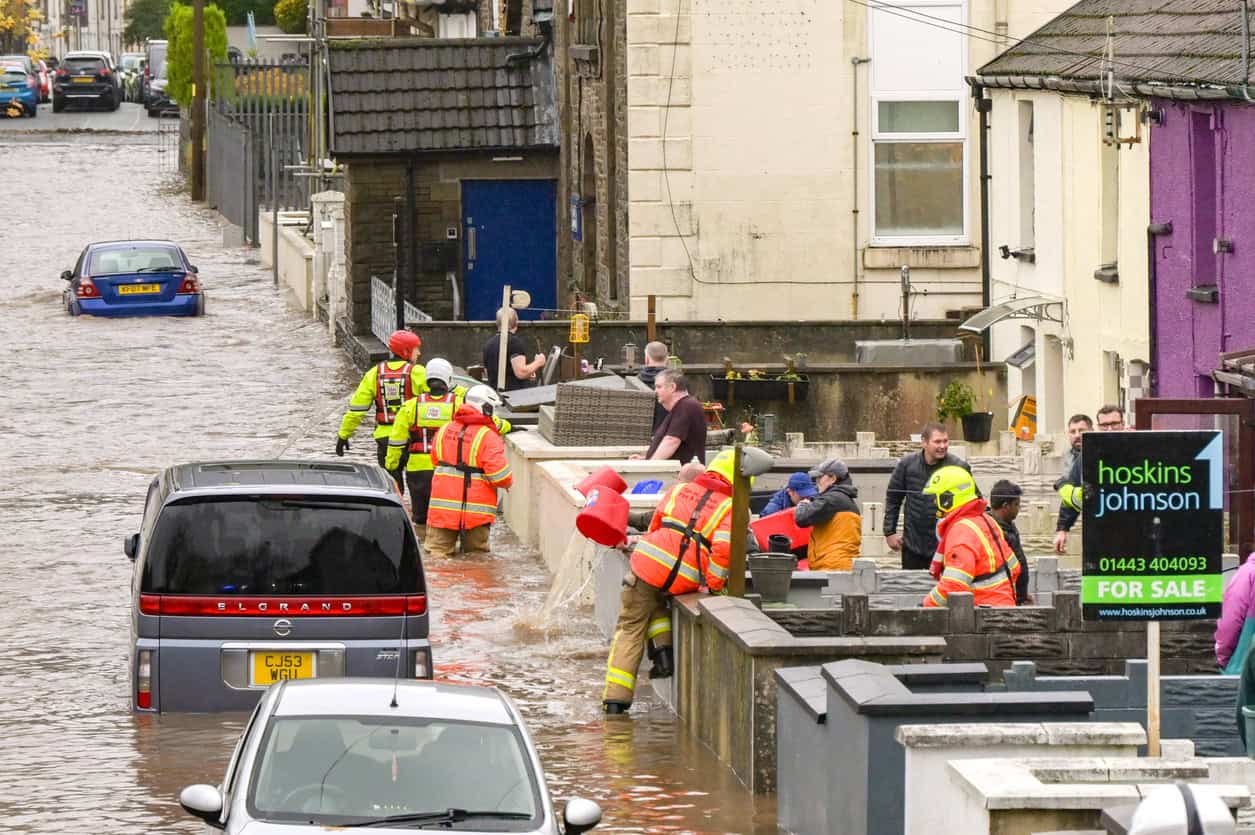
As pricing became more risk-based, some properties at high flood risk faced very high premiums, large flood excesses or no cover at all. Flood Re was designed as a transitional fix: make cover affordable now, and give the market until 2039 to adjust to risk-reflective pricing, supported by better flood defences and property flood resilience. It was never meant to be permanent. The House of Commons Library sets out the same policy history in detail.
How does the Flood Re scheme work?
The Flood Re scheme deals with your insurer. You never deal with it directly. When you buy an eligible policy, your insurer can pass ("cede") the flood part of it to Flood Re for a fixed price, then handle everything else as normal: the rest of the cover, your premium and any claim. The four steps below show how a single policy moves through the scheme.
- You buy a policy. You take out buildings and/or contents insurance with an insurer or broker in the usual way.
- The insurer cedes the flood risk. If the property is eligible, the insurer can transfer the flood element of the policy to Flood Re. Whether to do so is the insurer's commercial decision.
- A fixed premium and excess apply. Flood Re charges the insurer a set reinsurance premium based on the property's Council Tax band, with a standard £250 flood excess per claim inside the scheme.
- Claims are paid and reimbursed. If you flood, your insurer manages and pays the claim as normal, and Flood Re later reimburses it for the flood element. To you, it is an ordinary claim.
Because the insurer still sets your retail price and forms its own view of your risk, cover and premiums vary between providers. Insurers often start from postcode-level data, which can overstate the risk to a particular building. Where an insurer's score looks wrong for the property, an independent flood risk assessment for insurance sets out the real, property-level flood risk (floor levels, flow paths and flood history) for an underwriter to weigh. A free first look at the mapped risk is available from the flood risk map postcode checker.
Insurer flagged your home for flood risk?
Postcode-level scores often overstate the risk to an individual building. An independent flood risk assessment for insurance gives an underwriter evidence on floor levels, flow paths and flood history.
Get a quote in 60 minutesWho is eligible for Flood Re?
Flood Re eligibility is set by regulation, and not every property qualifies. In broad terms a home must be a private residential property in the UK, in Council Tax bands A to H, built before 1st January 2009, and insured on an individual basis by the people who live there (or left unoccupied), in a building of no more than three units. Insurers then decide whether to cede an eligible policy to the scheme.
The table sets out the main dividing lines. For the full list, Flood Re's eligibility criteria are the definitive source.
| Factor | Usually eligible | Not eligible |
|---|---|---|
| Property use | Private homes, including holiday and second homes, home workers and B&Bs paying Council Tax | Commercial premises, B&Bs on business rates, multi-use properties |
| Build date | Built (and lived in) before 1st January 2009 | Built and first occupied on or after 1st January 2009 |
| Building size | A single home, or a building of two or three units | Blocks of more than three flats (buildings cover) |
| Policyholder | An individual or personal representative, resident or with the home unoccupied | Companies, housing associations, commercial portfolios |
| Council Tax | Bands A to H (or the equivalent in Wales and Northern Ireland) | Properties outside the domestic Council Tax system |
| Cover type | Buildings, contents or combined; tenants' and leaseholders' contents; personally owned static caravans | Contingent policies, commercial buildings policies, commercial caravan sites |
Landlords, leaseholders and tenants meet the edges of these rules most often. Residential buy-to-let held by an individual landlord can qualify, but a company-held or portfolio policy cannot. Tenants and individual leaseholders can insure their own contents through the scheme even where the freeholder's buildings cover cannot be ceded. A leasehold block of up to three units can qualify where the freeholder lives in one of them. And the "band" here refers to Council Tax, not flood risk: being in a high flood zone does not, by itself, decide eligibility.
The Flood Re 2009 rule explained
The most important line in the scheme is the 1st January 2009 cut-off: homes built on or after that date are excluded from Flood Re entirely. The aim is to avoid encouraging new building in flood-risk areas by promising publicly backed insurance behind it. Post-2009 homes must find flood cover on the open market, at whatever price the underlying risk commands. There is no fallback.
What matters is when a home was first lived in. Flood Re's guidance on a property built in 2008 but given its Council Tax band in 2009 is direct:
If there's evidence the property was used as a residence before January 2009 then it may qualify. A utility bill may help to prove this.
Flood Re, frequently asked questions
For a homeowner, the rule means insurability should never be assumed for a newer property in a flood-risk area. Check it before you commit, using the steps in how to check flood risk before buying a property. A buyer of a post-2009 home flagged for flood risk can commission a flood risk survey before buying to establish the property-level position before exchange, including how lenders and insurers are likely to view it.
What the 2009 rule means for new builds and developers
Because Flood Re has never covered homes completed on or after 1st January 2009, the long-term insurability of any new residential scheme has to be judged without it. The consequences are severe. A new home that cannot be insured on reasonable terms is difficult to mortgage, and a home that cannot be mortgaged is difficult to sell, which reaches straight back to the value of the scheme and to the developer's exit. Open-market pricing reflects climate-adjusted flood risk, and it can move further as the 2039 wind-down approaches.
That chain prompted seventeen signatories from insurers, lenders and flood charities, Flood Re among them, to write jointly to ministers in March 2026, warning that weakening flood safeguards could leave some new homes uninsurable, unmortgageable and hard to sell. The background is in why the insurance industry is warning against the NPPF flood risk changes. The surface-water exemption from the Sequential Test they opposed survived into the NPPF published in August 2026, so a scheme can now pass that planning step on land its future occupiers may struggle to insure. The knock-on effects for buyers are covered in getting a mortgage on a flood-risk property and whether flood risk affects house prices, with the wider picture in flood risk and the UK housing market.
Around 6.3 million properties in England are at risk of flooding, about 4.6 million of them from surface water, the source that most often sits outside the mapped flood zones.
Those figures are from the Environment Agency's national assessment of flood and coastal erosion risk, built on the NaFRA2 flood risk data. Where a site is affected by river, coastal or surface water flooding, a robust flood risk assessment for planning is usually needed to show the development will be safe for its lifetime and will not push risk elsewhere.
How much does Flood Re charge? Premiums by Council Tax band
Flood Re prices the reinsurance it sells to insurers by Council Tax band, not by detailed property-level modelling. For 2026/27 the combined buildings and contents premium runs from £205 a year in bands A and B to £1,613 in band H, and every ceded claim comes with a £250 excess. The insurer pays that fixed price for the flood element, then sets the retail premium you actually pay.
The figures are Flood Re's published net rates from 1st April 2026, set out in its explanation of how premiums are set. They apply across the UK, with Wales using bands A to I and Northern Ireland bands 1 to 8. Band H is the outlier. Its buildings premium of £1,077 is more than double band G's £447, the widest step in the table.
Two things follow for a householder. Similar homes can be quoted very different prices by different insurers, because each sets its own retail margin and view of non-flood risks. And being in Flood Re does not guarantee the cheapest quote. It underpins affordability; shopping around still matters. The band-based model is also at the centre of the reforms described below.
Does Flood Re cover all types of flooding?
Flood Re relates to the flood peril inside a standard home insurance policy, which typically covers flooding from rivers, the sea and surface water. It does not create a separate flood policy; it reinsures the flood element of the cover your insurer already provides, so the exact scope depends on your policy wording.
Two limits matter.
Flood Re addresses the cost of insurance, not the hazard itself.
Flood Re does nothing to reduce the chance a property floods from any of the different sources of flooding, or the residual risk that remains behind defences. It is also no route for a property refused cover on non-flood grounds. If the concern is the underlying risk rather than the premium, that is a question for a flood risk assessment, not a reinsurance scheme.
What's changing: the 2026 Flood ReThink reforms
On 1st July 2026, ten years after it launched, Flood Re set out a reform package called "Flood ReThink". Its most visible element is the Flood Performance Certificate (FPC), a rating of how well a home resists and recovers from flooding, much as an EPC rates energy efficiency. Flood Re will pilot FPCs with premium discounts for households that hold one. The reforms also cut the contents-only premium for Council Tax bands A and B from £58 to £25 from April 2027, and introduce a cap on the claims insurers can pass to the scheme.
The government set out the same package in the House of Commons on the day of the announcement:
Flood Re is more than halving the premiums it charges to insurers for contents-only insurance for the 45% of homes in council tax bands A and B to £25 a year from April 2027.
Emma Hardy MP, Parliamentary Under-Secretary of State for Environment, Food and Rural Affairs, House of Commons, 1st July 2026
The logic is a structural imbalance. According to Flood Re's tenth-anniversary announcement, in three of the last four years the scheme spent more repairing homes in bands G and H, under 4% of UK homes, than in bands A and B, around 45% of them. The claims cap means insurers carry the cost above an agreed level, with the level still to be settled with the industry.
- Flood Performance Certificates. Piloted with insurers, with premium discounts for households that obtain an FPC or complete an equivalent self-assessment.
- Cheaper contents cover for bands A and B. The reinsurance premium falls from £58 to £25 a year from April 2027, aimed at lower-income households and renters.
- A claims cap. Insurers will pay the part of a ceded claim above an agreed level, reducing the pull of high-value homes on the pool.
- Build Back Better. Introduced in April 2022, Build Back Better lets flooded households claim up to £10,000 towards resilience measures on top of repairing the damage, and Flood Re is pressing more insurers to offer it.
The FPC detail is covered in Flood ReThink 2026: Flood Performance Certificates explained. An FPC rates a home's resilience for insurance purposes. It is not a planning document and does not replace a site-specific flood risk assessment. And because Flood Re has never covered post-2009 homes, evidenced resilience is becoming a commercial asset for new builds that rely on the open market from day one, a theme picked up in property flood resilience and planning.
When does Flood Re end?
Flood Re is scheduled to end in 2039. It was always designed as a transitional, 25-year scheme, on the basis that by then the insurance market will have moved to risk-reflective pricing, supported by stronger flood defences and wider property resilience.
2039 is thirteen years away. A home bought or built today will still be standing well beyond it, and a 40-year mortgage taken out now runs to 2066, 27 years past the scheme's end. Long-term insurability has to be judged on the open market, not on the assumption that Flood Re will always be there.
For most existing eligible homes the scheme is a here-and-now benefit, and the 2026 reforms are partly about smoothing the exit rather than delaying it.
Flood Re and planning policy
Flood Re operates separately from the planning system. Excluding post-2009 homes deliberately reinforces the principle that new building in flood-prone areas should not lean on public reinsurance. The two systems interact, but the planning tests stand on their own.
Available insurance is never evidence that a development is acceptable in flood-risk terms.
England: the National Planning Policy Framework
In England, the National Planning Policy Framework requires the Sequential and, where needed, Exception Tests to steer development away from the highest-risk land; since 17th August 2026 they sit at Policies F5 and F6. Development must be safe for its lifetime, must not increase flood risk elsewhere, and should reduce it where possible. Demonstrating that depends on a site-specific flood risk assessment and, where the tests apply, a Sequential Test report, not on whether cover happens to be available.
Wales: TAN15
In Wales, Technical Advice Note 15 takes a precautionary approach, defining flood zones by risk, requiring justification for vulnerable development and building in climate change allowances, as covered in the TAN15 2025 update. Flood Re plays no part in that assessment. A post-2009 home permitted in a flood-risk area in Wales must still secure cover on the open market, and a compliant flood consequence assessment is usually central to showing the scheme is acceptable.
For an existing home, two questions decide the price of cover: whether the insurer cedes the policy to Flood Re, and whether its view of the flood risk matches the building. The first is a phone call. The second is where most overpricing starts, because a postcode score cannot see a raised threshold, a flow path that runs past the house or a street that has never flooded. Where an insurer has loaded or declined a home on flood grounds, a flood risk assessment for insurance puts the property-level evidence in front of the underwriter, with a tailored quote returned within 60 minutes. For a post-2009 home, or any site heading for planning, Flood Re offers nothing at all, and the evidence has to carry the whole case.
Frequently asked questions about Flood Re
Can you apply to Flood Re directly?
No. Flood Re works behind insurers and has no dealings with the public. You buy buildings and contents insurance from an insurer or broker as normal, and the insurer decides whether to pass the flood element into the scheme. There is no application to make.
Is a property in Flood Zone 3 automatically covered?
Not automatically. Being in a high flood zone does not decide Flood Re eligibility. That depends on the regulatory criteria (residential use, the pre-2009 build date, Council Tax band and so on) and on whether your insurer chooses to cede the policy. A high-risk location makes the scheme more relevant, but it is not what qualifies a home.
How can you tell if your insurance is backed by Flood Re?
Often you cannot tell from the policy itself, because ceding happens between the insurer and the scheme. If flood cover on an eligible older home is available at a reasonable price where you might expect it to be difficult, Flood Re is frequently the reason. Your insurer can confirm whether it uses the scheme for your policy.
Which insurers use Flood Re?
Every UK home insurer pays the levy, but ceding a policy is each insurer's choice. Flood Re keeps a list of the insurers and brokers offering cover through the scheme on its find an insurer page. Start there if cover for an older home is proving hard to find.
Can tenants and leaseholders use Flood Re?
Yes, for contents. An individual tenant or leaseholder can insure their own contents through an eligible policy even where the freeholder's buildings cover for a larger block cannot be ceded. It is one of the areas where contents and buildings cover are treated differently.
Can a home that has already flooded get Flood Re-backed cover?
Yes. A flood history does not appear in the eligibility criteria, and homes that have flooded before are among those the scheme was set up to help. A previous claim may still affect the retail premium and terms an insurer offers, so ask any insurer whether it cedes to Flood Re and whether it offers Build Back Better.
Does Flood Re guarantee affordable insurance after 2039?
No. The scheme is scheduled to end in 2039, after which flood cover is expected to be priced on a risk-reflective basis. Flood Re has a statutory duty to manage that move before it leaves the market, which is why its reforms now reward resilience. For a high-risk home, long-term affordability beyond 2039 should not be assumed.
Will a flood risk assessment lower an insurance premium?
It can, though nothing is guaranteed. Insurers often price off broad, postcode-level data that can overstate the risk to a specific building. An independent, property-level flood risk assessment for insurance gives an underwriter defensible evidence of the real exposure, including floor levels, flow paths and flood history. It helps most where the ground floor sits above the modelled flood level, or where the insurer's data predates defences built since.
Does Flood Re make a property safe from flooding?
Flood Re changes what cover costs, not how often a home floods. Physical protection comes from defences, drainage and resilience measures such as flood doors, non-return valves and raised electrics. After a claim, Build Back Better can help pay for those measures where the insurer offers it.
About the author. Jackie is a co-founder and Director of Unda with 30+ years in flood risk, and sits on CIWEM's South Eastern Branch committee. Unda has been trading since 2014, is a CIWEM Business Partner with CIWEM member and chartered (C.WEM MCIWEM) consultants, and has delivered 5,000+ flood risk assessments and drainage strategies across England and Wales.
Jackie Stone · MSci, BSc (Hons), DIC, CIWEM Environmental Partner
Latest news



One of our experienced Flood Risk Consultants will get back to you within 60 minutes
