Flood Risk and Drainage for Gypsy and Traveller Sites: The Planning Requirements
Estimated reading time 15 minutes
A Gypsy and Traveller site flood risk assessment is needed for almost every pitch scheme on land that carries any flood risk, and these applications are judged against a tougher standard than ordinary housing. The reason is the caravan. Under the National Planning Policy Framework, a caravan or mobile home intended for permanent residential use is classed as "highly vulnerable" in flood terms. That is a harder starting point than the "more vulnerable" band houses sit in. A second policy then applies that never touches a normal housing scheme: the government's Planning Policy for Traveller Sites tells councils to keep these sites away from land at high risk of flooding, "given the particular vulnerability of caravans".
This guide sets out what the two policies ask for, when a flood risk assessment and drainage strategy are triggered, how the sequential and exception tests apply to a pitch, and why so many of these applications are made retrospectively. It is written for the current framework. The NPPF was rewritten on 17 August 2026, moving flood policy into a dedicated Chapter 18 with nine coded policies (F1 to F9) and a new Annex F.
A note on language first. The planning terms used here, "Gypsies and Travellers", "Gypsy and Traveller sites" and "pitches", follow the government's own policy wording. Romany Gypsies and Irish Travellers are recognised ethnic groups protected under the Equality Act 2010, and this article stays on the planning and flood-risk question throughout.
Permanent residential caravans are classed "highly vulnerable" in flood-risk terms: the same band as basement flats, and a rung above ordinary housing.
Two policies apply at once: the NPPF and Planning Policy for Traveller Sites
Most development answers to one flood policy. A Gypsy and Traveller site answers to two. The NPPF governs flood risk for every application in England, and its rules now sit in Chapter 18. Alongside it, the Planning Policy for Traveller Sites (PPTS) adds a specific instruction that no other use gets.
The relevant line is Policy B, paragraph 13(g), which tells local planning authorities to:
do not locate sites in areas at high risk of flooding, including functional floodplains, given the particular vulnerability of caravans.
Planning Policy for Traveller Sites, Policy B, paragraph 13(g)
That single sentence shapes everything downstream. It is why a case officer will look harder at a pitch in a flood zone than at a house next door. It is also why the flood risk assessment for a Gypsy and Traveller site has to do more than tick the NPPF box. It has to answer the PPTS concern head on. A strong flood risk assessment for planning meets both tests in one document, and reads the local plan and the council's traveller-site policy as carefully as it reads the Flood Map for Planning.
The two policies pull in the same direction, which helps. Both ask whether the people living on the site can be kept safe, now and over the development's lifetime, and whether the scheme pushes flood risk onto anyone else. Our guide to the NPPF flood risk rules covers the Chapter 18 policies in full. The sections below focus on where a traveller site parts company with a standard application.
Why caravans are treated as "highly vulnerable"
This is the point that catches applicants out. Under Annex F, Table 2 of the NPPF, caravans, mobile homes and park homes intended for permanent residential use are "highly vulnerable". That is the same band as basement dwellings and emergency services. A conventional house is only "more vulnerable", one rung down. The classification decides what can go where, so that one rung matters a great deal.
Put the vulnerability class against the flood zone and the picture is stark:
| Flood zone | Annual flood probability | Residential Gypsy and Traveller pitch (highly vulnerable) |
|---|---|---|
| Zone 1 | Less than 0.1% | Appropriate; FRA still needed if other triggers apply |
| Zone 2 | 0.1%–1% (rivers) | Exception Test required |
| Zone 3a | 1% or greater (rivers) | Should not be permitted |
| Zone 3b (functional floodplain) | 3.3% or greater (1 in 30) | Should not be permitted |
The August 2026 rewrite moved this compatibility table into Annex F as national policy, and worded the outcomes as instructions rather than guidance. So an incompatible combination now reads as "should be refused", not as something an officer can quietly weigh away.
A permanent pitch in Flood Zone 3 is, on the face of the policy, the wrong use in the wrong place.
It is worth being clear about what this does and does not cover, because the vulnerability band flips depending on how the caravans are used. A holiday, touring or short-let caravan and camping site is "more vulnerable", and only then if it carries a specific warning and evacuation plan. That is a different question, which we cover in our guide to campsite and glamping flood risk. A permanent residential pitch, where people live year-round, is the harder "highly vulnerable" case. If you are unsure which band your scheme falls into, our explainer on the flood risk vulnerability classification works through Annex F in detail.
When does a Gypsy and Traveller site need a flood risk assessment?
The trigger sits in Policy F4. In Flood Zone 2 or 3, a site-specific flood risk assessment is required whatever the size of the site. A single pitch counts. In Flood Zone 1, an assessment is still needed where any of these apply:
- The site is one hectare or larger. This is site area, not the footprint of the caravans.
- The site sits in a critical drainage area, as flagged by the Environment Agency or the council's strategic flood risk assessment.
- The site is shown at risk from any source, whether surface water, groundwater, an ordinary watercourse or a reservoir, on the Flood Map for Planning or the local assessment.
The August 2026 Framework widened that last trigger. Policy F4 dropped the old qualifier that Flood Zone 1 risk only counted where the scheme introduced a "more vulnerable" use. So any Zone 1 site the mapping shows at risk from surface water can now need an assessment. Many rural pitches sit on clay or in low-lying fields, exactly where surface water collects, so this catches more sites than it used to. To check your own position first, our article on when you need a flood risk assessment sets out the triggers in plain terms.
Groundwater is a recurring theme on these sites. Rural pitches are often on chalk, river-valley gravels or land within a groundwater source protection zone, where the water table sits close to the surface for months at a time. The Flood Map for Planning does not show groundwater. It has to be assessed separately in the report and, where soakaways are proposed, tested properly.
Passing the sequential and exception tests
The sequential test (Policy F5) asks a simple question with an awkward answer: is there a reasonably available site at lower flood risk where this development could go instead? For a Gypsy and Traveller site the honest answer is often "not really", and the test is where a lot of applications succeed or fail.
Two points help. First, the August 2026 Framework capped the area of search at "the anticipated catchment of the development in terms of its likely occupiers or users", which ended the borough-wide searches that used to sink small schemes. Second, councils accept that flood risk is unevenly spread. In low-lying districts, much of the land where sites already cluster is at risk, and an authority cannot always meet its accommodation need in the lowest-risk zones. A well-argued sequential case, drawing on the council's own site availability and land supply evidence, is central to a credible application. Getting the sequential and exception test evidence right is often the difference between a validated application and a refusal.
Where a highly vulnerable pitch remains in Flood Zone 2, the exception test (Policy F6) then applies. It now runs to three limbs. The development must deliver wider sustainability benefits, be safe for its lifetime without increasing risk elsewhere, and, where possible, reduce flood risk overall. This is where the accommodation shortfall earns its keep. A demonstrated lack of a five-year supply of deliverable pitches, or an acute local need, is a real planning benefit that can be weighed in the first limb, provided the safety case in the second limb genuinely stacks up.
The January 2026 Traveller Caravan Count recorded 29,402 caravans in England, of which 4,950 (16.8%) were on sites without planning permission, a figure up 23% on the year before.
A structural lack of authorised pitches is part of why so many families end up applying for land they already occupy.
Planning a Gypsy or Traveller site in a flood-risk area?
Unda has delivered more than 5,000 flood risk assessments and drainage strategies since 2014, and prepares combined FRA and drainage reports that answer both the NPPF and the PPTS. Get a fixed-fee quote, usually within the hour.
Start a quoteWhat the flood risk assessment must show
Where a site is defensible in principle, the assessment turns to keeping people safe. The mitigation for a residential caravan pitch is well established, and a case officer or the Environment Agency will expect to see most of it. The order matters, so it reads best as a sequence:
- Establish the design flood level. Model or take the flood level for the relevant event, add the Environment Agency's climate change allowance for the site's catchment, and compare it against surveyed site levels to Ordnance Datum.
- Raise the living accommodation clear of it. Static caravans and day rooms are set with their floor level, or at least their underside, above the design flood level. The EA looks for around 600mm of freeboard, reducible to 300mm where the flood level is well understood.
- Secure the caravans. Anchoring vans to their bases at several points stops a floating unit becoming a debris hazard to the site and to neighbours downstream.
- Keep floodwater moving. Boundary treatments use hit-and-miss or palisade fencing rather than solid walls, so water and its storage are not displaced, and any lost floodplain volume is compensated level for level.
- Plan safe access and escape. The report sets out a dry or low-hazard route off the site, and a flood warning and evacuation plan prepared with the council's emergency planners, backed by registration with the Environment Agency's flood warning service.
None of this is exotic, but it has to be evidenced against modelled levels rather than asserted. A report that raises floor levels without proving where the water actually reaches, or that ignores the loss of floodplain storage, is the kind that draws an Environment Agency objection. On a Zone 2 or 3 site, the EA is a statutory consultee.
Drainage: why even a single pitch now needs a strategy
Flooding is only half the water question. Where the caravans and hardstanding go, rain that used to soak into a field now runs off, and the planning system wants that runoff controlled. Policy F8 of the August 2026 NPPF made sustainable drainage designed to the 2025 National Standards mandatory for all development, major or minor. For the first time, that reaches a single pitch as surely as a housing estate.
On the surface water side, the strategy has to work down the discharge hierarchy: reuse first, then infiltration, then a watercourse, and a sewer only as a last resort. On the clay and high-groundwater sites where many pitches sit, infiltration is often ruled out. Runoff is then held in cellular storage or tanked permeable paving and released at the greenfield rate through a flow control. Storage is sized for the one-in-100-year storm with a climate change allowance and a further margin for urban creep. A compliant surface water drainage strategy shows the rate, the volume, the destination and the water quality, with the exceedance route and a maintenance plan the LLFA will look for.
Foul drainage is the quieter trap. Rural pitches rarely sit on a convenient public sewer, so foul water usually goes to a package treatment plant, or, during a retrospective case, a serviced portable system, with the long-term aim of a mains connection once a capacity check is done. Off-mains systems bring their own consents, either the general binding rules or an Environment Agency permit, which a foul drainage strategy confirms up front. Guidance now lets the flood risk assessment and drainage strategy be combined into a single document, which suits these smaller schemes. Our drainage strategy service explains how the two fit together.
Retrospective sites: proving it after the build
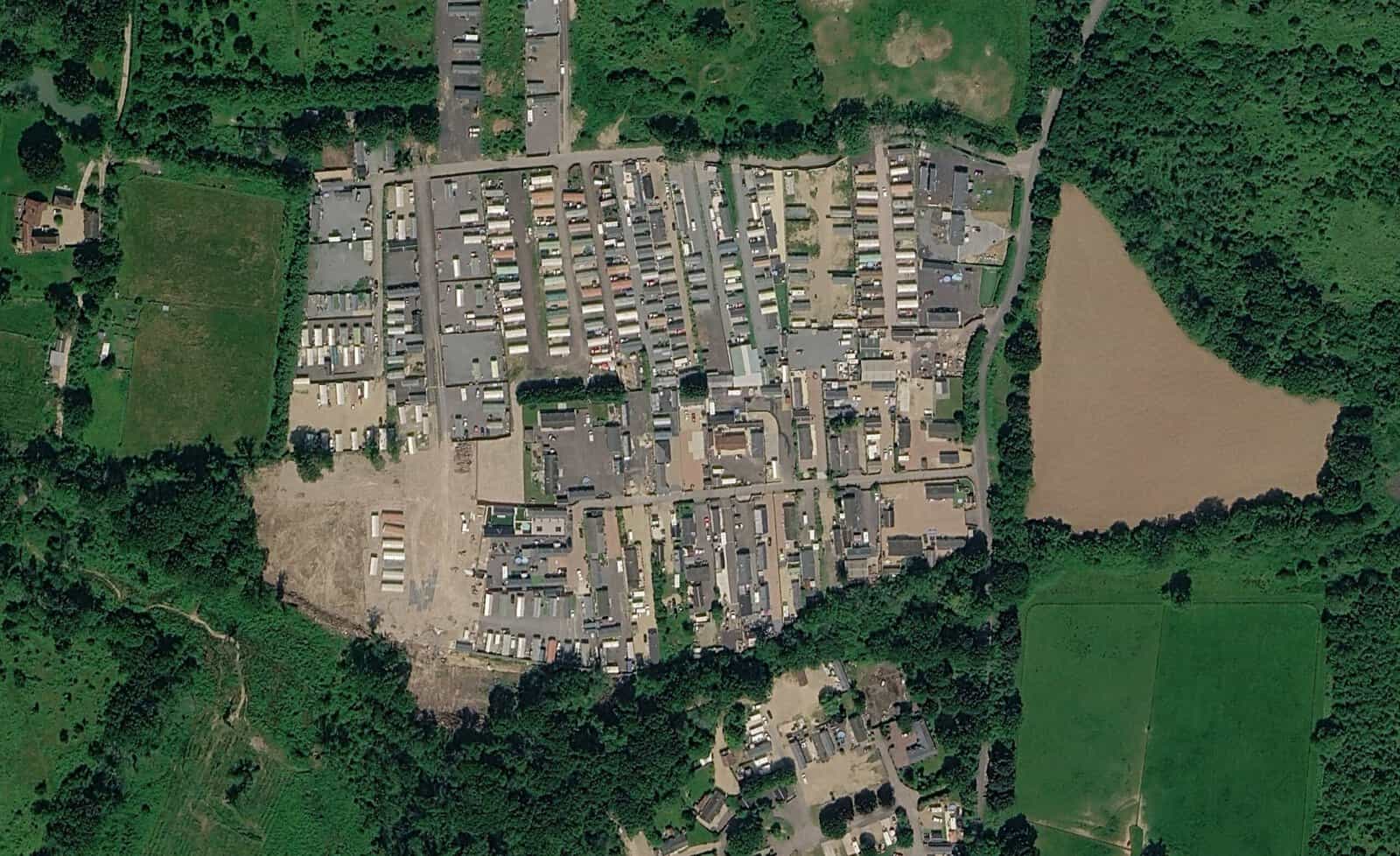
A large share of Gypsy and Traveller applications are retrospective. The pitches are laid out and occupied first, then regularised through a Section 73A application. This is often driven by the same shortage of authorised sites that shows up in the caravan count, and the government has said it is looking again at whether national policy on intentional unauthorised development should be tightened.
The flood-risk difficulty is that a retrospective scheme is judged against exactly the same current policy as a fresh one, but the evidence is far harder to produce after the build. The pre-development ground levels are gone. The finished floor levels are fixed. The below-ground drainage is already in, and any groundwater monitoring window, usually November to May, may already have been missed. Where a completed site cannot be shown to be safe, the remedy is physical: raising floor levels, reworking drainage, or reducing the number of pitches, not a better-worded report. And a flood risk activity permit for works near a main river can never be granted after the event.
A retrospective flood-risk case is an evidence-reconstruction exercise, not a design one.
None of that makes a retrospective case hopeless. Our detailed guide to retrospective planning applications and flood risk sets out the Section 73A route, the enforcement time limits, and how to build the case after the fact.
Frequently asked questions
Can you ever get permission for a permanent pitch in Flood Zone 3?
It is very difficult. A highly vulnerable use in Flood Zone 3a or the functional floodplain (3b) should not be permitted under Annex F, and the exception test does not reach the functional floodplain at all. The realistic routes are narrow: an existing lawful site being regularised, a defended location where modelling shows the pitches sit above the design flood level, or a genuinely exceptional case on unmet-need grounds. Each turns on site-specific modelled evidence, not on the flood map alone.
Does a single-pitch application really need a drainage strategy?
Yes. Since Policy F8 applied the 2025 National Standards to all development, the size threshold that used to exempt small schemes has gone. A single pitch that adds a caravan, a day room and hardstanding creates new impermeable area, and the council will expect that runoff to be controlled to the greenfield rate.
How is this different from a holiday or glamping caravan site?
It comes down to how the caravans are used. Permanent residential pitches are "highly vulnerable". Holiday, touring and short-let sites are "more vulnerable", and even that lower band depends on a specific warning and evacuation plan. The Planning Policy for Traveller Sites also applies only to the residential case, so a permanent pitch faces a stricter test in the same flood zone.
Who checks the flood risk and drainage on a traveller site application?
The council decides the application, but it takes advice from two consultees. The Environment Agency is a statutory consultee on river and sea flooding for sites in Flood Zone 2 or 3, or within 20 metres of a main river. The Lead Local Flood Authority advises on surface water drainage. An objection from either can stall or sink an application, so both are worth engaging early.
Should the flood risk assessment and drainage strategy be one report or two?
Government guidance now allows them to be combined, and for a single site that is usually the cleaner option: one document that resolves flood safety and surface water together, unless a council's validation list specifically asks for two separate files.
If you are preparing a Gypsy or Traveller site application on land with any flood or drainage constraint, it pays to get the evidence right the first time. Unda's chartered flood risk consultants prepare NPPF- and PPTS-compliant flood risk assessments and drainage strategies for these sites across England, and can tell you quickly whether a scheme is defensible before you commit. Start a quote and we will come back to you, usually within the hour.
About the author. Jackie is a co-founder and Director of Unda with 30+ years in flood risk, and sits on CIWEM's South Eastern Branch committee. Unda has been trading since 2014, is a CIWEM Business Partner with CIWEM member and chartered (C.WEM MCIWEM) consultants, and has delivered 5,000+ flood risk assessments and drainage strategies across England and Wales.
Jackie Stone · MSci, BSc (Hons), DIC, CIWEM Environmental Partner
Latest news



One of our experienced Flood Risk Consultants will get back to you within 60 minutes