What the 2025–30 London Surface Water Strategy Means for Planning

Estimated reading time 11 minutes
As climate change accelerates and urban environments become denser, cities around the world face mounting challenges in managing water. Nowhere is this truer than in London, where the convergence of ageing infrastructure, rising population pressures, and increasingly erratic weather patterns has exposed the capital to a growing threat: surface water flooding.
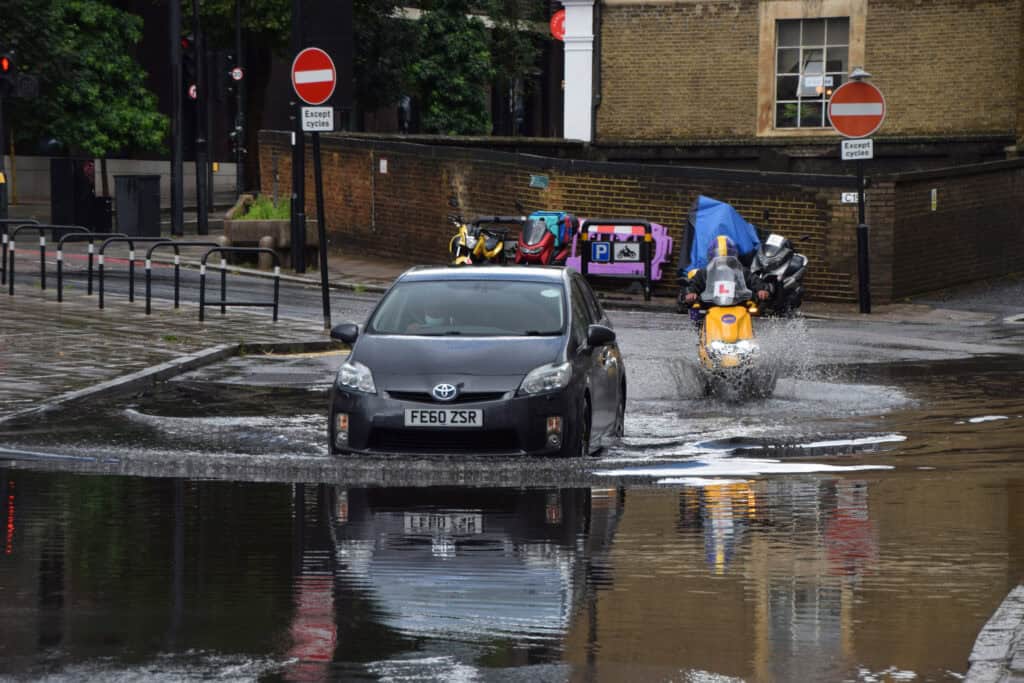
In recent years, London has witnessed dramatic flash floods, submerging roads, homes, and critical infrastructure. These events have not only highlighted vulnerabilities in the city’s drainage systems but also underscored the pressing need for a strategic, long-term response — one that not only reacts to flooding events but proactively reduces risk through planning, design and investment.
The London Surface Water Strategy (2025–30) is that response: a bold, integrated vision that unites risk management authorities, boroughs, developers, planners, architects and the wider public in making the capital more flood-resilient. As climate pressures rise, embedding water management into the very fabric of planning and development is no longer optional — it’s essential.
This article explores the Strategy in depth: what it is, why it was created, who is involved, what the technical and financial requirements are, and what it means for developers, planners, communities, and Londoners at large. the Strategy in depth: what it is, why it was created, who is involved, what the technical and financial requirements are, and what it means for developers, planners, communities, and Londoners at large.
What Is the London Surface Water Strategy?
The London Surface Water Strategy (2025–30) is a city-wide, coordinated response to the growing threat of surface water flooding across Greater London. Developed by the Flood Ready London partnership, this Strategy sets out a comprehensive plan to enhance the capital's resilience to intense rainfall and urban drainage challenges through systemic, hydrology-led, and community-focused action.
Surface water flooding occurs when heavy rainfall overwhelms the drainage capacity of urban areas, leading to water pooling on the surface. It is exacerbated by impermeable surfaces such as concrete and asphalt, which dominate London’s built environment. With an estimated 320,000 properties at high risk — 30% of all such properties in England — and around 56,000 basement dwellings, London is uniquely vulnerable. The Strategy also identifies approximately 40% of commercial properties in the capital as being at surface water risk.
In July 2021, back-to-back storms exposed the city’s susceptibility, causing major disruption to hospitals, the Underground, roads, and homes. These events underscored the inadequacy of existing drainage infrastructure and the need for urgent systemic action.
Why Has the Strategy Been Published?
The Strategy is a response to mounting evidence that London is underprepared for the impacts of climate change and urban flooding:
- The London Climate Resilience Review (2024) sounded the alarm on surface water flooding as one of the city’s most pressing and potentially lethal risks.
- The Environment Agency's National Flood Risk Assessment (2024) revealed the capital's disproportionate share of high-risk surface water properties.
- Climate projections from the Met Office suggest that by 2075, storms producing extreme rainfall will occur four times more frequently than today.
Emma Howard Boyd CBE, Chair of the London Climate Resilience Review, stressed the urgency of the situation, stating:
“We need to recognise that Londoners now face lethal risks, and a step change is needed.”
In addition, London’s fragmented flood governance — with responsibilities divided among boroughs, utilities, and national agencies — has hindered coordinated action. Coupled with skills shortages, inconsistent funding, and rapid population growth (expected to reach 9.6 million by 2035), the current trajectory is unsustainable. The Strategy therefore represents a ‘step change’, coordinating public, private, and community efforts to reshape London’s urban water systems.
Aims and Objectives
At its core, the Strategy seeks to increase London’s resilience to surface water flooding by 75% by 2075, achieving this through a long-term vision built around three strategic ambitions:
- Resilient Places – Ensuring infrastructure and landscapes are designed or retrofitted to slow, capture, or redirect rainfall, minimising localised flood risks.
- Empowered People – Increasing public awareness, providing tools for household and community adaptation, and fostering behavioural change through education and engagement.
- Coordinated Delivery – Establishing effective governance, improving funding efficiency, and aligning data, planning, and delivery across institutional boundaries.
To support these ambitions, six guiding principles have been embedded throughout the Strategy:
- Prioritising the most vulnerable people and areas.
- Championing nature-based solutions (NbS) that work with natural systems.
- Developing evidence-based, hydrology-informed interventions.
- Creating cross-sector partnerships at the catchment level.
- Enabling change through institutional leadership and clear governance.
- Applying interventions at the right geographic and hydrological scale.
Key Stakeholders and Governance
The Strategy is driven by Flood Ready London, a multi-agency coalition formed in 2022 with representation from:
- Environment Agency – providing strategic oversight and data.
- London Councils – representing the 32 boroughs and City of London.
- Mayor of London / Greater London Authority – setting the city-wide vision and aligning planning policy.
- Thames Water – managing sewer networks and water infrastructure.
- Transport for London (TfL) – safeguarding transport resilience.
- London Fire Brigade – ensuring public safety and emergency response.
Charlie Wood, London Area Director for the Environment Agency, noted:
“We are proud to be part of leading such a groundbreaking approach to reducing the impacts of urban surface water flooding in a major worldwide city like London.”
Cllr Kieron Williams, London Councils’ Executive Member for Transport and Environment, added:
“Boroughs play a vital role in protecting our city from the very real threat of flooding... We are committed to ensuring Londoners are protected from the risk of flooding and the huge damage and disruption it can bring.”
Together, these organisations will implement the Strategy via 10 Surface Water Catchment Partnerships (SWCPs). These partnerships reflect natural water flow and hydrological boundaries, rather than political ones. Each will create bespoke Surface Water Catchment Action Plans (SWCAPs) to coordinate projects, data, and investment.
Technical Approach and Requirements
The Strategy's technical backbone is built on the Source-Pathway-Receptor model, allowing authorities to intervene where rainfall originates (source), how it travels (pathway), and where it causes damage (receptor). London’s interventions are categorised into a three-tier solution hierarchy:
- Capture (up to 15mm rainfall) – These are micro-scale, hyper-local solutions aimed at retaining water where it falls. Examples include green roofs, rain gardens, water butts, permeable paving, and depaving schemes.
- Control (up to 45mm rainfall) – These systems manage stormwater flow and direct it safely through infrastructure. Measures include swales, detention basins, de-culverted rivers, sewer upgrades, and smart water flow management using sensors.
- Adapt & Respond (up to 75mm rainfall) – When rainfall exceeds the above measures, adaptation becomes critical. This includes property-level flood resilience (flood doors, airbrick covers), raising kerbs, emergency drainage paths, community flood action plans, and better flood warning systems.
This technical methodology is supported by robust modelling. The Strategy uses a high-resolution 350m hex grid across London to assess risk based on three dimensions:
- Exposure (properties and people affected)
- Vulnerability (socio-economic sensitivity)
- Consequence (financial and wellbeing impacts)
Key data visualisations highlight priority source and receptor areas, strategic catchments, and infrastructure stress points. Modelling suggests an annual flood damage cost of £24 million today, rising to £36 million in coming decades if unaddressed. In a worst-case event, economic damages could exceed £2.4 billion.
The Strategy also commits to the development of a London Surface Water Resilience Standard — a practical, rainfall-based performance framework to guide infrastructure and planning decisions.
Funding and Investment Needs
Financially, the Strategy presents a shift from reactive to preventive spending. It estimates a capital investment requirement of £2 to £2.2 billion over 50 years—roughly £41 million annually (present value). This includes both construction and lifecycle maintenance.
To realise this, the Strategy proposes:
- A centralised London Surface Water Fund.
- Use of blue-green infrastructure finance models and public-private co-investment.
- Greater use of Schedule 3 of the Flood and Water Management Act (2010) to ensure SuDS implementation.
- Scalable pilot schemes such as market-based SuDS delivery via streetworks.
Implications for Planning
For the development sector, the Strategy introduces both responsibility and opportunity. Key implications include:
- Planning Compliance: Boroughs and the GLA will strengthen requirements for SuDS and surface water risk assessments as part of planning permissions.
- Design Expectations: Developers must prioritise multifunctional spaces with water-sensitive design—rain gardens, swales, green corridors, and tree planting.
- Collaboration: Larger developments will be expected to align with SWCPs and catchment-scale goals, including coordinated drainage strategies.
- Funding Eligibility: Schemes demonstrating flood resilience co-benefits may qualify for access to centralised or match funding under the Strategy.
- Community Engagement: Projects should integrate co-creation with local communities, ensuring the end use supports social as well as technical resilience.
For planners, the London Surface Water Strategy calls for a paradigm shift in how development proposals are reviewed, approved, and monitored in the context of flood risk and climate adaptation.
Local Planning Authorities (LPAs) will need to take a more active role in aligning local policy and decision-making with the Strategy’s hydrological priorities and surface water catchment logic. Planning authorities are encouraged to:
- Embed SWCP priorities into local plans: Each borough will need to reference their Surface Water Catchment Action Plan (SWCAP) in their Local Plan, ensuring alignment between planning policy and water resilience objectives.
- Strengthen application requirements: Planning applications should include robust surface water management strategies, supported by site-specific Flood Risk Assessments (FRAs) and clear SuDS proposals that go beyond minimum compliance.
- Apply the London Surface Water Resilience Standard: Once published, this standard will serve as a benchmark for assessing the adequacy of proposed developments in managing rainfall under future climate scenarios.
- Prioritise multifunctional public realm design: Planning officers should assess how proposed schemes integrate blue-green infrastructure (e.g., rain gardens, tree pits, wetlands) into streetscapes and open spaces, delivering flood benefits alongside urban greening.
- Support strategic infrastructure planning: Boroughs must also consider how smaller developments contribute cumulatively to catchment-level outcomes. Planning authorities are expected to work closely with Thames Water, TfL, and other infrastructure providers to optimise strategic drainage capacity.
- Enhance public and stakeholder engagement: The Strategy emphasises co-creation, particularly with vulnerable communities. Planners should expect greater engagement obligations around flood and SuDS schemes, fostering awareness, acceptance and long-term stewardship.
- Reinforce maintenance and monitoring obligations: SuDS and other drainage infrastructure will need long-term management strategies. Planners should ensure legal agreements (e.g., planning conditions, Section 106) secure appropriate oversight and funding.
Architects and masterplanners also have a vital role to play. With surface water management now considered fundamental to site design, they must ensure that flood resilience is not an afterthought, but a core design principle from the outset. Layouts should account for topography, flow paths, and water-sensitive features such as detention basins or bio-retention areas.
For developers, the Strategy implies earlier and more frequent engagement with drainage engineers, landscape architects and planning authorities. Proposals will be scrutinised not just for aesthetics or density, but for their contribution to catchment-scale water management and climate resilience. It will no longer be enough to demonstrate mitigation; developers must also demonstrate adaptive capacity and place-based benefits.
This integrated approach may also affect project timelines and budgets. While upfront design costs could increase, the long-term value is clear: lower flood risk, more robust planning consents, and increasingly, improved investor confidence as resilience becomes a factor in ESG assessment.
The Strategy ultimately empowers planners to shift from a reactive to a preventive mindset. By doing so, they play a pivotal role in mainstreaming water-sensitive urban design, reducing risk across neighbourhoods, and securing a safer, more climate-resilient London.
Conclusion
"This is an important step toward making London genuinely resilient to climate change," says Antony Rousou, Senior Drainage Consultant at Unda. "But its success will depend entirely on meaningful buy-in — from developers, architects, planners, infrastructure providers and local authorities alike. Effective collaboration and early integration into project design will be key."
The London Surface Water Strategy (2025–30) is a transformational document—comprehensive in scope, urgent in tone, and practical in ambition. It addresses one of the capital’s most complex and escalating climate risks through an innovative mix of science, policy, investment, and community mobilisation.
As the Strategy moves into its implementation phase, success will depend on a united front: boroughs embedding resilience into planning, developers building with water in mind, and communities becoming stewards of their own flood safety. Together, these actions can deliver a capital that not only withstands future storms—but actively adapts, improves, and thrives as a resilient, future-ready city. The Strategy challenges all sectors—especially planning and development—to rethink their role in shaping London's urban landscape. A Flood Ready London is now within reach, but it demands shared commitment and decisive action. If you're navigating the challenges and opportunities presented by the London Surface Water Strategy, Unda can help. We work with public and private sector clients to design and deliver effective, future-ready responses to flood risk. Our team specialises in sustainable drainage systems (SuDS), surface water management strategies, flood risk assessments (FRA), alongside practical support for site-specific drainage design and planning submissions.


One of our experienced Flood Risk Consultants will get back to you within 60 minutes