What the Gladman Judgment Means for the Sequential Test
Estimated reading time 7 minutes
Flood risk, planning appeals and the High Court
The High Court’s judgment in Gladman Developments Ltd v Secretary of State for Housing, Communities and Local Government and Lancaster City Council (15 January 2026) is an important decision on flood risk, the Sequential Test and lawful planning decision-making.
Over the past two years, the Sequential Test has shifted from being a relatively settled component of development management to a frequent source of appeal risk and legal challenge, particularly following the September 2025 update to national guidance on flood risk and the Sequential Test.
This judgment is not a relaxation of flood risk safeguards. Nor is it a workaround for the Sequential Test. It is a reminder that even strongly framed national policy must still be applied through planning judgment, with a clear explanation of how the planning balance has been reached.
The Lancaster appeals – essential facts
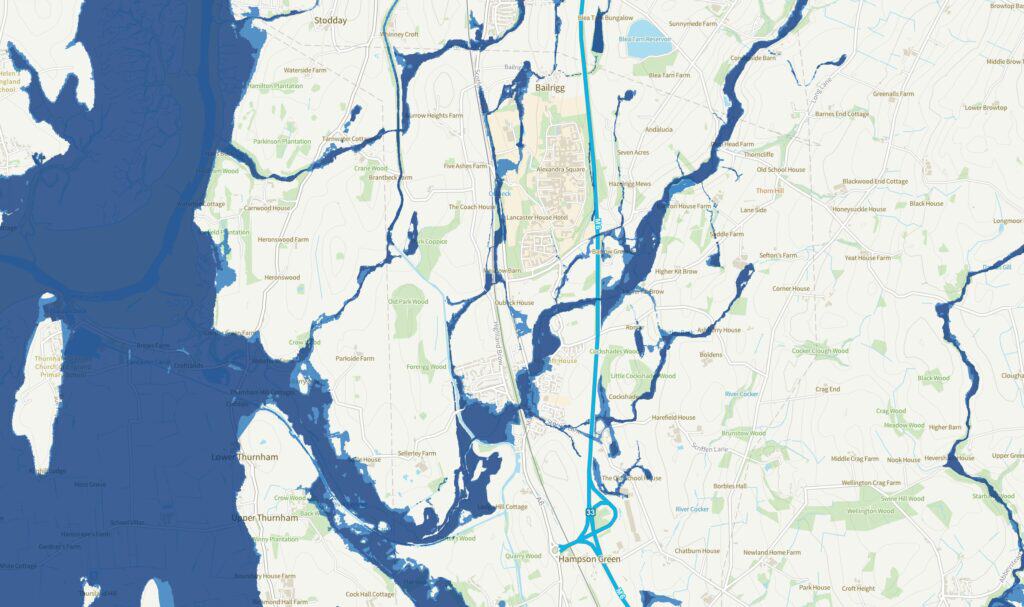
The case arose from two linked appeals at Bailrigg Lane, Lancaster, including a proposal for up to 644 homes.
Most of the site lay within Flood Zone 1, with a very small area affected by higher flood risk associated with a watercourse. The Inspector concluded that a Sequential Test was required and that none had been provided.
However, she also accepted that:
- the development as proposed would not be at unacceptable risk of flooding;
- the drainage strategy and associated works could deliver flood risk betterment, including reduced downstream flows; and
- all other reasons for refusal had been resolved, leaving flood risk as the sole determinative issue.
The Inspector identified substantial planning benefits, including market and affordable housing delivery in the context of a significant housing land supply shortfall. Despite those findings, both appeals were dismissed on the basis that failure to undertake a Sequential Test amounted to an overriding policy conflict.
The legal error identified by the High Court
The High Court quashed the Inspector’s decision. It did not do so because the Inspector was wrong to require a Sequential Test, nor because flood risk policy was misdirected in principle.
The error lay in how the policy conflict was handled. Reading the decision letter as a whole, the Court found that the Inspector treated the absence of a Sequential Test as fatal, without carrying out a lawful and meaningful planning balance under section 70(2) of the Town and Country Planning Act 1990 and section 38(6) of the Planning and Compulsory Purchase Act 2004.
In practical terms, the Inspector appeared to stop once she had identified a policy breach capable of being a “clear reason” for refusal under footnote 7 to the National Planning Policy Framework. The Court held that this was a mechanistic approach and therefore unlawful.
Why a “clear reason” is not the end of the analysis
Footnote 7 is important because it can disapply the tilted balance. It does not, however, disapply the statutory duty to take all material considerations into account or the requirement to determine applications in accordance with the development plan unless material considerations indicate otherwise.
A Sequential Test failure can carry significant weight and may, in the right circumstances, justify refusal. The point made in the Gladman judgment is that the decision-maker must still explain why that policy conflict outweighs countervailing considerations on the facts of the case.
That obligation is particularly important where the decision-maker has accepted that the scheme would be safe and has identified flood risk betterment. If refusal remains the outcome, the reasoning must show clearly how that conclusion has been reached.
This sits comfortably with appeal decisions where failure of the Sequential Test has been treated as an important negative factor, but not an automatic show‑stopper, including the Yatton appeal.
Why the factual context mattered
The Gladman judgment should not be read as a universal template. The Court’s reasoning was closely tied to the Inspector’s own findings on the specific facts of the case.
In particular, the Court was influenced by the combination of:
- no identified substantive flood harm to the development as proposed;
- identified flood risk betterment;
- substantial housing and affordable housing benefits; and
- no remaining non-flood reasons for refusal.
Those features made it especially important for the Inspector to explain why the Sequential Test failure was overriding.
The same broader issues have been evident in post‑Mead practice, including the role of national guidance, the circumstances in which a Sequential Test is required and the evidential burden needed to demonstrate safety and appropriate policy application, as reflected in guidance on applying the Sequential Test post‑Mead.
What the judgment does not say
Given the increasingly polarised debate around the Sequential Test, it is important to be clear about what the Gladman judgment does not do.
It does not remove the requirement to apply the Sequential Test where policy and guidance require it. It does not diminish flood risk as a spatial constraint. It does not suggest that real‑world flood safety automatically resolves policy conflict. And it does not require decision‑makers to give limited weight to Sequential Test failures.
Those distinctions matter, particularly in light of concerns raised by professional bodies about how the Sequential Test is being applied in practice, including those set out in the TCPA’s position on the Sequential Test.
How this fits with recent policy and appeal decisions
The judgment sits alongside – rather than cutting across – recent changes in flood risk policy and guidance.
The September 2025 update to the Planning Practice Guidance was intended to address the ‘blue within red’ issue that had begun to dominate decision‑making, supporting a more proportionate approach where a site‑specific flood risk assessment clearly demonstrates lifetime safety and no increased risk elsewhere.
Recent appeal decisions have also shown Inspectors grappling with how to weigh technical policy breaches against demonstrable flood safety and wider planning benefits. The Faversham appeal illustrates how those judgments can turn on careful reasoning rather than blanket outcomes.
At the same time, the direction of travel in national policy remains towards clearer and more demanding flood risk requirements, as reflected in the December 2025 draft National Planning Policy Framework. The Gladman judgment does not dilute that trajectory. If anything, it reinforces the need for careful, lawful reasoning when applying it.
Practical implications
For decision‑makers, the judgment reinforces the need to show clearly why a Sequential Test failure outweighs other material considerations on the facts of the case. Describing a policy conflict as “overriding” or a “clear reason” is not, on its own, sufficient.
For applicants, the case underlines the importance of robust, site‑specific flood risk evidence and of addressing both policy compliance and real‑world outcomes. Submissions should clearly separate whether a Sequential Test is required, what the nature of any policy conflict is and how that conflict should be weighed in the planning balance.
Discipline, not deregulation
Ultimately, the Gladman judgment is best understood as a reminder of discipline in planning decision‑making. Flood risk policy remains fundamental, and the Sequential Test remains a key safeguard. What the Court has rejected is an approach that treats policy language as a shortcut past the statutory planning balance.
In a system where flood risk is becoming more prominent rather than less, that distinction matters.
If you are grappling with the application of the Sequential Test, flood risk evidence or planning balance reasoning – whether at application, appeal or inquiry stage – Unda advises on flood risk, drainage and planning strategy across complex sites. Our work spans site promotion, appeal support and expert evidence, helping ensure flood risk policy is applied robustly, proportionately and lawfully. Get in touch to discuss how we can support your project.
Latest news





One of our experienced Flood Risk Consultants will get back to you within 60 minutes