NPPF August 2026 Changes: Flood Risk and Drainage Implications for Planning
Estimated reading time 18 minutes
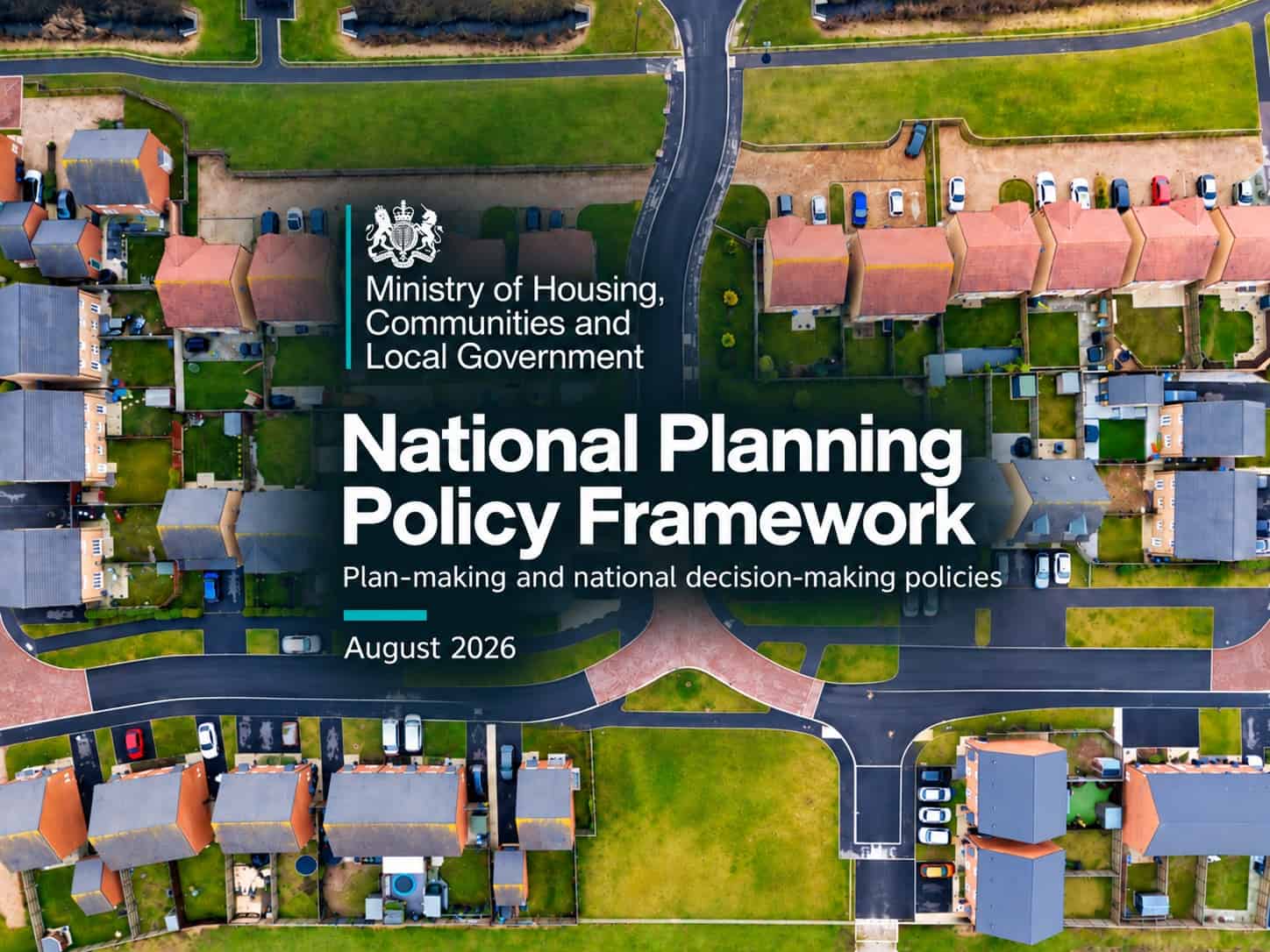
The NPPF 2026 changes are now live. Government published the new National Planning Policy Framework on 17 August 2026, and it applies to planning decisions in England from the day of publication. For flood risk and drainage this is no tidy-up. The old flood paragraphs are gone, replaced by nine coded policies (F1 to F9) in a dedicated chapter; the flood zones and vulnerability tables now sit inside the Framework itself; and SuDS design must follow the national standards. Here is what has changed, and what it means for applications already in the system.
The new Framework applies to every planning decision made from 17 August 2026 — including applications submitted under the December 2024 version.
What has changed at a glance?
The August 2026 NPPF replaces the December 2024 Framework in full. National policy is restructured into coded plan-making and decision-making policies, and the Guardian called it the biggest rewrite of planning rules in more than a decade. The published document runs to 130 pages against the old 82. Much of that growth sits in the annexes now carrying the flood risk detail.
- A dedicated flood chapter. Chapter 18, Managing flood risk and coastal change, holds nine policies (F1 to F9) covering strategic flood risk assessment, the sequential and exception tests, safety, SuDS and coastal change.
- Annex F. The flood zone definitions (including the Zone 3a/3b split), the flood risk vulnerability classification and the zone compatibility table are now inside the Framework. Until now the zones and the compatibility matrix lived only in the planning practice guidance on flood risk and coastal change.
- A surface water exemption from the sequential test. Sites at risk of surface water flooding only can avoid the test where a flood risk assessment demonstrates the development would stay safe for its lifetime.
- National SuDS standards made mandatory. Policy F8 requires SuDS to be designed in accordance with the 2025 National Standards for Sustainable Drainage Systems, on all development.
- A national information requirements list. Annex C names the site-specific flood risk assessment, a SuDS statement and a coastal change vulnerability assessment as national validation requirements.
- Refusal wording throughout. Where the old paragraphs said development "should only be allowed" if the tests were met, the new policies say it "should be refused unless" they are.
The sections below work through each change in turn. If one bears on a live application, allocation or appeal, our NPPF flood risk guidance and planning support sets out exactly what the 2026 Framework now asks of the site; our flood risk assessments and sequential and exception test reports are written to the F policies from the outset; and our surface water drainage strategies are built to the national SuDS standards set out below.
Where did the old flood risk paragraphs go?
Old Chapter 14 has been split three ways. Climate change policy now sits in Chapter 5 (policies CC1 to CC3), energy and water infrastructure in Chapter 10 (W1 to W4), and flood risk and coastal change in Chapter 18. Quote paragraph 170, 181 or 182 in a committee report today and you are citing a document that no longer exists as national policy.
| Theme | Old NPPF (December 2024) | New Framework (August 2026) |
|---|---|---|
| Climate change | Paragraphs 161 to 164 | Chapter 5 — policies CC1 to CC3: mitigation, adaptation and flood resilience cross-references |
| Energy and water | New territory | Chapter 10 — policies W1 to W4: water supply, drainage and wastewater capacity |
| Strategic flood risk assessment | Paragraph 171 | Policy F1 — assessing flood risk for plan-making |
| Flood risk management | Paragraph 172 | Policy F2 — planning for effective flood risk management |
| Sequential test | Paragraphs 173 to 176 | Policy F5 — the sequential test, with new exemptions |
| Exception test | Paragraphs 177 to 180 | Policy F6 — the exception test, now three limbs |
| Safety and FRA triggers | Paragraph 181 + footnote 63 | Policies F7 (safety) and F4 (flood risk assessment triggers) |
| Sustainable drainage | Paragraph 182 | Policy F8 — SuDS to national standards, plus watercourses |
| Coastal change | Paragraphs 183 to 185 | Policies F3 and F9 — coastal change, extended beyond CCMAs |
| Vulnerability classification | Annex 3 | Annex F, Table 2 — vulnerability classification, updated |
Renumbering sounds cosmetic. For live documents it is not. A flood risk assessment that cites the December 2024 paragraphs is not wrong in substance, but case officers will be working from the F codes, and any report drafted from today should cite them directly.
How has the sequential test changed?
The sequential test survives, but policy F5 redraws its boundaries in three ways practitioners have argued over for two years. Much of the September 2025 planning practice guidance update has been absorbed into national policy. The Framework then goes further.
- The area of search is capped. F5 says the area the test is applied to should not be greater than the anticipated catchment of the development in terms of its likely occupiers or users. Councils that asked for borough-wide searches for a village surgery no longer have policy on their side.
- Allocated sites are exempt in policy. Where a site was sequentially tested during plan preparation, the test is not applied again at application stage.
- There is now a surface water exemption. Biggest of all, the test is no longer needed for sites where a site-specific flood risk assessment demonstrates clearly that the site is at risk of surface water flooding only, and that the design keeps people safe for the lifetime of the development.
Sites where a site-specific flood risk assessment demonstrates clearly that ... the site would be at risk of surface water flooding only, [and] the proposed layout, design, and mitigation measures would ensure that occupiers and users would remain safe from current and future surface water flood risk for the lifetime of the development without increasing flood risk elsewhere in accordance with policy F7.
National Planning Policy Framework, August 2026, policy F5(2)(b)
Seventeen insurance and flood bodies, including the ABI, Aviva and Flood Re, formally opposed the surface water exemption during consultation. It survived unchanged.
The burden shifts onto the flood risk assessment, which must make the demonstration "clearly". A thin surface water chapter that would once have triggered a request for a sequential test will now sink the exemption altogether. And the insurers' joint letter to ministers in March 2026 signals where scrutiny goes next: homes consented through this route still face the market's own tests on insurability, long after the planning file is closed.
The exception test remains, now at policy F6. It is confined expressly to river and sea flooding in Zones 2, 3a and 3b, and it has grown a third limb: wider sustainability benefits, lifetime safety, and no increase in flood risk elsewhere must all be demonstrated.
How to evidence the surface water exemption: a worked example
The exemption is not a shortcut. It swaps a sequential test for a higher evidence bar in the flood risk assessment, and the demonstration has to be made "clearly" or the exemption falls away. Take a typical case to see what that means in practice: a small residential infill site in Flood Zone 1 that the updated Flood Map for Planning now shows within a surface water risk extent, with no river or tidal risk present.
To rely on policy F5 rather than run the sequential test, the flood risk assessment has to close out each limb in turn.
- Prove surface water is the only source. Confirm from the Flood Map for Planning and the local strategic flood risk assessment that the site sits clear of fluvial, tidal and, where relevant, groundwater and reservoir risk. If any other source is in play, the exemption does not apply and the test is back.
- Model the surface water risk on the site. Move past the risk band to depths, velocities and flow routes across the layout, using climate change allowances for the development's lifetime. "Low risk" on the map is a probability, not a design input.
- Design for safety and show it. Set finished floor levels above the modelled level with freeboard, keep safe access and egress, steer flows through the layout with levels and landscaping, and tie the drainage strategy to the design so runoff is controlled to greenfield or betterment rates.
- Show no increase in risk elsewhere. Demonstrate the scheme does not push water onto neighbouring land, in line with policy F7, with the calculations appended rather than asserted.
Done properly, this removes the sequential test from the critical path and can unlock a site the old wording would have stalled. Done thinly, it invites a refusal on the very policy it was meant to satisfy. This is exactly the demonstration our sequential and exception test reports are built to make.
The exemption is also an opportunity
Read defensively, F5(2)(b) is a higher evidence bar. Read commercially, it is a route to unlock land the December 2024 wording would have stalled. A small Flood Zone 1 site now shown within a surface water extent no longer has to pass a sequential test it might have failed on catchment grounds; where the flood risk assessment demonstrates lifetime safety clearly, the scheme proceeds on its own evidence. The site is won or lost on the strength of that assessment — so the advantage goes to whoever brings the evidence first.
Relying on the surface water exemption?
Our flood risk consultants build the F5(2)(b) demonstration into a full, site-specific flood risk assessment — and we quote within the hour.
Get a QuoteWhat do the drainage changes mean for SuDS?
Drainage gains more new policy than any other area. Policy F8 makes three moves.
- SuDS must be designed to the national standards. F8 requires design in accordance with the National Standards for Sustainable Drainage Systems published in 2025. Those standards were guidance with no legal force; planning policy now enforces them, and the December 2014 SuDS written ministerial statement is listed as incorporated or superseded.
- The requirements apply to all development, major or minor. Old paragraph 182 attached its requirements to major development. F8 applies the design and maintenance requirements to every SuDS proposal, with only the duty to take Lead Local Flood Authority advice still confined to major applications.
- A new watercourse policy. Development should not enclose existing watercourses without compelling reasons, and should where possible remove existing culverts and renaturalise river channels. Deculverting has never had national planning policy status before.
Behind F8 sits Annex C, which requires a statement outlining how the national SuDS standards have been achieved for any proposal that could affect drainage on or around the site. In practice, drainage design moves to the front of the programme: infiltration testing, discharge hierarchy evidence and maintenance arrangements now belong at submission, not at conditions stage. A compliant surface water drainage strategy now needs to be in the application, not deferred to a condition.
National SuDS Strategy Templates now sit behind Policy F8
The day after the Framework took effect, the Chief Planner's newsletter of 18 August 2026 announced two national SuDS Strategy Templates to support Policy F8 and the Annex C SuDS statement. Produced by the Environment Agency with CIRIA, the Association of SuDS Authorities and Arup, they give applicants a single national format for showing that a drainage design meets the 2025 national standards, and give lead local flood authorities a consistent way to check it. They are implementation guidance, not new policy: they do not change what F8 requires, they standardise how you evidence it.
There are two templates, matching the Framework's proportionate approach — the fuller one for major schemes, the lighter one for everything else:
- SuDS Strategy Template for Major Development. The full evidence set, for major applications; download it from the Planning Portal or CIRIA.
- SuDS Strategy Template for Non-major Development. A proportionate version for minor and householder-scale drainage, on the same sources.
The Environment Agency is encouraging every local planning authority and lead local flood authority to adopt the national templates in place of their own local forms, so a strategy prepared to the template should travel across authority boundaries without being reformatted. The template is only as good as the evidence in it, though: infiltration testing, the discharge hierarchy, storage calculations and maintenance arrangements still have to be done, and the form simply makes any gaps easier for a case officer to spot. A free SuDS e-learning module for planners, run by the Environment Agency, the TCPA and the Association of SuDS Authorities, means the officers reviewing your drainage submission are being trained to the same standard — another reason a thin SuDS statement is now a refusal risk.
Schedule 3 of the Flood and Water Management Act 2010 remains uncommenced in England. The new Framework builds a planning-led version of it instead.
Do more sites now need a flood risk assessment?
Yes. Policy F4 carries the old footnote 63 triggers into policy and widens them. In Flood Zone 1, an FRA is now needed for any land identified in a strategic flood risk assessment or on the Flood Map for Planning as at risk of flooding from any source, now or in the future. The old qualifier, which only caught proposals introducing a more vulnerable use, has gone.
That widening lands on top of the May 2026 Flood Map for Planning update, which added surface water climate change extents and banded depth data. Land the old maps showed clear now sits inside a mapped risk area, and any of it proposed for development needs an FRA at validation. For anyone appraising a site before purchase, that makes early flood risk due diligence part of the checklist.
The Environment Agency puts 4.6 million properties in England at risk from surface water; the new mapping is how that risk reaches individual planning files.
Flood zones and vulnerability move into the Framework
Annex F settles questions that used to need a trip into planning practice guidance. Table 1 defines the flood zones, including the functional floodplain (Zone 3b) at 3.3% annual probability. Table 2 updates the vulnerability classification. Table 3 matches vulnerability to zones, and for the first time in the Framework states that incompatible development should be refused.
| Table | What it does | What changed |
|---|---|---|
| Table 1 — Flood zones | Defines Zones 1, 2, 3a and 3b in national policy | First time in the Framework; previously guidance only. Zone 3b defined at 3.3% annual probability |
| Table 2 — Vulnerability classification | Sorts development types by flood consequence | Data centres, EV charging stations, hydrogen production, carbon capture and heat networks join essential infrastructure; land-raising classified as less vulnerable |
| Table 3 — Compatibility | Matches vulnerability to flood zones | Refusal outcomes stated in policy: highly vulnerable uses refused in Zone 3a, most uses refused in Zone 3b |
Read the Table 2 additions as a list of the government's infrastructure priorities. Data centres, EV charging stations, hydrogen production, carbon capture and heat networks all join essential infrastructure, which gives them an exception test route into high-risk zones, provided they are designed to stay operational in a flood.
What about coastal change?
Coastal policy is the sleeper in this chapter. Policy F3 requires plans to identify Coastal Change Management Areas covering the coast, estuaries and tidal rivers over the next century, and names Shoreline Management Plans and the National Coastal Erosion Risk Map in national policy for the first time. Policy F9 then applies its restrictions beyond designated areas to any land likely to face erosion or tidal inundation over the next century. New residential development there is inappropriate unless strict tests are met.
F9 applies whether or not a council has designated a Coastal Change Management Area — the policy follows the evidence, not the designation.
What should applicants do now?
The new policies are material considerations from today, and Annex A instructs that development plan policies materially inconsistent with them carry very limited weight. Anyone with a flood-affected application in the system should act rather than wait.
- Re-check the FRA triggers. A Flood Zone 1 site shown at risk on the current Flood Map for Planning now needs a flood risk assessment, whatever the proposed use.
- Reassess the sequential test position. Surface-water-only sites may no longer need a test at all. Fluvial and tidal sites face refusal-worded policy and should expect less latitude for a failed test.
- Check drainage submissions against the national standards. Any proposal affecting drainage needs a SuDS statement demonstrating compliance, plus maintenance arrangements covering the lifetime of the development.
- Update citations. Reports drafted from today should cite policies F1 to F9 and the Annex F tables, not the December 2024 paragraph numbers.
- Review live appeals. The April 2026 appeal reforms bar most new evidence, but a change of national policy is a recognised exception, and the new Framework plainly qualifies.
Common mistakes to avoid
The substance of flood risk work has not been relaxed, so the errors that sink applications are mostly about reading the new Framework correctly rather than doing less. These are the ones we expect to see most in the first months.
- Citing the old paragraph numbers. A report that quotes paragraphs 173 to 176 or 182 is referencing a Framework that no longer exists. The assessment may be sound, but the policy references need to move to the F codes before submission.
- Assuming Flood Zone 1 means no assessment. An FRA is still required in Zone 1 where the site is one hectare or more, has critical drainage problems, or is shown at risk from any source in the strategic flood risk assessment or on the Flood Map for Planning.
- Treating the surface water exemption as automatic. Policy F5 removes the sequential test only where the flood risk assessment proves safety "clearly". A thin surface water chapter loses the exemption and invites a refusal.
- Confusing drainage design with flood mitigation. A SuDS scheme controls runoff generated by the development. On its own it does not deal with water flowing onto the site from elsewhere, which is a flood risk matter.
- Leaving levels and drainage until last. Under F8 and Annex C, infiltration testing, discharge evidence and finished floor levels belong at submission. Fixing them after the layout is frozen is where schemes lose developable area.
Frequently asked questions
Does the new NPPF apply to an application I submitted before 17 August 2026?
Yes. The policies are material considerations in every decision made from publication day, whenever the application was submitted. Where your evidence was built around the old paragraphs the substance usually carries over, but check the position against the new tests before the case officer does.
Is a flood risk assessment that cites the December 2024 paragraph numbers now invalid?
No. The technical work stands, and decision-makers understand the transition. An FRA drafted from now on should cite the F policies, though, and an older report on a live application is worth updating if it relies on provisions that changed in substance, such as the footnote 63 triggers or the sequential test exemptions.
Do householder extensions still need the sequential test?
No. Householder extensions remain outside the sequential test, and the flood zones themselves have not moved. If you are extending in a flood zone you will still need a flood risk assessment, and finished floor levels and resilience measures stay the practical focus.
Does the surface water exemption remove the need for a flood risk assessment?
No — it does the opposite. The exemption removes the sequential test, but only because a site-specific flood risk assessment carries the demonstration instead. You still need the FRA, and it has to prove surface-water-only risk and lifetime safety "clearly", or the exemption does not apply.
Are the 2025 national SuDS standards a legal requirement?
Not by statute — Schedule 3 of the Flood and Water Management Act 2010 is still uncommenced in England. But policy F8 now requires SuDS to be designed to the 2025 national standards, so as a planning matter they are effectively mandatory: a proposal affecting drainage needs a SuDS statement showing how the standards have been met.
What happens to the December 2025 draft now?
It is spent. The draft was consulted on until 10 March 2026 and the published Framework is the outcome. Where the final text differs from the draft, the published version governs. The surface water exemption survived consultation despite formal opposition.
Has the September 2025 PPG update been superseded?
Partly. The new Framework absorbs much of it into policy F5, and the planning practice guidance is expected to be rewritten to match the new structure. Until then the PPG remains in place, but where it conflicts with the published Framework, the Framework prevails.
Do the changes apply in Wales?
No. The NPPF applies to England only. Wales operates under Planning Policy Wales and TAN15, which was itself rewritten in March 2025.
Unda's consultants have worked with the new Framework from the day of publication, and our reports cite the F policies and Annex F tables directly. If a planning application, allocation or appeal touches flood risk or drainage, our NPPF flood risk guidance service and our sequential and exception test reports set out exactly what the 2026 Framework asks of your site. Get in touch and we will quote within the hour.
About the author. Edward is a co-founder and Director of Unda with 20+ years in flood risk and drainage, and a national-press commentator on flooding. Unda has been trading since 2014, is a CIWEM Business Partner with CIWEM member and chartered (C.WEM MCIWEM) consultants, and has delivered 5,000+ flood risk assessments and drainage strategies across England and Wales.
Edward Bouët · BSc (Hons)
Latest news




One of our experienced Flood Risk Consultants will get back to you within 60 minutes
