What is BRE365 Infiltration Testing (Soakaway Design)?

Estimated reading time 8 minutes
BRE365 infiltration testing is the in-ground test that measures how fast your site's soil can absorb surface water, so you can prove a soakaway will work and size it correctly. It follows BRE Digest 365, the standard UK method for surface water soakaway design, and most planning authorities expect it before they will accept an infiltration-based drainage strategy. If you have been asked to carry out BRE365 infiltration testing for a planning application, this guide explains what the test involves, why it matters, and how the result feeds your wider SuDS-compliant drainage strategy.
What is BRE365 infiltration testing?
BRE365 infiltration testing is a controlled soakage test that finds the rate at which water drains out of a trial pit and into the surrounding ground. That rate, the soil infiltration rate, is the single figure that decides whether a soakaway is viable and how big it needs to be. The method comes from BRE Digest 365, Soakaway design (2016), which BRE describes as one of its most widely used publications for supporting planning and development applications.
The test is carried out on site, in the exact spot and at the depth the soakaway will occupy. Real measured data replaces the assumed infiltration rates that planning officers no longer accept, which is why it is now a routine requirement for development drainage.
Why is BRE365 testing needed for planning?
UK drainage policy follows a hierarchy that sends surface water into the ground first, ahead of pipes and sewers. Under the 2025 National Standards for Sustainable Drainage Systems, developers have to show why sustainable options such as infiltration cannot be used before they fall back on a piped connection. Demonstrating that the ground can take the water is the first step, and BRE365 testing is how that is evidenced.
Running the test early in a project helps in several ways. It demonstrates compliance with SuDS and NPPF planning requirements, gives certainty to the drainage design so you avoid costly redesigns, and heads off objections from the Lead Local Flood Authority by putting real measured numbers in front of them instead of assumptions. It can also cut reliance on expensive sewer connections.
Whether your specific site needs testing depends on the ground conditions, the stage of the application, and the drainage method proposed. Our guide to whether you need infiltration testing sets out when it is required and when it can be deferred.
How is a BRE365 soakaway test carried out?
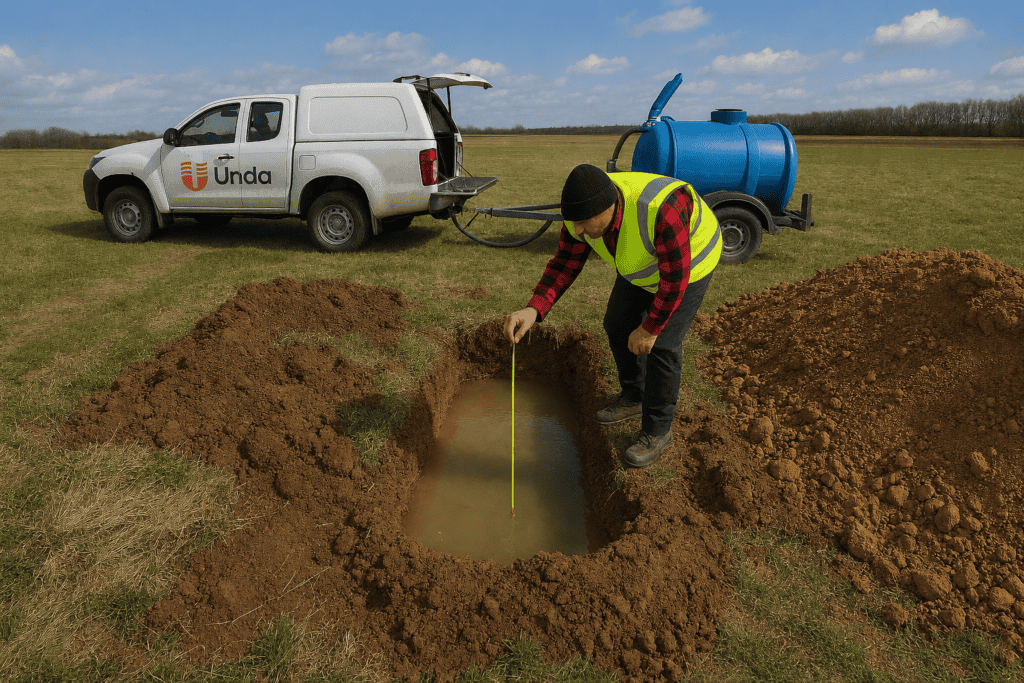
A BRE365 test fills a trial pit with water three times and times how long the water takes to drain away on each run. The procedure is structured and repeatable so the result is defensible:
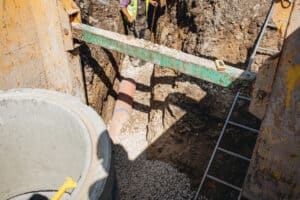
- Excavate a trial pit. A pit is dug at the proposed soakaway location, to the depth the soakaway will sit at, typically between 1 and 2.5 metres. The base should be roughly 1 to 3 metres long and 0.3 to 1 metre wide, with vertical sides trimmed square. Where the ground is unstable, the pit can be backfilled with granular material and a perforated observation tube installed so water levels can still be read.
- Fill the pit rapidly. The pit is filled quickly with water, to its maximum effective depth, to simulate heavy rainfall. A water bowser is often needed, as a large volume is used. For safety, nobody should enter the pit.
- Record the water level falling. The time is recorded as the water level falls from 75% to 25% of the effective stored depth. This 75–25 window is the part of the drain-down BRE365 uses to calculate the rate.
- Repeat three times. The fill-and-drain run is carried out at least three times, on the same or consecutive days. Early fills often drain faster as fine particles wash into the soil and clays take up water, so repeating the test captures the slower, long-term condition.
- Take the lowest rate. The design soil infiltration rate is taken as the lowest (slowest-draining) result of the tests completed, which is the conservative figure an engineer and an LLFA expect to see used.
Where the test must be carried out
BRE365 requires the test to be done at the actual position and depth of the proposed soakaway, not at a convenient corner of the site. A few siting rules matter for both the test and the eventual soakaway:
- The soakaway must sit at least 5 metres from any building to protect foundations.
- Its base must be at least 1 metre above the highest expected groundwater level; a high water table can rule infiltration out altogether.
- The pit should be placed where surface water naturally collects, and additional tests may be needed where ground conditions vary across the site.
Because groundwater levels move with the seasons, evidence of the highest likely water table is often needed alongside the test. Our explainer on groundwater monitoring for planning covers how that is done and why it is usually required for infiltration-led designs.
How the infiltration rate is used in soakaway design
The infiltration rate (f), expressed in metres per second, is an input to the soakaway design rather than the finished answer. Once you have a defensible rate, it feeds the soakaway sizing alongside the rainfall design event and the impermeable area being drained. As a rough guide, rates in the order of 10⁻⁴ to 10⁻⁵ m/s support a sensibly sized soakaway, while below about 10⁻⁶ m/s infiltration becomes impractical and an alternative discharge route is usually needed.
To work out the design rate from your own trial-pit timings, use our free BRE 365 infiltration rate calculator, which applies the BRE Digest 365 equation, takes the lowest of up to three tests, and returns the rate in both m/s and mm/hr.
BRE365 or BS6297: which test do you need?
BRE365 and the percolation test used for foul drainage are often confused, and they are not interchangeable. BRE Digest 365 is the method for surface water soakaways, such as roof and hardstanding runoff, and reports an infiltration rate in metres per second. If you are designing a drainage field for foul effluent from a septic tank or treatment plant, the relevant standard is BS 6297, which uses a different percolation test and an acceptable range of 15 to 100 seconds per millimetre. For the foul drainage case, see our explainer on BS 6297 infiltration testing for foul drainage fields.
What happens if you skip the test?
Relying on assumed infiltration rates, or jumping straight to a sewer connection, carries real risk at planning. Lead Local Flood Authorities increasingly require in-situ testing before approving a drainage strategy, and some authorities have tightened their checklists so that assumed rates without test data no longer pass. If the assumed figures turn out to be wrong, the design may need major revision, and a drainage planning condition frequently requires infiltration data before construction can begin. Testing early avoids those delays and the costs that come with them.
How Unda can help with BRE365 infiltration testing
Unda can arrange BRE365 infiltration testing as part of your drainage strategy, working with a trusted network of geotechnical specialists who carry out accurate in-situ testing. We then take the result through to a surface water drainage strategy and SuDS design that planners will accept. Soakaway construction also has to satisfy Approved Document H of the Building Regulations, and we make sure your scheme is designed accordingly. If you have the equipment and expertise to test yourself, we can also provide practical guidance on the procedure.
One of our experienced Flood Risk Consultants will get back to you within 60 minutes
Frequently asked questions
The pit is dug to the depth the soakaway will sit at, usually between 1 and 2.5 metres, with its base above the highest expected groundwater level. The aim is to test the ground the soakaway will actually drain into.
The three fill-and-drain runs are completed on the same or consecutive days, so fieldwork is usually quick. Where ground conditions or seasonal groundwater need to be confirmed, the wider evidence can take longer to gather, which is why it is worth starting early.
You can, provided you have the equipment, water supply, and a safe method of working, as nobody should enter the pit. Many developers prefer to use a specialist so the result is presented in the form an LLFA expects. Unda can do either.
Turn your test result into an approved drainage strategy
A defensible infiltration rate is the start of the conversation with a Lead Local Flood Authority, not the end of it. Once you have your BRE365 result, get in touch and we will take it through to a surface water drainage strategy planners will accept.
Latest news

One of our experienced Flood Risk Consultants will get back to you within 60 minutes
