Erosion of trust: the government’s own words versus its coastal erosion grant
Estimated reading time 10 minutes
There is no coastal erosion compensation in the UK. If the sea takes your home, there is no insurance payout and no statutory compensation for the land or the building. Until 15 July 2026 there was a demolition grant that had sat at £6,000 since 2010, against costs of £25,000 to £35,000. That grant has just doubled to £10,000. It still covers, at best, two-fifths of what it costs to pull a house down safely.
The timing is the interesting part. On 20 March 2026 the Environment, Food and Rural Affairs (EFRA) Committee published Erosion of trust: the impact of coastal erosion on communities, setting out the human cost of that gap in plain terms. On 22 June 2026 the government published its formal response. By the Committee chair's own account, it accepted only two of the report's recommendations in full. Three weeks later, Defra did the one thing it had signalled it would move on fastest: it raised the grant. On the government's own evidence, that grant is still less than half of what demolition actually costs.
What the EFRA Committee found in "Erosion of trust"
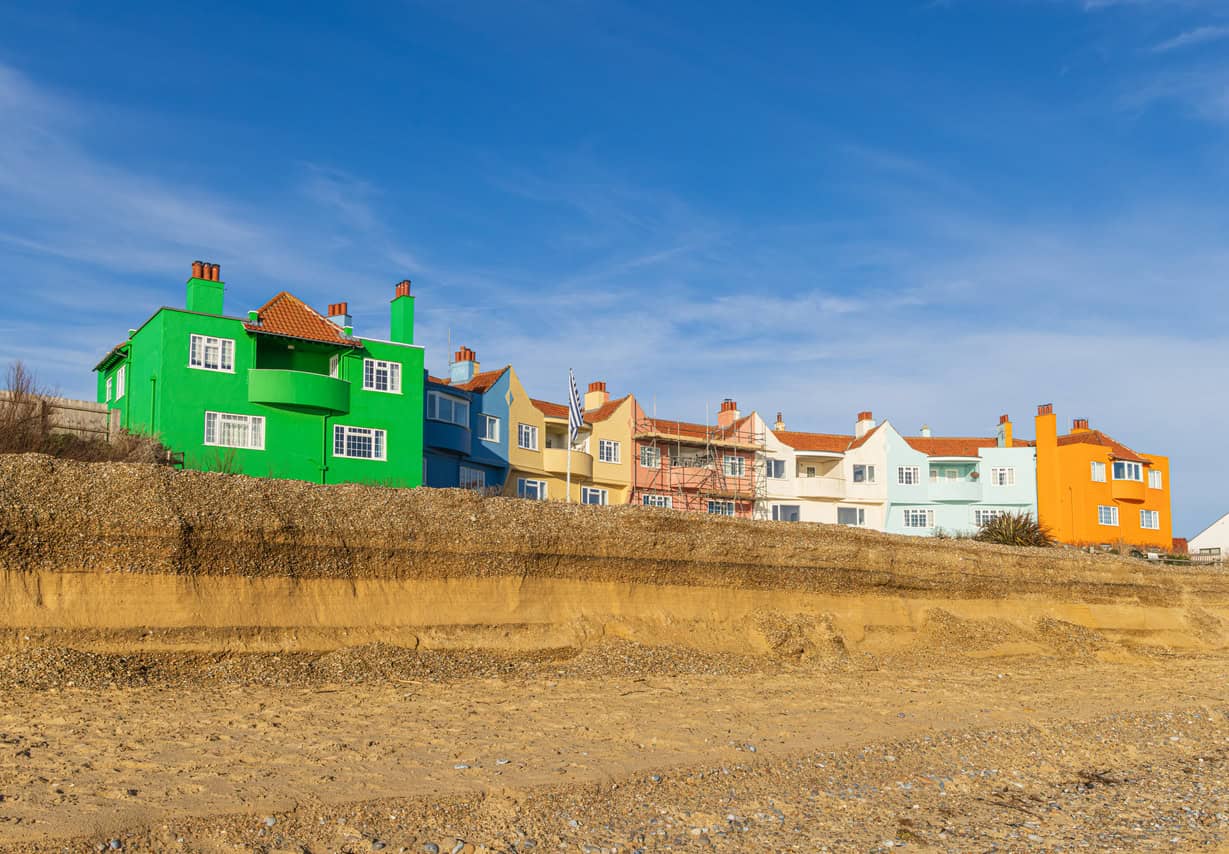
The Committee's central finding was blunt: coastal erosion causes "profound and distressing disruption" that goes well beyond losing a building, including mental health harm, fractured communities and a disproportionate impact on already deprived areas. Its evidence session heard from Thorpeness in Suffolk, where eleven homes were lost to the sea in a single winter, up from four reported just ten weeks earlier, including residents in their late eighties and nineties forced to relocate with little notice.
The Coastal Erosion Assistance Grant had been frozen at £6,000 since 2010, against demolition costs the Committee itself put at £25,000 to £35,000 per property: a shortfall the report called "substantially below the true costs of demolition".
The report was equally pointed on disclosure. Current rules mean a seller has no legal duty to tell a buyer their home is at risk of falling into the sea. During the Commons debate on 26 March 2026, Suffolk Coastal MP Jenny Riddell-Carpenter put it directly:
If my home were about to fall into the sea, I could sell it to you legally today, with no duty to tell you about the risks. Coastal communities deserve more than sympathy; they deserve action, support and long-term funding.
Jenny Riddell-Carpenter MP, House of Commons, 26 March 2026
The Committee also called the grant's eligibility rule "arbitrary": it only applies to properties bought before 15 June 2009, a cut-off with nothing to do with how much risk a household actually faces today. Its eight recommendations included extending or scrapping the 2009 cut-off, making erosion risk material information in property transactions, commissioning a feasibility review of a Flood Re-style insurance scheme for coastal erosion, and setting a national relocation strategy no later than March 2027.
The government's response, and why MPs call it inadequate
Defra's formal reply landed on 22 June 2026, as the First Special Report of Session 2026–27 (HC 300). The Committee's chair, Alistair Carmichael, did not treat it as a win.
- Accepted in full: a review of the Coastal Erosion Assistance Grant's value and eligibility criteria, and closer integration of Shoreline Management Plans into local planning decisions.
- Rejected outright: any government-backed insurance scheme for coastal erosion, on the stated basis that erosion is "typically known, permanent and progressive" rather than an insurable event.
- Deferred, not delivered: a fixed national relocation strategy. The Committee wanted one by March 2027; the government pointed instead to its Coastal Adaptation Pilots, which don't conclude until spring 2029.
- Refused: publishing a clear split of how the £10.5 billion, ten-year flood and coastal budget divides between inland flood defences and coastal erosion work.
Carmichael's assessment was that the response "fails to appreciate the emotional turmoil and real physical jeopardy that many coastal communities face", warning that without a genuine relocation strategy, residents could "be left homeless in the years to come".
One detail gets lost in that criticism. On the single recommendation that cost the least to act on, the government moved fast. The response committed to completing the grant review by June 2026 and implementing changes "no later than April 2027". It beat both dates: on 15 July 2026, three weeks after publishing the response and nine months ahead of its own implementation deadline, the Coastal Erosion Assistance Grant rose from £6,000 to £10,000 per property. The recommendations that would have cost real money (insurance, a funded relocation strategy) were the ones rejected, or pushed out to 2029.
The money: what the grant pays against what demolition costs
Even after doubling, the arithmetic doesn't close. Environment Agency guidance confirms the grant now stands at £10,000 per property, with local authorities able to make a case for more "in exceptional circumstances", and able to apply retrospectively. Set that against demolition costs the Committee put at £25,000 to £35,000, and against East Riding of Yorkshire Council's own figure of £798,567 spent on demolitions since 2010, and the grant starts to look less like compensation than a contribution.
Even at its new, higher rate, the grant covers at most 40% of the low end of what demolition costs. By the time MPs debated the report on 26 March 2026, some were already citing live costs as high as £35,000 to £50,000, ahead of even the Committee's own figure. And demolition is all the grant is for: the safe, prompt removal of a home that is about to fall into the sea. It does not replace the value of the property, the land, or the life built around it.
Is coastal erosion covered by insurance? Why Flood Re doesn't apply
No. Coastal erosion is not covered by standard home insurance, and it sits entirely outside Flood Re, the government-backed scheme that keeps flood insurance affordable for at-risk homes. The government's own response to the Committee explains why the two are treated so differently.
- Coastal flooding is usually insurable. It is a discrete, uncertain event (a storm surge, a tide, a breach), and Flood Re exists precisely to keep that risk affordable, as Unda has covered in Flood Re's 2026 "Flood ReThink" reforms.
- Coastal erosion is treated as uninsurable. Defra describes it as "typically known, permanent and progressive", which in underwriting terms means it isn't really a risk at all. It's closer to a scheduled, gradual loss.
- The Committee asked Defra to explore a Flood Re-style scheme for erosion anyway, a state-backed insurance mechanism to smooth exactly this kind of gradual, unavoidable loss.
- The government said no, flatly, with "no plans to explore government-backed insurance for coastal erosion and landslides".
That distinction matters well beyond the coast. Flood risk and erosion risk are assessed, insured and compensated in entirely different ways, something Unda has set out in more detail in looking at how rising sea levels are already increasing coastal flood risk and in what Flood Re's eventual end in 2039 could mean for the housing market more broadly.
What ministers have promised, and by when
Take the rhetoric out and the government's own response leaves a genuine timeline. Read it as a sequence and the gaps between the dates tell their own story.
- June 2026: complete the review of the Coastal Erosion Assistance Grant's value and eligibility criteria (delivered on time, published alongside the response on 22 June 2026).
- 15 July 2026: the grant rises from £6,000 to £10,000 per property, nine months ahead of the government's own April 2027 deadline for implementation.
- Later 2026: publish guidance on treating coastal erosion risk as material information in property transactions, addressing the disclosure gap Jenny Riddell-Carpenter raised in the Commons.
- 2026 to spring 2029: run the Coastal Adaptation Pilots in East Riding of Yorkshire, Norfolk and East Suffolk, generating what the government calls "evidence for a long-term model of support" for relocation.
- No earlier than spring 2029: use that pilot evidence to inform any future national relocation strategy, roughly two years later than the March 2027 deadline the Committee actually asked for.
The Committee asked for a national relocation strategy by March 2027. The government won't commit to using the evidence for one before its pilots conclude in spring 2029: a gap of about two years on the one recommendation that would actually help households plan their futures.
What coastal homeowners can do now
None of this changes what a coastal property owner or buyer can actually control. A handful of things do help.
- Check your own exposure using the Environment Agency's coastal erosion risk checker, which shows the Shoreline Management Plan policy for your stretch of coast and the timeframe it applies to.
- Don't assume Flood Re helps. It applies to flooding, not erosion, even where the two risks sit on the same stretch of coastline. Flood risk alone already affects house prices and mortgage decisions; erosion risk is treated even more cautiously by lenders and insurers.
- Get independent, property-level evidence before you sell, remortgage or buy near an eroding coastline. A lender or insurer working from a broad coastal risk map has no idea what your specific property, its levels and its defences actually face.
- Read the Shoreline Management Plan for your frontage, not just the national coastal erosion maps. "Hold the line" and "no active intervention" can sit on the same stretch of coast a few hundred metres apart.
If an insurer, lender or buyer has queried flood or coastal risk at a specific property, that is a question about evidence, not sympathy. Unda prepares independent, property-level flood risk assessments for insurance, built from site data rather than a postcode-level score, for owners whose cover has been queried, loaded or declined.
Frequently asked questions
Does the Coastal Erosion Assistance Grant cover anything besides demolition?
No. The grant exists solely to fund the prompt, safe demolition of a home at imminent risk of falling into the sea. It doesn't compensate for the lost value of the property, the land, alternative housing, or relocation costs; there is currently no separate scheme for any of those.
Can you get a mortgage on a home at risk of coastal erosion?
It gets harder as the risk becomes more immediate. Lenders assess erosion risk against the Shoreline Management Plan timeframe for that stretch of coast, and mortgage terms, loan-to-value limits or eligibility can all tighten well before a property is actually lost, sometimes years ahead of any physical change to the land.
Is coastal erosion the same as coastal flooding for insurance purposes?
No, and the distinction is the whole reason one is insurable and the other isn't. Coastal flooding is a discrete event that Flood Re is designed to cover. Coastal erosion is a gradual, largely predictable process that the insurance market, and the government, in rejecting a Flood Re-style scheme for erosion, treats as effectively uninsurable.
What should sellers tell buyers about coastal erosion risk?
Under current rules, there is no specific legal duty to disclose coastal erosion risk to a buyer, which is exactly what the EFRA Committee wants changed by making it material information in property transactions. Until that guidance is published, buyers of any coastal property should check the Shoreline Management Plan and erosion mapping themselves rather than rely on disclosure.
Latest news




One of our experienced Flood Risk Consultants will get back to you within 60 minutes