Early SuDS Planning: CIRIA C823F and What the 2026 NPPF Now Requires

Estimated reading time 13 minutes
Early SuDS planning means settling the surface water question at land acquisition and site appraisal, before roads, levels and plot positions are fixed. Since 17 August 2026 that is no longer only good practice. CIRIA's guide Enabling development: Getting SuDS right from the start (C823F), a free 50-page guide published in September 2025, written by a team at Arup and endorsed by CIWEM, makes the commercial case for it. The new National Planning Policy Framework supplies the policy weight, because Policy F8 now expects every development proposal to incorporate sustainable drainage designed to the 2025 National Standards. Between them, drainage stops being a condition to discharge and becomes a decision taken before the offer goes in.
The earlier SuDS are considered on your site, the greater the scale of benefits that can be realised and the easier they are to integrate into your scheme.
That line is the heart of the guide, and CIRIA has paired the guidance with a short animation aimed at anyone making early decisions on a site.
The practical consequence is a change of order. On most schemes the drainage question is asked after the land is bought and the layout is drawn, which leaves the answer to fit whatever space survives. Ask it first and it costs a day of specialist time. Ask it last and it costs plots. If you are appraising a site now, that first question belongs in a flood risk feasibility study on the land you are buying, and the answer then shapes the surface water drainage strategy rather than being squeezed into it.
What is CIRIA C823F, and who is it for?
C823F is CIRIA's free guide to getting sustainable drainage right at the start of the development process. It runs to 50 pages, was published in September 2025, was written by a team at Arup and is endorsed by CIWEM. It is deliberately short. Where the SuDS Manual (C753), first published in 2015, sets out how to design a drainage system, C823F sets out when the decisions that shape it have to be taken, and by whom.
- Land agents and promoters. A discharge constraint found after purchase is a valuation problem, not a design problem.
- Developers and housebuilders. Plot count is decided by the layout, and the layout is decided by where water can go.
- Masterplanners and urban designers. Swales, basins and rain gardens either sit in the open space plan or they sit in a fenced corner.
- Surveyors and site finders. The cheapest drainage due diligence is a desk study carried out before the offer.
The guide is advisory. It carries no statutory force, and its influence depends on how widely the industry adopts it. What has changed since it was published is that national planning policy has moved in the same direction.
What the August 2026 NPPF changed for early SuDS decisions
The Framework published on 18 August 2026 gives flood risk and coastal change its own chapter, Chapter 18, with nine coded policies from F1 to F9. Policy F8 is the drainage one. It expects development proposals to incorporate sustainable drainage systems designed in accordance with the 2025 National Standards for Sustainable Drainage Systems, and it expects the Lead Local Flood Authority to be consulted on major development. The wording matters as much as the substance. Across the new flood policies the old formula, that development should only be allowed if the tests are met, has become a refusal unless they are.
| Before 17 August 2026 | From 17 August 2026 | |
|---|---|---|
| Policy home | Flood risk paragraphs inside the December 2024 Framework | Chapter 18, policies F1 to F9 |
| SuDS requirement | Authorities to promote SuDS unless clearly inappropriate | Policy F8: proposals to incorporate SuDS designed to the 2025 National Standards |
| Scope | Weighted towards major development | Design expectation across development, with LLFA consultation on major schemes |
| Tone | Development should only be allowed if the tests are met | Development should be refused unless the tests are met |
None of this makes SuDS a separate consent. Schedule 3 of the Flood and Water Management Act 2010, which would have created a SuDS Approving Body in England, has still never been commenced. The House of Commons Library briefing of 4 February 2026 records the government's position plainly.
Better delivery of SuDS may be achieved by continuing to improve the current planning policy-based approach and looking at ways of improving the approach to adoption and maintenance, rather than commencing Schedule 3.
House of Commons Library briefing CBP 10483, February 2026
So the delivery route is the planning system, and the planning system now asks the question earlier and answers it more strictly. That is the argument C823F was making a year before the Framework caught up.
Why does early SuDS planning matter?
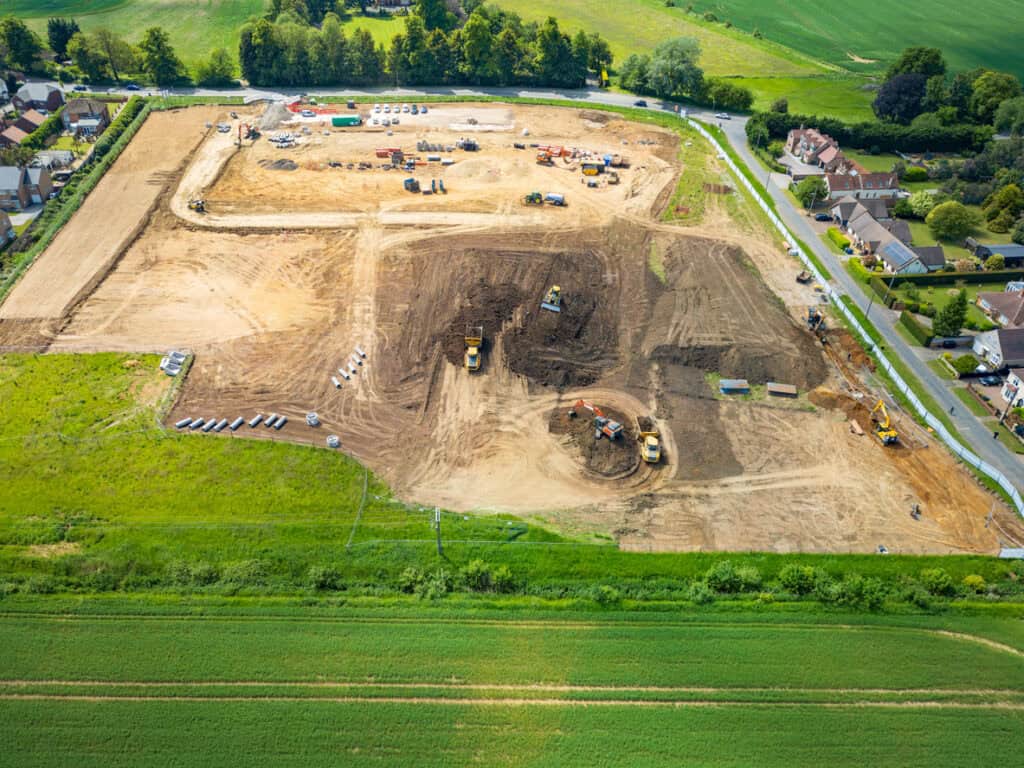
Early SuDS planning matters because the cheapest and highest-value drainage decisions are the ones taken before a layout is fixed. Once roads, plot positions and site levels are set, sustainable drainage has to fit around whatever space is left over, which usually means smaller, harder-working and more expensive features that deliver less. Bring drainage in at the start and it shapes the layout instead of fighting it.
Too often SuDS are treated as a planning formality, addressed only at application stage or deferred until a drainage condition is discharged. CIRIA argues that this late consideration is precisely where design quality, cost and multi-functional benefit are lost.
- Design quality. Drainage squeezed into leftover corners performs worse than a scheme designed around the site's natural flow paths.
- Cost. Retrofitted tanks and pipes are more expensive to build and maintain than shallow, source-control features designed in early.
- Amenity and biodiversity. Rain gardens, swales and green corridors are easily lost once the layout is finalised, leaving fenced-off basins or buried storage that add no value.
- Programme. Constraints spotted late trigger redesigns, objections and delays that a due-diligence check would have caught. Groundwater monitoring is the usual culprit, because a full winter of readings cannot be compressed.
- Viability. Flood risk or discharge problems that surface after land is bought can leave a site harder to develop, or undeliverable.
A soakaway that fails its infiltration test in month nine of a programme is the same technical fact it would have been in week one, at a fraction of the cost.
The four gateways of early SuDS planning
The guide organises early SuDS around four gateways in the land development process. At each one the project team widens and the drainage question sharpens, from a first due-diligence sift at acquisition through to a masterplan with SuDS built into its bones. The gateways are a sequencing device rather than a procedure: they say who needs to be in the room, and what has to be known before the next decision is taken.
Land acquisition and due diligence
Bring a drainage specialist in before the site is bought. Understand flood risk, ground conditions and likely discharge points so they inform valuation, feasibility and the offer.
Team: developer · land agent · drainage consultant
Initial site appraisal
Widen the team and assess the site's physical and environmental conditions before an architect is appointed, so the findings shape the design brief rather than react to it.
Add: geotechnical · landscape architect · ecologist
Detailed site appraisal
Refine the surface water strategy, confirm discharge points and size the space above-ground features will need, so drainage and layout develop together.
Add: hydrologist · masterplanner · drainage engineer
Masterplan and layout
Fix SuDS into the masterplan alongside open space, routes and landscaping, and confirm the scheme is deliverable, so there is no need for later retrofits or compromises.
Confirm: deliverability · adoption · multi-benefit design
At every gateway the guide encourages early dialogue with the bodies that will judge the scheme: the Lead Local Flood Authority, the Environment Agency, the Local Planning Authority and the relevant water and sewerage companies. Confirming their expectations early is what prevents a redesign when drainage and layout collide. Most LLFA objections land on a drainage strategy that was technically competent but agreed with nobody.
How the guide says early SuDS adds value
C823F reframes sustainable drainage as a commercial opportunity rather than a constraint. Considered up front, the guide says, SuDS can speed up the planning approval process, optimise the developable area, improve a site's chances of being allocated in a local plan, and lift development value and saleability. The argument is aimed squarely at the people who choose and shape sites: developers, land agents, promoters, surveyors and masterplanners, and it was put to the sector in those terms when the guide launched.
We have written this guide as targeted, simple support for those involved in the very early stages of site progression, to demonstrate how early consideration of sustainable drainage can maximise benefits and mitigate risks. I hope that a quick flick through can save your site from many headaches in the future.
Emma Cecil, Senior Civil Engineer, Arup and a guide author
There is a technical dividend too. Because source control manages rainfall close to where it falls and sits at shallow depth, it can cut construction and long-term maintenance costs against traditional deep piped drainage. The same features carry the amenity and biodiversity benefits a late retrofit cannot, and they are the ones that can be counted towards biodiversity net gain rather than deducted from it.
Following the surface water discharge hierarchy
Getting SuDS right early also means designing to the surface water discharge hierarchy from the outset, rather than defaulting to a pipe and a connection. Standard 1 of the 2025 National Standards sets the order in which a development must try to deal with its surface water, and knowing where a site is likely to sit on that ladder at acquisition stage is exactly the kind of early insight C823F is asking for.
- Collect for reuse: rainwater harvesting where there is genuine non-potable demand.
- Infiltrate to ground: soakaways or infiltration features, subject to ground conditions and infiltration testing.
- Discharge to a watercourse: at rates and volumes agreed with the risk management authority.
- Discharge to a surface water sewer: only where capacity is confirmed.
- Discharge to a combined sewer: the last resort, once every higher option is ruled out.
Cost alone is never a sufficient reason to skip a higher tier. The standards expect evidence that each option has been maximised before moving down, which is why the ground investigation that settles tier two belongs in the appraisal and not in the condition discharge.
Establishing the probable discharge route early tells you how much land your drainage will need, before that land is committed to something else.
Does early SuDS planning cost developable land?
A common objection is that designing SuDS in early eats into the developable area. The guide tackles this head-on: done early, sustainable drainage tends to protect yield rather than shrink it. It is late, retrofitted drainage, forced into whatever space survives the layout, that most often costs plots.
Early consideration of SuDS represents a win-win for both land agents and masterplanners, ensuring better outcomes for new developments via sustainable drainage.
Adrien Baudrimont, Senior Research Manager and CIRIA project lead
Early SuDS can also open up sites that look marginal. Land dismissed as too wet, too complex or too high-risk can become viable once drainage is understood and designed for from the start, so the constraint becomes part of the offer rather than a reason to walk away.
What early SuDS planning means for your scheme
The message of C823F comes down to one thing: treat sustainable drainage as a design driver from land acquisition onwards, not a box to tick at application stage. Handled that way, it protects the developable area and the programme while producing schemes that manage water better and make better places. The guide itself is advisory. Its impact still depends on how consistently the industry adopts it, but Policy F8 has turned the direction of travel into a planning requirement rather than a recommendation, and the planning practice guidance on flood risk and coastal change says the same thing about integrating drainage early.
If you are appraising a site or shaping a layout, our team can bring drainage in at the right gateway and produce the drainage strategy for your planning application that the Lead Local Flood Authority will accept when it goes in.
Buying a site? Settle the drainage before the offer
Our consultants appraise flood risk, ground conditions and discharge options at gateway one, so the answer informs the price rather than the redesign.
Get a quote in 60 minutesFrequently asked questions
Is early SuDS planning a legal requirement in England?
No. SuDS in England are delivered through the planning system, not a standalone approval regime, because Schedule 3 of the Flood and Water Management Act 2010 has never been commenced. What changed in August 2026 is the strength of the planning route: Policy F8 expects proposals to incorporate SuDS designed to the 2025 National Standards, and the flood policies are worded as grounds for refusal.
Where can I download CIRIA C823F, and is it free?
Yes. Enabling development: Getting SuDS right from the start (C823F) is a free 50-page guide available from CIRIA, along with the supporting animation. It was published in September 2025.
Does early SuDS planning apply to small or brownfield sites?
Yes. The gateways scale down: even on a small or brownfield plot, checking flood risk, ground conditions and discharge options before purchase avoids expensive surprises. Brownfield sites often reuse existing discharge arrangements, and an existing connection is worth confirming rather than assuming.
How does C823F differ from the CIRIA SuDS Manual (C753)?
C823F is a short, free guide about when and why drainage decisions are taken, aimed at the people who buy and shape sites. The SuDS Manual is the technical design reference that tells an engineer how to size and detail the system. They are companions rather than alternatives.
At what point should a drainage consultant be appointed?
At gateway one, before the land is bought. A desk-based appraisal of flood risk, ground conditions and likely discharge points costs a fraction of what a redesign costs, and it is the only stage at which the finding can still change the price you pay.
What does the LLFA expect to see at outline stage?
Enough to show the discharge route is deliverable: the flood risk position, the proposed point of discharge with evidence for it, indicative runoff rates, and confirmation that the space the drainage needs is on the layout rather than notionally available. The Environment Agency's standing advice on preparing a flood risk assessment asks for a sustainable drainage strategy wherever a proposal could affect drainage on or around the site. Detailed design follows at condition stage.
About the author. Ellen is a Flood Risk and Drainage Consultant working across flood risk assessment and sustainable drainage design. Unda has been trading since 2014, is a CIWEM Business Partner with CIWEM member and chartered (C.WEM MCIWEM) consultants, and has delivered 5,000+ flood risk assessments and drainage strategies across England and Wales.
Ellen Webb · BSc (Hons), GradCIWEM
Latest news



One of our experienced Flood Risk Consultants will get back to you within 60 minutes