Source Control in UK Drainage: SuDS at Plot Level

Estimated reading time 11 minutes
Source control means managing rainfall as close as possible to where it lands, before it has a chance to run off into the wider drainage network. It sits at the very top of the SuDS hierarchy, and in principle it shapes how every new development in the UK should deal with surface water. In practice, it is the part of drainage design that most often gets skipped.
A recent Guardian article on rain fences making Dutch homes more climate resilient put the idea in a nutshell. The Dutch adapt ordinary boundary fences to catch roof runoff, hold it briefly, then either reuse it or let it go slowly. None of that is new technology. What stood out was how casually it was built into a normal home — part of the fence you lean on in the garden, rather than a piece of bolt-on infrastructure.
The UK already has the technical frameworks and the policy to manage surface water this way. What we tend to lack is the habit of applying those principles at the scale where rainwater first hits the ground. This is a scale problem far more than a design problem, and it is worth understanding why.
What source control actually means
Source control is the range of measures used to manage rainfall and runoff at or near the point where it is generated, rather than collecting it and dealing with it further downstream. It is the first and most important stage of the SuDS management train, and everything below it in the system is meant to do less work as a result.
The SuDS hierarchy runs in a clear order of preference:
- prevention — reducing impermeable area so less runoff is created in the first place
- source control — managing what runoff remains, on the plot, close to where it falls
- site control — gathering and managing flows across the wider site
- regional control — larger shared features such as basins and ponds
Techniques higher up the hierarchy are preferred to those lower down. The guidance is explicit that prevention and control at source should always be considered before site or regional measures, a principle set out in the UK's reference source for sustainable drainage, susdrain's source control overview.
In practice, source control has three aims:
- reduce the volume of runoff leaving a plot
- slow the rate at which water moves through a site
- encourage infiltration and reuse wherever the ground and the scheme allow it
Deal with water at source and the volume, the speed and the pollution load all drop before they reach anything downstream. That means smaller, cheaper site-wide features and a system that is less likely to be overwhelmed.
The measures that make up source control
Source control is not a single feature. It is a collection of small, distributed measures spread across a development, each modest on its own.
| Measure | What it does | Where it sits | Typical use |
| Rainwater harvesting | Captures roof runoff for reuse or slow release | On the building / plot | Houses, schools, commercial roofs |
| Permeable paving | Stores and infiltrates water in sub-base layers | Driveways, parking, paths | Replaces impermeable hardstanding |
| Green or blue roofs | Hold and slow roof runoff | Building roof | Flats, commercial, higher density |
| Rain gardens | Shallow planted features that hold and infiltrate | Gardens, verges, public realm | Residential and street scale |
| Filter strips / swales | Slow and cleanse runoff close to source | Plot edges, between plots | Linking plots into the train |
| On-plot storage / rain fences | Tanks or boundary features that hold water | Garden, boundary | Distributed plot-level attenuation |
The value of these measures lies less in any one of them and more in how consistently they are applied. The Dutch rain fence is a useful example precisely because it folds storage into something a household already has. Where infiltration is the goal, ground conditions decide what is realistic — which is why BRE365 infiltration testing is often the first practical question on any source-control scheme. Harvesting, meanwhile, is increasingly designed in deliberately rather than added on, an approach we cover in integrating rainwater harvesting into SuDS design


Why source control is now a compliance question, not just good practice
For years, source control was something planners and drainage engineers were encouraged to consider. That has changed.
Standard 2 of the 2025 National Standards for Sustainable Drainage Systems, published by the government in June 2025, introduced an interception requirement. Evidence must now be provided that runoff from each positively drained surface, for at least the first 5mm of rainfall, is collected for reuse, infiltrated into the ground, or captured and stored within SuDS features rather than discharged off site. The aim is to stop runoff in roughly 80% of summer and 50% of winter rainfall events — the frequent, light rain that washes most urban pollution into watercourses.
That first 5mm is, in effect, a source-control requirement. It cannot realistically be met with a single downstream tank; it has to be dealt with where the rain lands, across the roofs and surfaces of a site. The full national framework is set out in the government's national standards for sustainable drainage systems, and it shifts source control from a design preference to something a scheme has to evidence.
Why scale matters
On a single plot, source control is a small intervention. Across a development of a few hundred homes, it becomes something else entirely.
If every plot holds back a share of its own runoff, the effect compounds. Peak flows into the site-wide system drop. Water reaches the attenuation features more slowly. The pressure on downstream pipes and basins eases because less is arriving at once.
Source control also changes how a drainage system behaves when it is pushed. Instead of leaning on a handful of large assets, performance is spread across many small ones. That builds in redundancy: no single feature is carrying the whole load, so no single failure is catastrophic.
This matters more as rainfall patterns shift. The trend toward more intense rainfall events is steadily pushing systems designed around historical assumptions beyond what they were built for. Distributed storage does not replace larger infrastructure, but it does reduce how hard that infrastructure has to work — and how often it is asked to cope with conditions it was never sized for.
The reverse case makes the same point. When permeable surfaces are swapped for hardstanding, plot by plot, urban catchments lose capacity they never formally accounted for. We explore that in why paved gardens threaten urban flood resilience. Distributed retention works the same way in reverse: it only delivers if it is applied consistently.
Why it still isn’t happening at plot level
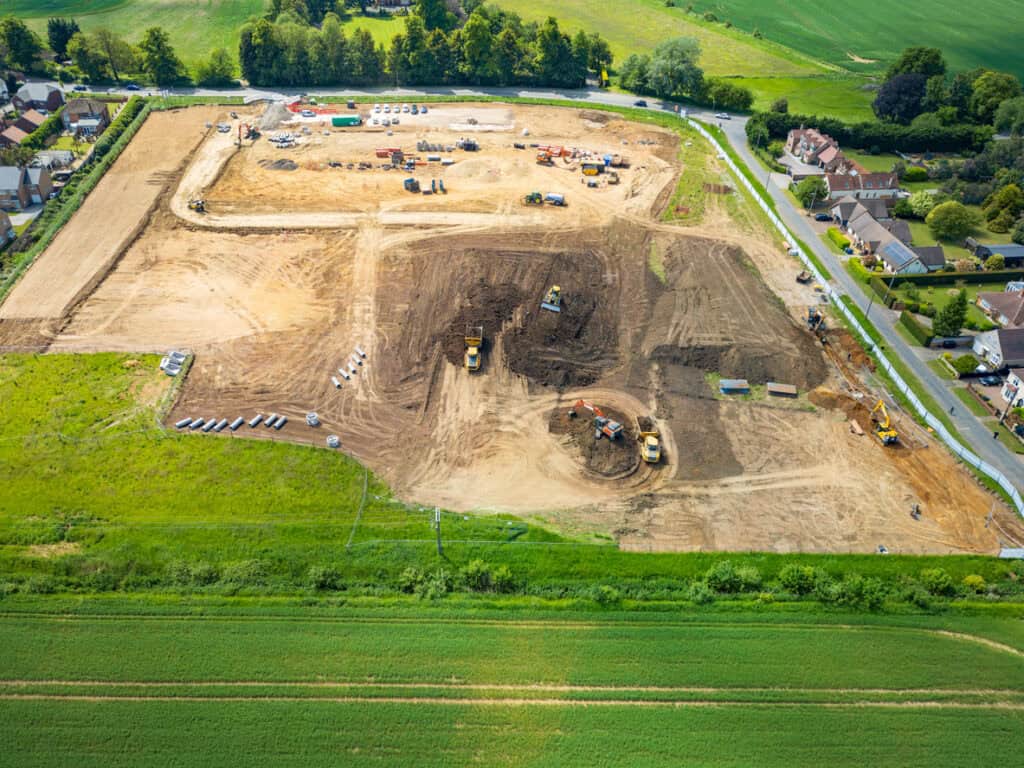
Source control is written into UK guidance, yet it rarely gets properly developed plot by plot. In most schemes, drainage is still resolved at the site-wide level, with design effort concentrated on attenuation basins, underground storage and discharge control. All of those are necessary, but they sit downstream of where rain actually falls. Roof water and small flows are typically piped straight into the network, and the focus lands on meeting a discharge rate rather than cutting the volume entering the system in the first place.
There are real, practical reasons for this.
The planning system generally assesses drainage at a site-wide level, and compliance is often demonstrated through strategic modelling rather than a close look at how individual plots contribute. Key elements of design are also frequently deferred, as we set out in what drainage information is needed for planning permission. By the time layouts and levels are fixed, the window for meaningful plot-level source control has usually closed.
Maintenance is another sticking point. Distributed features raise awkward questions about who owns them and who keeps them working over decades, questions that sit within the wider picture of who is responsible for managing flood risk in England.
And there is a design convention at work. UK developments tend to prefer drainage that stays out of sight — pipes underground, ponds at the edges. More visible, integrated approaches remain rare, even where they would be straightforward, which is part of what makes green and nature-based SuDS feel novel here when they are routine elsewhere.
Getting it right means designing it in early
Decisions about how water is managed at plot level are not really made inside the drainage strategy. They are shaped earlier, by site layout, building design, levels and thresholds, and the landscape strategy. Once those are locked in, the room for distributed storage shrinks fast, and drainage design becomes an exercise in working around constraints rather than shaping them.
This is why guidance increasingly pushes for early integration. CIRIA's guide for early SuDS planning places drainage at the heart of layout and design rather than treating it as a late technical fix. A stronger focus on source control would not need new technology. It would, though, change the order in which decisions get made — capturing roof runoff for reuse or controlled release, building storage into boundary features and gardens, and using permeable and vegetated surfaces as part of the drainage system rather than as landscaping laid on top of it.
The single requirement is consistency, applied early enough to actually influence the design.
How Unda can help
Getting source control right starts at the layout stage, not at the end of a project. Unda's surface water drainage strategy and SuDS service works runoff through the SuDS hierarchy from the top down, so source control and the 5mm interception requirement are designed in rather than retrofitted.
For schemes at an early stage, a preliminary drainage design for planning identifies infiltration potential and runoff constraints while layouts can still respond to them. Where permission is already granted, we prepare the detailed schemes needed for the discharge of drainage planning conditions, including the SuDS-hierarchy evidence local authorities now expect.
One of our experienced Flood Risk Consultants will get back to you within 60 minutes
The practical takeaway
Rain fences are a useful example because they show how source control can be folded into the everyday parts of a development: the fence, the garden, the driveway. The UK already has the policy framework and the technical guidance to do the same. What we are short on is the habit of applying it routinely, plot by plot.
Improving drainage performance is not only about bigger infrastructure or more detailed modelling. It is also about how we manage small volumes of water, in lots of places, starting at the very point where rain first meets the ground.
Frequently asked questions
Source control is the practice of managing rainfall and runoff at or near the point where it falls, before it enters the wider drainage network. It is the first stage of the SuDS management train and includes measures such as rainwater harvesting, permeable paving, green roofs and rain gardens.
Common measures include rainwater harvesting systems, permeable paving, green or blue roofs, rain gardens, filter strips and swales, and on-plot storage such as tanks or integrated rain fences. Most schemes use several of these together across a site.
In effect, yes for most new development. The 2025 National Standards for SuDS require the first 5mm of rainfall from drained surfaces to be intercepted on site, which can only be achieved through source control measures rather than downstream storage alone.
Source control reduces the volume and rate of runoff at the point it is generated. Attenuation stores runoff further downstream and releases it at a controlled rate. Source control reduces how much water reaches the attenuation features, so the two work together rather than as alternatives.
By applying source control consistently across plots — harvesting roof water, using permeable surfaces, and building storage into gardens and boundaries — and by designing this in early, while site layout and levels can still accommodate it.
Latest news


One of our experienced Flood Risk Consultants will get back to you within 60 minutes