First flush explained: why the first few millimetres of rain matter most in SuDS
Estimated reading time 12 minutes
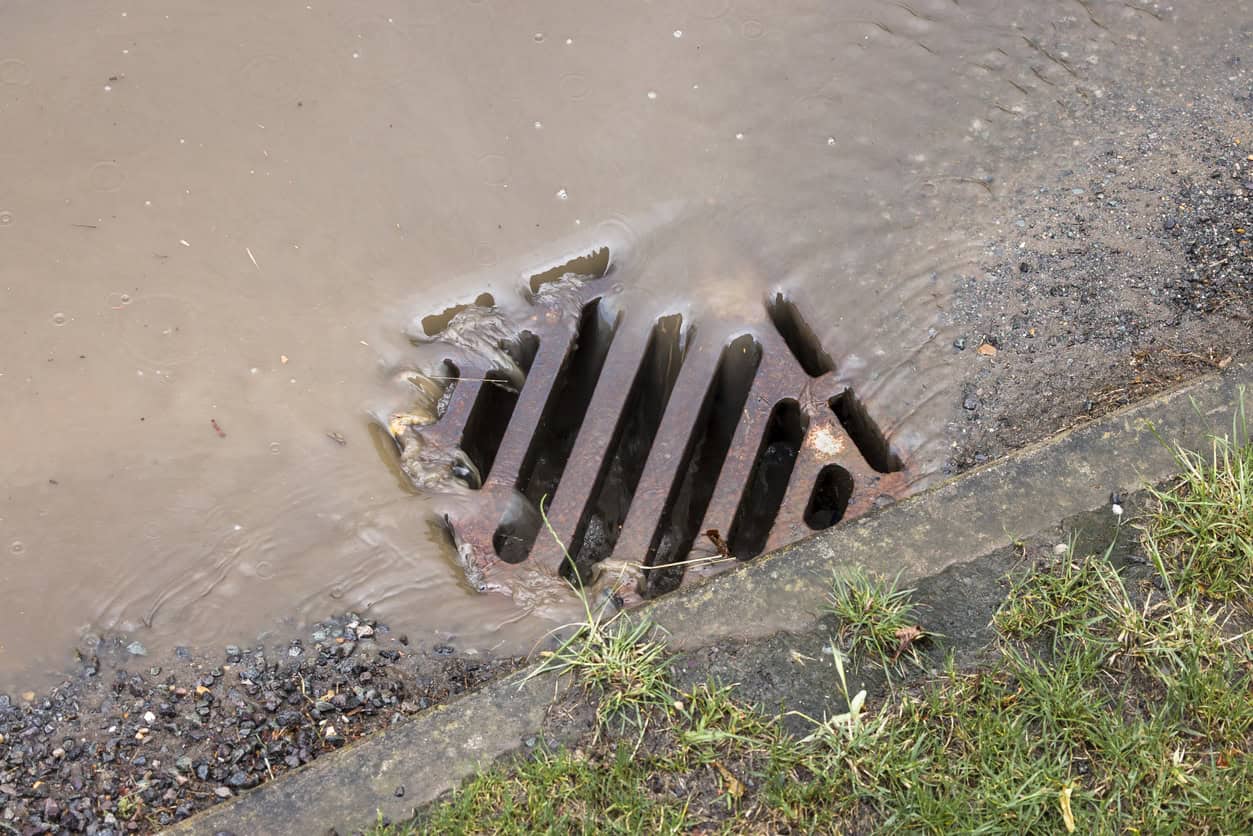
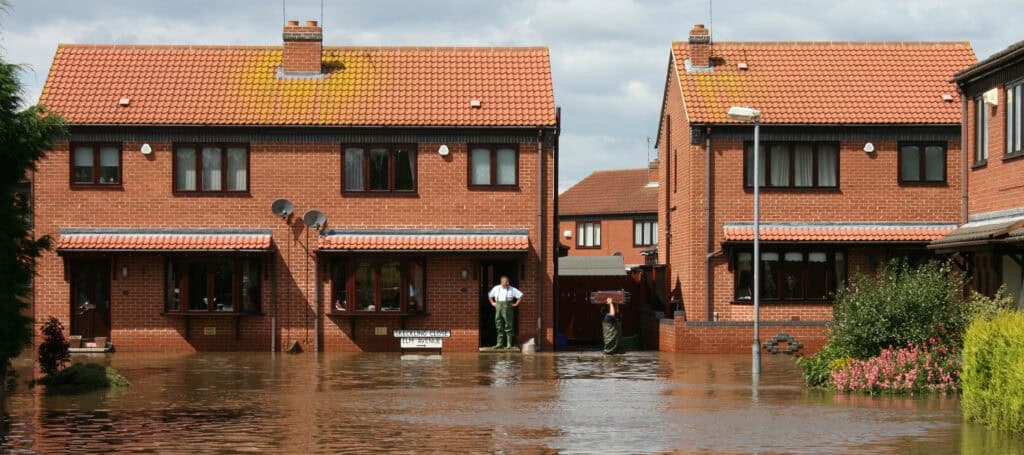
Every storm carries its dirtiest water at the start. In the first minutes of rain, run-off sluices weeks of built-up grime (oil, tyre and brake dust, sediment, metals and nutrients) off roofs, roads and car parks and into the nearest drain. That opening surge is the first flush, and for water quality it matters more than almost any other part of the storm. It matters commercially too. Surface water is now England’s most widespread flood source, with roughly 4.6 million properties exposed, and analysis published in August 2026 found that seven in ten UK home-insurance flood claims come from surface water and flash flooding rather than rivers.
For anyone designing drainage for a planning application, the first flush sits at the heart of the water-quality question. This article explains what it is, why the first few millimetres of rain are the dirtiest, whether the effect can actually be relied on, and how UK sustainable drainage systems (SuDS) capture it: through interception and the treatment train rather than a single “first flush volume”. Get that right and it becomes the backbone of a compliant surface water drainage strategy. Get it wrong and water quality is left to chance.
In studies of highway run-off, the first 10–20% of the run-off volume can carry 30–50% of the pollutant load. Not all rain is equally dirty.
What is the first flush?
The first flush is the initial run-off of a storm, when pollutant concentrations run markedly higher than in the rain that follows. During dry weather, pollutants collect on hard surfaces; when rain arrives it washes that load off quickly, so the earliest run-off is the most contaminated.
Two definitions are worth keeping apart. A concentration first flush is when the concentration of a pollutant spikes early in the event. A mass first flush is when a disproportionate share of the total pollutant mass leaves in the first slice of run-off volume. The mass version is the one that matters for design, because it tells you how much of the pollution you would catch by treating the early run-off.
There is a related effect in older combined sewers, the “first foul flush”, where solids that settle during dry weather are scoured out at the start of a storm. It is part of why combined sewer overflows spill such concentrated pollution. The mechanism is separate from surface-water SuDS, but it comes from the same idea: the dirtiest water moves first.
- Sediment and suspended solids: washed off roofs, roads and exposed ground, and the carrier for much of the rest of the pollution.
- Hydrocarbons: oil, fuel and tyre and brake wear from trafficked surfaces.
- Metals: zinc, copper and others, partly dissolved and partly bound to particles.
- Nutrients and organics: from vegetation, soils and general urban grime.
- Litter and gross solids: mobilised early from paved areas and gullies.
Why the first few millimetres of rain are the dirtiest
Pollutants build up on surfaces between storms and wash off fastest at the start, so the opening run-off carries far more than its share of the load. On a small, heavily paved catchment, the first few millimetres of rain can flush off the bulk of what accumulated during the dry spell.
The pattern is not uniform across pollutants, and this shapes how you treat it. Research on highway run-off has found that organic material, oils and fine sediment flush hard and early, as does coarser sediment with metals attached to it. Dissolved metals behave differently. A large share of the copper, nickel and zinc in run-off stays in solution and barely flushes at all, which is why settlement on its own never removes it. That single fact is why UK SuDS leans on vegetated and filtering features rather than ponds and tanks alone.
| Pollutant | First-flush behaviour | What it means for treatment |
|---|---|---|
| Organics, oils, fine sediment | Strong and early | Trap and filter early: forebays, bioretention, wetlands |
| Coarse sediment and attached metals | Strong and early | Removed well by sedimentation |
| Dissolved metals (some copper, nickel, zinc) | Weak, stays in solution | Needs filtration or bioretention media, not just settlement |
| Nutrients such as phosphate | Weak and variable | Vegetated treatment across the whole event |
A long dry spell loads the surfaces up. After England’s driest July in more than 190 years in 2026, the first heavy autumn storms will carry an unusually dirty first flush.
Does the first flush always happen?
Not reliably. The first flush is strong on small, heavily paved catchments after a long dry spell, but weak or absent on large ones, where dirty early run-off mixes with cleaner water arriving later from further away. Whether it can be measured at all depends on the catchment, the rainfall and how you choose to define it, and the research genuinely disagrees, with some monitoring finding little or no first flush.
On a large catchment the first flush effectively averages itself away, which is why catchment scale, not just land use, decides your water-quality approach.
What decides whether the effect shows up is mostly a question of scale and timing. On a small, fast catchment the dirty early water arrives at the outfall as one slug. On a large one it is smeared out and averaged away long before it reaches the pipe. This is the technical reason UK guidance does not hang water-quality design on a fixed “first flush volume”. It uses methods that hold up whether or not the effect appears on the day.
- Catchment size: the single biggest factor. Small, fast catchments show a clear flush; large ones average it out.
- Imperviousness: more hard surface makes the flush sharper and faster.
- Antecedent dry days: the longer the dry spell, the bigger the load waiting to wash off.
- Rainfall intensity: intense opening rain sharpens the flush; gentle or back-loaded storms blur it.
- Pollutant type: oils, organics and coarse sediment flush early; dissolved metals barely at all.
How UK SuDS captures the first flush
UK sustainable drainage does not design to a single “first flush volume”. It captures the same benefit two ways: interception, which holds back roughly the first 5mm of every storm at source, and the treatment train, which spreads pollutant removal across a sequence of features. Both work whether or not a textbook first flush turns up.
Capture by volume
What it does. Size a water quality volume to capture the run-off from a set design storm, often the 90th-percentile event (roughly 13–38mm).
The catch. It leans on that early surge actually arriving. A fixed volume misses much of the load on large, heavily paved catchments.
Interception and the treatment train
What it does. Hold back the first ~5mm at source, then treat the rest across a train of SuDS features, scored by the Simple Index Approach.
Why it holds. It works whether or not a first flush appears, because it targets the frequent, dirty early rain and spreads the treatment.
Interception. The 2025 National Standards for SuDS and the CIRIA SuDS Manual (C753) set an interception target: as far as practicable, no run-off should reach a sewer or watercourse for the first 5mm of rainfall, aiming to hold back around 80% of summer events and 50% of winter ones. The first few millimetres are both the most frequent run-off and the most polluted, so capturing them at source deals with the bulk of the annual pollutant load. That is exactly the case for managing rainfall where it lands, through source control.
Water-quality sizing. For water quality specifically, C753’s Simple Index Approach scores a site’s pollution hazard by land use against the mitigation the proposed SuDS features offer, and Lead Local Flood Authorities routinely ask to see it. Our SuDS water quality calculator runs that comparison, and water quality is one of the four pillars of SuDS every scheme has to satisfy.
The treatment train. The train runs prevention and source control, then site control, then regional control, following the discharge hierarchy set out in the SuDS hierarchy. Both the management train and the hierarchy come from the SuDS Manual, the UK’s principal design guide. Chaining features this way means no single component has to carry the whole load, so the strategy stays robust even when the first flush is weak. That is the quiet strength of the UK approach.
Rather than argue over whether the first flush exists, UK SuDS captures the frequent, dirty first 5mm at source and treats the rest across a train, so water quality holds up either way.
Designing drainage for a planning application?
We build interception, the Simple Index Approach and a full treatment train into a compliant surface water drainage strategy, with a fixed-fee quote.
Get a surface water drainage strategyFirst flush at plot scale: where it is real and useful
The first flush is strongest exactly where SuDS is cheapest to build: the individual roof or plot. At that scale it can be captured on purpose, before mixing across a wider catchment has a chance to blur it.
The smaller and closer to source you go, the more real, and more useful, the first flush becomes.
Several plot-scale features exploit the effect directly. A first-flush diverter on a rainwater-harvesting system throws away the dirtiest initial roof run-off before the tank fills, and rainwater harvesting itself is a natural fit for SuDS design. A sediment forebay on a pond or basin is effectively a first-flush trap, catching the early coarse slug and protecting everything downstream. And permeable paving treats run-off where it falls, filtering that early run-off through the sub-base rather than piping it away, which makes it one of the most useful nature-based SuDS features on a constrained site.
- First-flush diverters: throw the dirtiest early roof run-off away from rainwater storage, roughly the first fraction of a millimetre off the roof.
- Sediment forebays: trap the early coarse-sediment slug and shield downstream ponds, basins and wetlands.
- Permeable paving: filter run-off at source through an open sub-base, cutting both volume and pollution.
What the first flush means for your drainage strategy
For a planning application, the first flush is the reason a drainage strategy has to manage water quality, not just water quantity. Expect the Lead Local Flood Authority to want interception designed in and the Simple Index Approach demonstrated, and expect a missing or weak water-quality case to be a common trigger for an LLFA objection. Many authorities also want the position summarised in a SuDS proforma at validation.
Design for the first flush early and it stops being a debate and becomes a line in your drainage strategy.
The practical answer is to design for it early. Interception, source control and a treatment train that removes the right pollutants, settlement for the particle-bound load and filtration for the dissolved fraction, will handle it whether or not it arrives as a textbook slug on any given day.
If you are planning a development, we can prepare a compliant surface water drainage strategy that builds interception and treatment in from the start, and our SuDS water quality calculator is a quick way to sense-check the Simple Index Approach before you submit.
Frequently asked questions
Is the first flush the same as a combined sewer overflow?
No, though they share a mechanism. A combined sewer overflow spills when a combined sewer is overwhelmed, and the “first foul flush”, settled sewer solids scoured out at the start of a storm, is part of why those spills are so polluted. The surface-water first flush is about run-off washing pollutants off surfaces, and SuDS is designed to keep that run-off out of the sewer in the first place.
How much rain counts as the first flush?
There is no fixed figure, which is part of why the effect is debated. In UK practice the number that matters is the interception target: managing the first 5mm of rainfall at source, which captures the most frequent and most polluted run-off without relying on a precise first-flush depth.
Do I have to design for the first flush to get planning permission?
Not as a named volume. UK SuDS handles it through interception and the Simple Index Approach rather than a first-flush calculation, so a compliant drainage strategy demonstrates those instead. The underlying goal, treating the dirtiest run-off, is the same.
Does a first-flush diverter count as SuDS?
At plot scale it contributes, usually as part of rainwater harvesting or source control, but a single diverter is not a drainage strategy. It handles one roof’s dirtiest run-off; a scheme still needs interception, attenuation and treatment across the whole site.
About the author. Ellen is a Flood Risk and Drainage Consultant working across flood risk assessment and sustainable drainage design. Unda has been trading since 2014, is a CIWEM Business Partner with CIWEM member and chartered (C.WEM MCIWEM) consultants, and has delivered 5,000+ flood risk assessments and drainage strategies across England and Wales.
Ellen Webb · BSc (Hons), GradCIWEM
Latest news




One of our experienced Flood Risk Consultants will get back to you within 60 minutes
