Foul, Surface Water and Combined Sewers: How to Tell Them Apart
Estimated reading time 16 minutes
A foul sewer carries wastewater to treatment. A surface water sewer carries rainwater to a watercourse or an outfall. A combined sewer carries both in one pipe, and spills to a watercourse through a storm overflow when it fills. Those three sentences are the whole distinction between the three types of sewer in use in the UK. Nearly every drainage decision on a development site follows from which one applies, and the answer comes from a sewer record rather than from the age of the surrounding housing. Schemes that guess tend to find out at technical design, which is the expensive place to find out.
Around 14,500 storm overflows serve the combined sewer network in England, a legacy of Victorian single-pipe construction that no modern scheme would be designed to repeat.
Sewer type governs where foul water can discharge, whether surface water can connect at all, who eventually adopts the pipework, and what a local planning authority will expect to see. It is one of the first things worth establishing and one of the last things most schemes actually check. Where the answer turns out to be a combined sewer, the drainage design changes materially, and a foul drainage strategy for planning has to demonstrate rather than assert that the connection works.
Sewer, drain or lateral drain: what the law actually calls them
Three words get used interchangeably on site and mean different things in law. Section 219 of the Water Industry Act 1991 draws the line by how many properties the pipe serves, not by what it carries or how big it is. A pipe serving one building is a drain. A pipe serving more than one is a sewer. The stretch between the curtilage and the sewer is a lateral drain. Ownership follows that classification, so it decides who pays when something fails.
| Term | Statutory definition (s.219) | In practice | Who owns it |
|---|---|---|---|
| Drain | Drainage of one building, or buildings within the same curtilage | The pipework inside your boundary | The property owner |
| Lateral drain | The part of a drain running from the curtilage to the sewer it connects to | The short length under the pavement or verge | The sewerage undertaker, if it existed before 1 July 2011 |
| Sewer | Pipework used for the drainage of buildings, other than a drain as defined above | Anything serving two or more properties | Public if vested in the undertaker, otherwise private |
| Public sewer | A sewer vested in a sewerage undertaker in its capacity as such | Shown on the public sewer record | The water and sewerage company |
That classification is why the 2011 transfer mattered so much. Under the Water Industry (Schemes for Adoption of Private Sewers) Regulations 2011, private sewers and private lateral drains that connected to the public network and existed before 1 July 2011 passed into water company ownership on 1 October 2011. Single-curtilage drains did not transfer and remain private. Private pumping stations were excluded from that transfer and were vested separately, five years later, on 1 October 2016. Where a development creates new sewers intended for the public network, the route in is a section 104 adoption agreement instead.
What is a foul sewer?
A foul sewer carries foul sewage from toilets, sinks, baths, showers, washing machines and dishwashers to a sewage treatment works. It carries no rainwater by design. Because the flow is broadly predictable, a foul sewer is sized on population and occupancy rather than on rainfall, which is why an unintended rainwater connection causes disproportionate trouble: a modest roof area can contribute more flow in an hour than the properties it serves produce in a day.
- What it carries. Domestic sewage and permitted trade effluent, not rainwater or highway runoff.
- Where it discharges. To a sewage treatment works, by gravity or via a pumping station and rising main.
- How it is sized. On dry weather flow plus a peaking factor, not on a rainfall event. Persistent spills in dry weather are a capacity signal in their own right.
- What connects to it. Foul water drainage from the development, under the right to connect in section 106 of the Water Industry Act 1991.
- Where there is no mains. A package treatment plant or septic tank, subject to the general binding rules or a permit.
Approved Document H sets the order in which foul water must be disposed of, and it is a genuine hierarchy rather than a menu. Requirement H1 puts a public foul sewer first, then a private sewer communicating with a public sewer, then a septic tank with appropriate secondary treatment or another wastewater treatment system, then a cesspool, each option available only where the one above it is not reasonably practicable. The detail of pipe sizes, gradients and the practical consequences of that hierarchy sits in the separate Part H foul water explainer.
What is a surface water sewer?
A surface water sewer carries rainwater runoff from roofs, roads and paved areas to a watercourse, a soakaway or another outfall. It is sized on a design storm, so its capacity is far more sensitive to catchment area and rainfall intensity than a foul sewer's is. On a separate sewer system, a surface water sewer and a foul sewer run as two independent pipes along the same route, and keeping them independent is the whole point.
A surface water sewer is the last option in the hierarchy rather than the default, because Requirement H3(3) reaches it only after infiltration and a watercourse have both been shown to be unreasonable.
That ordering matters because it is routinely inverted on site. Approved Document H3(3) requires rainwater to discharge to an adequate soakaway or other infiltration system; then, where that is not reasonably practicable, to a watercourse; and only then to a sewer. That sequence is the same logic as the SuDS discharge hierarchy, and a drainage strategy that proposes a sewer connection without evidencing the two options above it is the single most common reason a lead local flood authority objects. Demonstrating that sequence properly is what a surface water drainage strategy for planning exists to do. For a domestic property rather than a development site, the companion piece on where a surface water drain goes and who owns it covers the same ground from the householder's side.
What is a combined sewer, and can new development still connect?
A combined sewer carries foul water and surface water in the same pipe. Combined foul and surface water drainage of this kind is common in older urban areas, where a combined drainage system was the standard form of construction before separate systems became normal practice. In dry weather the pipe carries foul flow to treatment. In heavy rain the rainwater component can rise far above the treatment works' capacity, and the system is designed to relieve itself through a combined sewer overflow rather than back up into properties. The Environment Agency's own explainer sets out why that design decision, sensible in the nineteenth century, is now the sector's central problem; London's response to it was the Thames Tideway Tunnel.
The version of the rule most often repeated, including in an earlier version of this article, is that new development cannot connect surface water to a combined sewer at all. That is not what the guidance says, and the difference changes what a drainage strategy has to prove.
Separate foul and surface water systems should be provided. If, subject to the approval of the local authority, surface water sewers are to discharge into an existing combined (single pipe) sewer system, the separate foul and surface water sewers should be combined at locations immediately upstream of the point where they discharge into the existing combined sewer system.
Design and Construction Guidance v2.3, Section C4 · Sewerage Sector Guidance Appendix C
There is no statutory prohibition on connecting new surface water to a combined sewer. Section 106(2) of the Water Industry Act 1991 bars foul water from a surface-water-only sewer outright, and bars surface water from a foul-only sewer without the undertaker's approval, but it says nothing about combined sewers. What governs the decision instead is the discharge hierarchy: the Design and Construction Guidance places a combined sewer last, after reuse, infiltration, a watercourse and a surface water sewer, and expects the developer to evidence that each option above it was tested and that the connection is the most practical solution, accepted by the planning authority and reviewed by the lead local flood authority on major development. The practical effect is close to a presumption against, but it is a presumption to be rebutted with evidence, not a door that is bolted.
One more provision is commonly misstated. The right to connect under section 106 was qualified by section 106A, inserted by Schedule 3 to the Flood and Water Management Act 2010, which ties the right to prior sustainable drainage approval. Section 106A was commenced in Wales in 2018 and 2019. It has never been commenced in England, where SuDS are delivered through planning policy instead. On an English site, the unqualified right in section 106(1) is what applies.
- Attenuation becomes the argument. The case usually turns on restricting discharge rate and volume, not on whether a connection is physically possible.
- Pollution control gains weight. Treatment stages that would be optional elsewhere become part of the justification.
- Separation may be expected. Planning authorities and water companies increasingly look for surface water to be taken out of the combined system rather than added to it.
- Spill performance is public. Event duration monitoring data for the receiving overflow is published, and objectors use it.
- Climate change allowances bite hardest here. Peak rainfall intensity uplifts applied to the design storm land on the same pipe that is already carrying foul flow, so a combined system absorbs the allowance less comfortably than a separate one.
- Capacity is finite and shared. A combined sewer already at its limit in storm conditions is unlikely to gain headroom for a new connection, and sewer flooding upstream is the consequence when it is pushed past it.
Storm overflows are now among the most closely watched assets in the water industry. Environment Agency monitoring data published on 26 March 2026 recorded 291,492 spill events across England in 2025, a fall of about 35 per cent on the previous year, with an average of 20.5 spills per overflow and event duration monitoring installed on every storm overflow in the network. The Environment Agency attributed much of the reduction to a dry 2025 following a very wet 2024 rather than to investment alone, which is worth keeping in mind before treating a single year as a trend. The Storm Overflows Discharge Reduction Plan sets targets running to 2050, and the Water (Special Measures) Act 2025 added new enforcement and transparency powers.
How to establish which sewer serves a site
Assumption is the usual failure. A site in a Victorian terrace is not automatically on a combined system, and a modern estate is not automatically separate. Partially separate systems, later infill and unrecorded alterations all break the pattern. Four routes establish the answer properly, and they are best run in this order.
- Request the public sewer record. Section 199 of the Water Industry Act 1991 obliges every sewerage undertaker to keep a map of the public sewers, lateral drains and disposal mains vested in it, recording what each conveys, and section 199(4) requires that record to be available for free public inspection. This is the authoritative starting point, and it distinguishes foul, surface water and combined assets directly.
- Commission a CON29DW drainage and water search. The standard conveyancing search draws on those records plus company-held asset data, and returns the sewer position, adoption status and any sewer flooding history in one document.
- Raise a pre-development enquiry with the water company. Developer services will confirm connection points, available capacity and any constraints the map alone does not show. This is the step that turns a record into a viable connection.
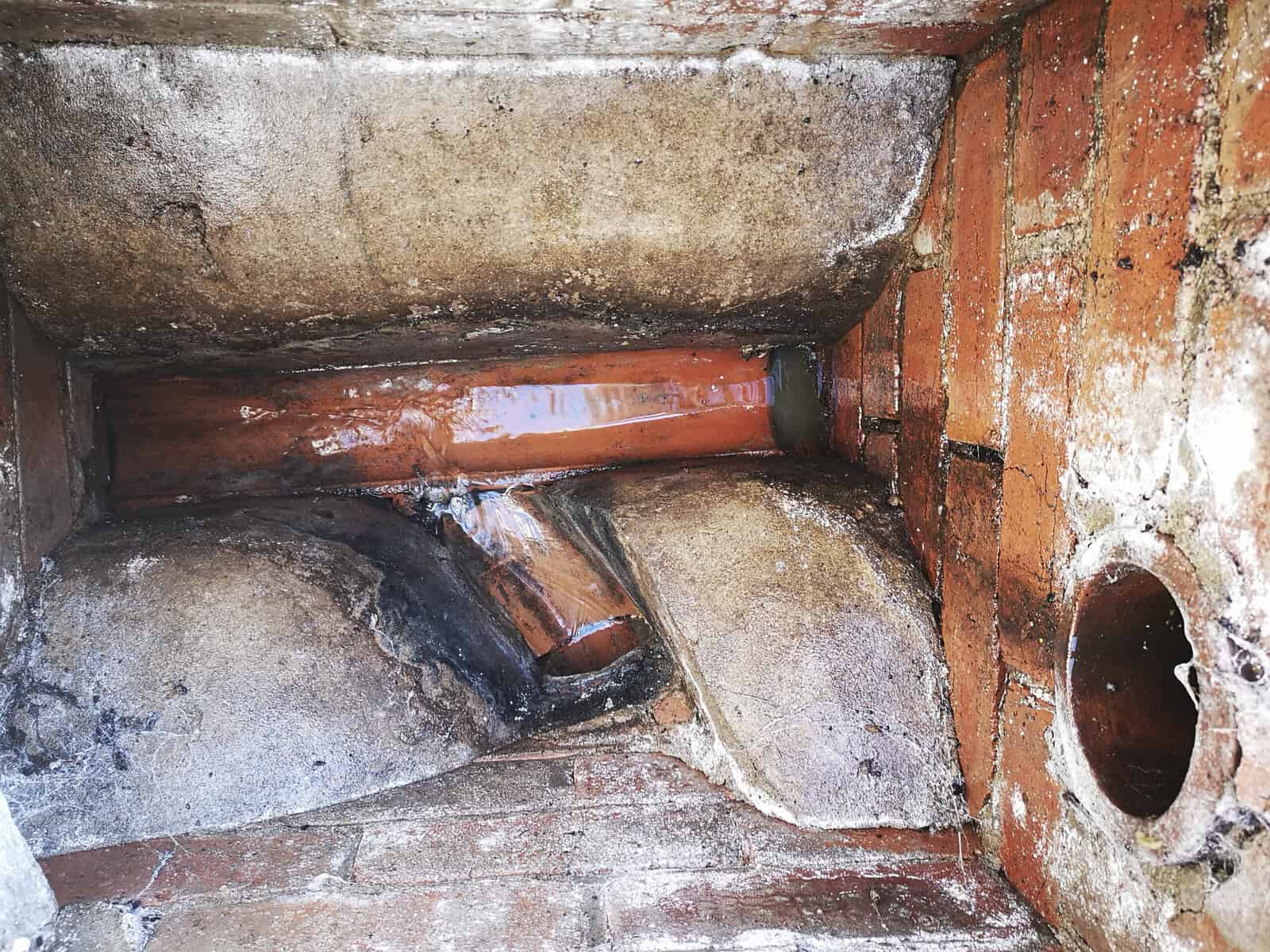
- Survey the manholes on and around the site. Lifting covers and recording invert levels, pipe sizes and flow confirms what is physically there, catches misconnections and reconciles the record against reality. A foul manhole and a surface water manhole running in parallel is the clearest evidence of a separate system; a single chamber taking both is not, on its own, proof of a combined one, because the two can share a chamber and stay hydraulically separate. Where the record and the ground disagree, the ground wins.
Where the sewer record and the manhole survey disagree, design to the survey. The record shows what was adopted, not what was subsequently built.
Misconnections are worth checking for at the same time. Where foul water has been wrongly plumbed into a surface water sewer, the discharge reaching the watercourse is a water discharge activity requiring an environmental permit under regulation 12 of the Environmental Permitting (England and Wales) Regulations 2016, and contravention is an offence enforced by the Environment Agency. The widely quoted figure of roughly one property in twenty being misconnected originates in water industry campaign material rather than an official statistical release, and is better treated as an indication that the problem is common than as a measured rate.
Who owns, adopts and maintains each part
Ownership determines who fixes a failure, who bears the long-term cost, and what a development is expected to hand over. It splits four ways, and the split is not intuitive.
| Part of the network | Responsible body | Adoption route | The point to watch |
|---|---|---|---|
| Public sewers | Water and sewerage companies | Already vested | Building over or near one needs the undertaker's agreement |
| New sewers on a development | Water and sewerage companies, once adopted | Section 104 agreement, to the Design and Construction Guidance | Design to the adoptable standard from the outset, not retrospectively |
| Private drains | The property owner, within the boundary | Not adoptable | Single-curtilage pipework never transferred in 2011 |
| Highway drains | The local highway authority or National Highways | Section 38 or a highway agreement | A highway drain is not a sewer, and cannot be treated as one |
| SuDS components | A management company, the local authority or the developer | Rarely adoptable as sewers | A funded, binding maintenance arrangement is required |
The adoption question is where schemes most often lose time. Most SuDS components cannot be adopted as sewers at all, because they are not pipes conveying flow in the statutory sense, so a separate long-term maintenance arrangement has to be in place before a drainage condition can be discharged. Designing pipework to the adoptable standard late, after the layout is fixed, is materially harder than designing to it from the start, and the standard itself has changed more than most people realise since Sewers for Adoption was withdrawn. The technical rules for what goes in the ground outside the building sit in BS EN 752.
What the sewer type changes for a development
By the time a layout is fixed, the sewer type has already determined several things that are difficult to unwind. Establishing it at feasibility rather than at technical design is the cheapest intervention available on most schemes.
- Discharge point and rate. A combined connection almost always attracts a tighter restriction than a watercourse outfall.
- Storage volume. The tighter the permitted rate, the more attenuation the layout has to hold, and the earlier that space has to be found.
- Treatment. Pollution control stages scale with the sensitivity of whatever receives the discharge.
- Adoption route. Whether the scheme needs a section 104 agreement, a private management arrangement, or both.
- Programme. A capacity constraint found at pre-development enquiry is a design problem; the same constraint found at discharge of conditions is a delay.
Not sure which sewer serves your site?
Unda establishes the sewer position and designs the connection, for foul and surface water, across England and Wales. Quotes are returned within 60 minutes.
Get a drainage strategy quoteFrequently asked questions
Can a property be on a combined system for foul water but separate for surface water?
Yes, and it is common enough to have its own name. A partially separate system takes the foul flow and some surface water, typically the front roof and the highway drainage, into one pipe, while the rest of the surface water runs separately to a soakaway or a watercourse. It is why a single manhole rarely settles the question for a whole site, and why the manhole survey needs to cover more than one chamber.
Does the sewer type change the greenfield runoff rate calculation?
The runoff rate calculation is about what leaves the site, not about what receives it, so the destination does not change the greenfield rate itself. What the destination changes is the permitted discharge rate, and therefore the storage the site has to provide. A combined sewer connection typically attracts a lower permitted rate than a watercourse, which is what pushes the attenuation volume up.
Who pays to upsize a public sewer that has no capacity for a new connection?
The undertaker may not refuse a connection simply because the network is tight; section 106(4) limits refusal to the drain or sewer failing to meet reasonable standards, or being prejudicial to the sewerage system. Reinforcement is generally funded through the infrastructure charging regime rather than billed directly, but the timing is the developer's problem: network reinforcement runs to its own programme, and that programme rarely matches a build programme.
Is a sewer shown on the public record always still there?
Not reliably. The record shows assets vested in the undertaker, and it can lag diversions, abandonments and unrecorded alterations by years. It is also silent on private sewers by definition. That is why the manhole survey sits in the sequence at all. The record establishes what should be present; the survey establishes what is.
What happens if a scheme connects surface water to a foul sewer by mistake?
The immediate consequence is hydraulic rather than legal: the foul sewer fills in rainfall it was never sized for, which raises the risk of surcharge and internal flooding upstream. Section 106(2) makes that connection conditional on the undertaker's approval in any event, so an unapproved connection is also a defect in the adoption position. Correcting it after occupation is far more expensive than avoiding it at design.
Sewer type is cheap to establish and expensive to assume. The public sewer record, a CON29DW, a pre-development enquiry and a manhole survey settle it in a few weeks at feasibility stage, against a redesign that can cost months once a layout is committed. Unda prepares foul and surface water drainage strategies across England and Wales, and can confirm the sewer position and design the connection for your site. Call 01293 214444 or email enquiries@unda.co.uk to discuss a site.
About the author. Edward is a co-founder and Director of Unda with 20+ years in flood risk and drainage, and a national-press commentator on flooding. Unda has been trading since 2014, is a CIWEM Business Partner with CIWEM member and chartered (C.WEM MCIWEM) consultants, and has delivered 5,000+ flood risk assessments and drainage strategies across England and Wales.
Edward Bouët · BSc (Hons)
Latest news




One of our experienced Flood Risk Consultants will get back to you within 60 minutes
