What Is a Surface Water Drain? Where Yours Goes and Who Owns It
Estimated reading time 22 minutes
A surface water drain carries rainwater away from your roof, driveway and garden. It is a separate system from the foul drain that takes waste from your sinks and toilet, and it usually ends in one of three places: a soakaway on your own land, a nearby ditch or stream, or a public surface water sewer under the road. Which of those you have decides who fixes it when it blocks, who pays, and whether you should be paying a drainage charge on your water bill at all.
Most homeowners never think about it until water is standing on the drive. By then the question is rarely about drains at all. It is about where responsibility ends at the edge of your garden.
Around 4.6 million properties in England sit in areas at risk of surface water flooding, roughly 1.1 million of them in the highest risk band — a 43% increase on the previous national assessment.
Those figures come from the Environment Agency's 2024 National Assessment of Flood and Coastal Erosion Risk, published in December 2024 and explained by the Agency here, which also projects the total rising to about 6.1 million properties by the 2040s to 2060s. The Agency attributes most of the increase to better modelling rather than a sudden change in the weather, and the pressure is heaviest in England’s cities. Either way, the drain at the bottom of your downpipe is doing more work than the person who installed it assumed.
What is a surface water drain?
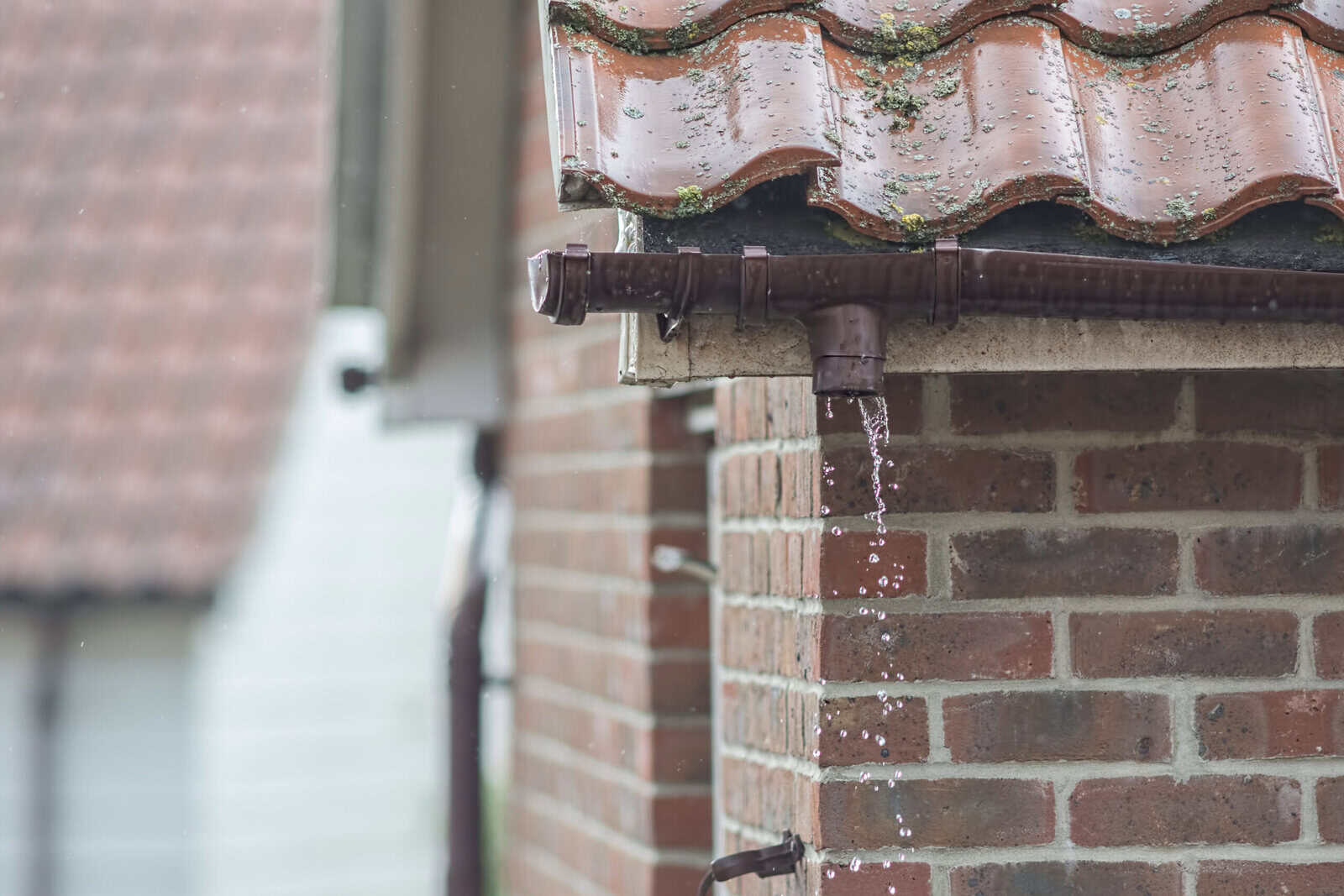
A surface water drain is the pipework that collects rainwater — from roofs, driveways, patios and paved areas — and takes it away from the building. It carries clean rainwater only. The foul drain, which is a different pipe, carries wastewater from kitchens, bathrooms and toilets to treatment. Older properties often have a single combined pipe doing both jobs, which is why heavy rain can back sewage up into a street. Our explainer on foul, surface water and combined sewers sets out the differences in full.
What people call “the drain” is really half a dozen components, each of which fails differently:
- Gutters and downpipes. Collect water off the roof and drop it to ground level. When they block, water runs down the wall instead, and that is where damp and pointing problems start.
- Gullies. The grated openings at the foot of a downpipe or at the low point of a drive. They trap leaves and silt deliberately, which is why they need clearing rather than ignoring.
- Channel drains. The long grated channels, often called ACO drains, set across a driveway or garage threshold to intercept runoff before it reaches the door.
- The underground drain. The buried pipe running from your gullies towards wherever the water finally goes.
- Soakaways. A buried chamber of rubble or plastic crates that lets water infiltrate into the ground instead of leaving your land at all.
- French drains. A gravel-filled trench with a perforated pipe inside, used to intercept water moving through the ground and redirect it away from a wall or a waterlogged patch of lawn.
Surface drainage at a house is really two jobs, and only the last two components do the second one. Gutters, gullies and channel drains collect the water and move it along; soakaways and French drains actually dispose of it. If the disposal end is not working, no amount of gutter clearing will help. Most drainage advice skips that distinction.
Where does your surface water actually go?
Rainwater from a house has three legitimate destinations, and building regulations set a firm order of preference between them. Approved Document H, the 2015 edition of the building regulations guidance on drainage, requires rainwater to go to a soakaway or other infiltration system first; to a watercourse only where infiltration is not reasonably practicable; and to a sewer only where a watercourse is not reasonably practicable either. Even where a sewer connection is the answer, it is a Section 106 connection to be applied for, not a given.
Into the ground on your own land
To a watercourse
To a public surface water sewer
To a combined sewer
The same hierarchy runs through the government's National Standards for Sustainable Drainage Systems, which we unpack in our guide to the 2025 national SuDS standards, and it is the logic behind every modern surface water drainage strategy for planning Unda produces. For a homeowner it matters for a plainer reason: the destination determines who is responsible for the pipe. Our explainer on the SuDS hierarchy covers how the same order applies to new development.
How to work out which system your house is on
Nobody hands you a drainage plan when you buy a house, the deeds almost never say, and the previous owner has usually forgotten, but you can generally settle the question in an afternoon with a hose and a lifted cover:
- Lift the gully cover at the foot of a downpipe. Run a hose into the gutter and watch. If the water disappears with a hollow, unrestricted fall, you are on a piped system. If it swirls and backs up slightly, you may be looking at a soakaway that is already near capacity.
- Look for an inspection chamber. Round or square covers in the garden and drive mark the line of the drain. Two separate runs converging suggests separate foul and surface water systems; a single run to one chamber suggests a combined system.
- Follow the fall. Chambers on a line heading towards the road usually mean a connection to a public sewer. Chambers heading away from the road, towards the garden, usually mean a soakaway.
- Check your water bill. A surface water drainage charge is your water company's assertion that your rainwater reaches its network. If you can see it draining to a soakaway instead, that charge is worth challenging.
- Order a drainage and water search. A CON29DW report shows the public sewer records for the property, including whether it is recorded as connected for surface water. It is the closest thing to a definitive answer without excavating.
If the ground beneath the property is clay, a soakaway may never have worked properly, and a soakaway that has never worked is the commonest hidden cause of a garden that floods every winter.
Unda's free geology and ground conditions checker gives a postcode-level read on whether your ground is suited to infiltration at all, and the BRE 365 infiltration rate calculator turns a simple soakage test into the design infiltration rate a proper resizing needs. If you want the underlying method, our guide to BRE 365 infiltration testing and soakaway design explains it.
Who is responsible for a surface water drain?
Responsibility follows the pipe across your boundary. Everything within the curtilage of your property — the garden, drive and the buildings on it — is a drain and belongs to you. The moment the pipe crosses the boundary on its way to the public sewer it becomes a lateral drain, and since 2011 that is the water company's. The public sewer itself has always been theirs. These are not informal conventions: they are the definitions in section 219 of the Water Industry Act 1991.
The change most homeowners have never heard of took effect on 1 October 2011, when the Water Industry (Schemes for Adoption of Private Sewers) Regulations 2011 transferred private sewers serving more than one property, and lateral drains beyond the boundary, into water company ownership. What it did not transfer is just as important: drains wholly inside your own boundary stayed yours, and so did soakaways, septic tanks and private treatment plants. A soakaway has never been anybody's responsibility but the owner's.
| The asset | Whose it is | Where the rule comes from |
|---|---|---|
| Gutters, downpipes, gullies and channel drains | You | Private fixtures on your building and land |
| The underground drain inside your boundary | You | Defined as a “drain” by section 219, Water Industry Act 1991 |
| Your soakaway, French drain or rain garden | You | Explicitly excluded from the 2011 private sewer transfer |
| The lateral drain beyond your boundary | Your water company | Transferred on 1 October 2011 under SI 2011/1566 |
| The public surface water sewer | Your water company | Vested in the sewerage undertaker, Water Industry Act 1991 |
| Road gullies and highway drains | Your highway authority | Duty to “scour, cleanse and keep open” drains in the highway, Highways Act 1980 s.100 |
| A ditch or ordinary watercourse on your land | You, as riparian owner | Environment Agency riparian owner guidance; Land Drainage Act 1991 |
Two consequences follow that catch people out. First, if the blockage is under the pavement rather than under your lawn, it is your water company’s problem and their cost, so call them before you call a drainage contractor. Second, a blocked road gully outside your gate is the county or unitary council's, not the water company's, because section 100 of the Highways Act 1980 puts a duty on the highway authority to scour, cleanse and keep open drains situated in the highway. Reporting it through your local council is usually faster than fixing your own drive.
The single most expensive mistake a homeowner makes is paying a contractor to excavate a drain that turned out to belong to the water company on the other side of the fence.
Above all of this sits the Lead Local Flood Authority, the county or unitary council with the statutory lead on local flooding from surface water, groundwater and ordinary watercourses. Under section 19 of the Flood and Water Management Act 2010 it must investigate floods in its area to the extent it considers necessary, and publish what it finds; section 21 also requires it to keep a public register of structures that significantly affect local flood risk. Our explainers on what a Lead Local Flood Authority does and who is responsible for managing flood risk in England map the wider picture. If a ditch takes your rainwater, the Environment Agency's guidance for a riparian owner applies to you, and altering or culverting it needs consent under section 23 of the Land Drainage Act 1991. Our guides to riparian ownership and ordinary watercourse consent set out what that involves.
Why surface water drains block and flood
Almost every domestic surface water failure comes down to one of six causes, and only two of them are actually a blockage, which is why a contractor booked before the diagnosis is made so often turns up, clears a gully and leaves the real fault untouched. Work out which you have first. It saves the money and the second visit.
- Leaves and silt at the gully. The commonest by a distance, and the easiest to fix. A gully is designed to catch debris; if nobody empties it, it stops catching and starts blocking.
- Lost fall in the gutter. If water still overflows after you have cleared the gutter, the slope towards the downpipe has usually gone, often after the gutter was refixed or resecured. That is a bracket problem, not a blockage.
- Root ingress and cracked pipework. Roots find the joints in older clay pipes. The symptoms are slow drainage that returns within weeks of every clearance, and this needs a CCTV drainage survey rather than another attempt with rods.
- A silted or undersized soakaway. A working soakaway should clear standing water within about a day of the rain stopping. If it does not, the chamber has silted up, was never sized for the roof and paving draining to it, or sits in ground that cannot take the water.
- Saturated ground. After a long wet spell the water table rises and infiltration effectively stops. Nothing is broken; the system has simply run out of somewhere to put the water.
- A misconnection. Foul waste plumbed into a surface water drain by mistake — a washing machine or a sink is the usual culprit. Defra has estimated that between 150,000 and 500,000 UK households are affected, a figure water companies and CIWEM both cite. It is also the reason an outside drain can smell foul without being blocked at all.
The scale of the downstream problem is worth knowing. Across England and Wales in the year to March 2025, water companies reported 4,808 incidents of sewage flooding inside properties and 50,281 incidents of gardens and private land being flooded, according to the industry's Discover Water reporting. A domestic surface water drain that is wrongly connected, or that pushes clean rainwater into an already overloaded combined system, contributes to both. If you want the mechanism in full, see our explainers on sewer flooding and pluvial, or surface water, flooding.
A drain that smells but drains freely is almost never blocked. It is usually a dry trap, a displaced gully grate, or foul waste connected to a pipe that was only ever meant to carry rain.
How to maintain a surface water drain
Maintenance is the cheapest flood mitigation available to a homeowner. Two hours a year covers it. The schedule below is the one Unda gives clients who ask what “keeping on top of it” actually means.
| What to check | How often | What you are looking for |
|---|---|---|
| Gutters and downpipes | Twice a year, autumn and spring | Leaves, moss and silt at outlets and corners; cracked or sagging sections |
| Gully and drain grates | Weekly through autumn | Leaf build-up; standing water above the grate after rain |
| Soakaways | After every heavy rain event | Standing water still present more than a day after the rain stopped |
| Channel and driveway drains | Alongside the gutters | Debris in the grate; pooling immediately beside the channel |
| Falls on drives and patios | After any resurfacing work | Water running away from the drain rather than towards it |
Two habits do most of the work. Flush the gutters with a hose after clearing them and confirm the water reaches the downpipe rather than assuming it. And keep the wrong things out: fats, detergents, cement, paint and swept-up garden waste all belong somewhere other than a surface water drain, because unlike a foul drain it discharges to a watercourse or a soakaway with nothing in between to treat it. Chemical drain cleaners are a particularly poor idea near a soakaway or permeable paving, where they kill the biological activity the system depends on.
A soakaway should clear standing water within about 24 hours of the rain stopping. If yours holds water for days, the problem is capacity, not debris.
How to clear a blocked surface water drain
Most blocked drains warn you first: slow drainage, a gurgle from the gully, or water lying on the drive after rain that used to disappear. Caught at that stage, the majority are a job for an afternoon rather than a contractor.
- Clear the grate before anything else. Lift it and take out the leaves, silt and grit by hand. This alone resolves a large share of what get reported as blocked drains.
- For slow drainage, try washing-up liquid and hot water. Add the detergent, wait a few minutes, then follow with hot water. Avoid boiling water on plastic pipework, where it can distort the joints.
- Use a plunger or drain rods for a genuine blockage. A plunger works on a shallow gully. Rods should be pushed and turned rather than forced, and will usually shift a blockage within the first metre or two.
- Check the chamber on the boundary side. If the chamber nearest your boundary is full but the one closer to the house is clear, the obstruction is downstream of you. That is your water company's to fix, at their cost.
- Stop when rodding stops working. If the blockage will not shift within a few metres, or the slow drainage returns within weeks, the fault is structural: a cracked pipe, root ingress or a collapse. That needs a CCTV survey, not another attempt with a hose.
Anything involving standing sewage, a suspected collapse, or repeated flooding of the house itself is past the point of DIY. Our guides on preparing for a flood and cleaning up afterwards cover what to do when water has already reached the building, and our guide to property flood resilience covers the measures that limit the damage next time.
When the problem is the design, not the drain
There is a point at which maintenance stops being the answer. If a property floods repeatedly despite clean gutters, clear gullies and a drain rodded within the last year, the system is doing exactly what it was designed to do. The design no longer matches the site.
Surface water flooding happens when there is so much rainwater that it overwhelms drainage systems.
Julie Foley · Director of Flood Risk Strategy and Adaptation, Environment Agency
Three things push a system past its design. The first is more hard surface: every extension, patio and paved-over front garden sends water that once soaked into lawn straight to the gully instead. In England, laying more than five square metres of impermeable surfacing on a front garden needs planning permission unless the water is directed to a permeable area, as the Planning Portal sets out. We cover that rule in our pieces on permeable paving and why paved gardens weaken urban flood resilience. The second is rainfall itself, which is arriving in shorter, heavier bursts than the pipe sizes of forty years ago assumed; our article on how increasing rainfall is changing UK flood risk covers the trend. The third is a soakaway that was undersized from the day it went in.
Maintenance keeps an existing system working. It cannot fix a system that was never sized for the water it now has to handle.
The fix in that case is a better design rather than another repair: resizing the soakaway against a real infiltration rate, replacing impermeable paving with a permeable build-up, adding a rain garden or water butts to slow the flow, or splitting the roof between two outfalls. These are the same principles that govern development-scale schemes. Our explainers on the four pillars of SuDS, source control at plot level and rainwater harvesting in SuDS design set out the reasoning. Unda's free drainage calculators will size most of them. You can also check what the national mapping says about your own address on Unda's flood risk map, or against the Environment Agency's own long term flood risk service.
Can you stop paying the surface water drainage charge?
If no surface water from your property reaches a public sewer, you can apply to your water company to have the surface water drainage element removed from your bill. Ofwat, the industry regulator, confirms the principle and notes that a refund may be due where the company knew, or should have known, that the property was not connected.
The eligibility test is strict and the same across companies: all of the rainwater from your roof and hard surfaces must go somewhere other than the public sewer — typically a soakaway, a watercourse or an infiltration system. A water butt does not count, because the overflow still has to go somewhere.
- You apply once. Most companies then apply the reduction automatically each year without a fresh application.
- You will need evidence. Usually a plan or sketch of the property showing where each downpipe and gully discharges to.
- Backdating is possible. Yorkshire Water, for example, backdates successful applications by up to six financial years, or to the date you became responsible for the bill, whichever is later.
- Flats and shared connections rarely qualify. If the block drains to a shared connection into the public sewer, the exemption will not apply.
- Highway drainage is charged separately. Some companies levy it as its own line, and it is not removed by a successful surface water application.
It is a small annual sum, but it is also a useful diagnostic. If your water company believes your rainwater goes to its sewer and you can see it going to a soakaway, one of you is wrong, and finding out which is worth doing before the next wet winter rather than after it.
Not sure where your surface water goes?
Our experienced consultants assess domestic and commercial drainage across England and Wales, from a failing soakaway to a full drainage strategy for planning. Free appraisal, and a quote back within 60 minutes.
Start a quoteFrequently asked questions
What is the difference between a soakaway and a French drain?
A soakaway is a destination and a French drain is a route. A soakaway is a buried chamber sized to hold a volume of water and release it into the surrounding soil, so it is where the water finally goes. A French drain is a gravel trench with a perforated pipe that intercepts water moving through the ground and carries it somewhere else — often to a soakaway. A French drain with nowhere to discharge to simply moves the problem a few metres.
Can a blocked drain or a failed soakaway cause damp or subsidence?
Both are possible. Water running down an external wall from an overflowing gutter is a common cause of penetrating damp and of decayed pointing. Repeated saturation of the ground close to a foundation can also contribute to movement, particularly on shrinkable clay where wetting and drying cycles cause the soil to swell and shrink. Neither is inevitable, but a soakaway discharging within a few metres of a foundation is worth taking seriously.
Is maintaining a surface water drain a legal requirement?
There is no statute requiring a homeowner to clear their gutters. But responsibility for the consequences sits with the owner of the asset, so if a neglected private drain floods a neighbour or discharges polluted water to a watercourse, that is your liability. Where a ditch or ordinary watercourse crosses your land the position is firmer: as riparian owner you must let water flow freely and keep the channel clear of obstructions.
Do I need permission to install or replace a soakaway?
Replacing a like-for-like soakaway serving an existing house does not usually need planning permission, but drainage work forming part of an extension or a new building is covered by the building regulations and needs building control sign-off. A soakaway serving a new or altered building should be designed against a measured infiltration rate and positioned clear of foundations. A soakaway taking foul effluent is an entirely different matter and is separately regulated.
Does buildings insurance cover damage from a blocked surface water drain?
Policies vary, and the distinction insurers draw is between sudden accidental damage and gradual deterioration. Escape of water from a suddenly collapsed drain is often covered; damage traced to years of unmaintained guttering frequently is not, on the basis that it was foreseeable and preventable. Keeping dated evidence of maintenance is a practical safeguard. Check the wording of your own policy rather than relying on the general position.
What happens if my surface water drain is wrongly connected to the foul sewer?
A misconnection is the property owner's to correct, even where a previous owner or a builder created it. Rainwater going into a foul sewer adds to the volume that causes storm overflows to spill; foul waste going into a surface water drain discharges untreated to a watercourse. Water companies, local authorities and the Environment Agency all have enforcement roles, but in practice the route is voluntary correction first. The industry's ConnectRight campaign explains how to check your own connections.
If a drainage problem has moved past maintenance — a soakaway that will not clear, a driveway that floods every storm, or a planning condition that needs a drainage design behind it, Unda's consultants work on domestic and development sites across England and Wales. Start with our drainage strategy services or, where the question is flood risk rather than drainage, our flood risk assessment service. Or get in touch to talk it through.
About the author. Charlotte is Unda’s Marketing Manager, and is completing an MSc in Marketing at the London School of Economics. Unda has been trading since 2014, is a CIWEM Business Partner with CIWEM member and chartered (C.WEM MCIWEM) consultants, and has delivered 5,000+ flood risk assessments and drainage strategies across England and Wales.
Charlotte Stone · BSc (Hons)
Latest news



One of our experienced Flood Risk Consultants will get back to you within 60 minutes