Clydach Terrace, Ynysybwl: How 14 Flood-Prone Homes Fell Outside the Flood Defence System
Estimated reading time 12 minutes
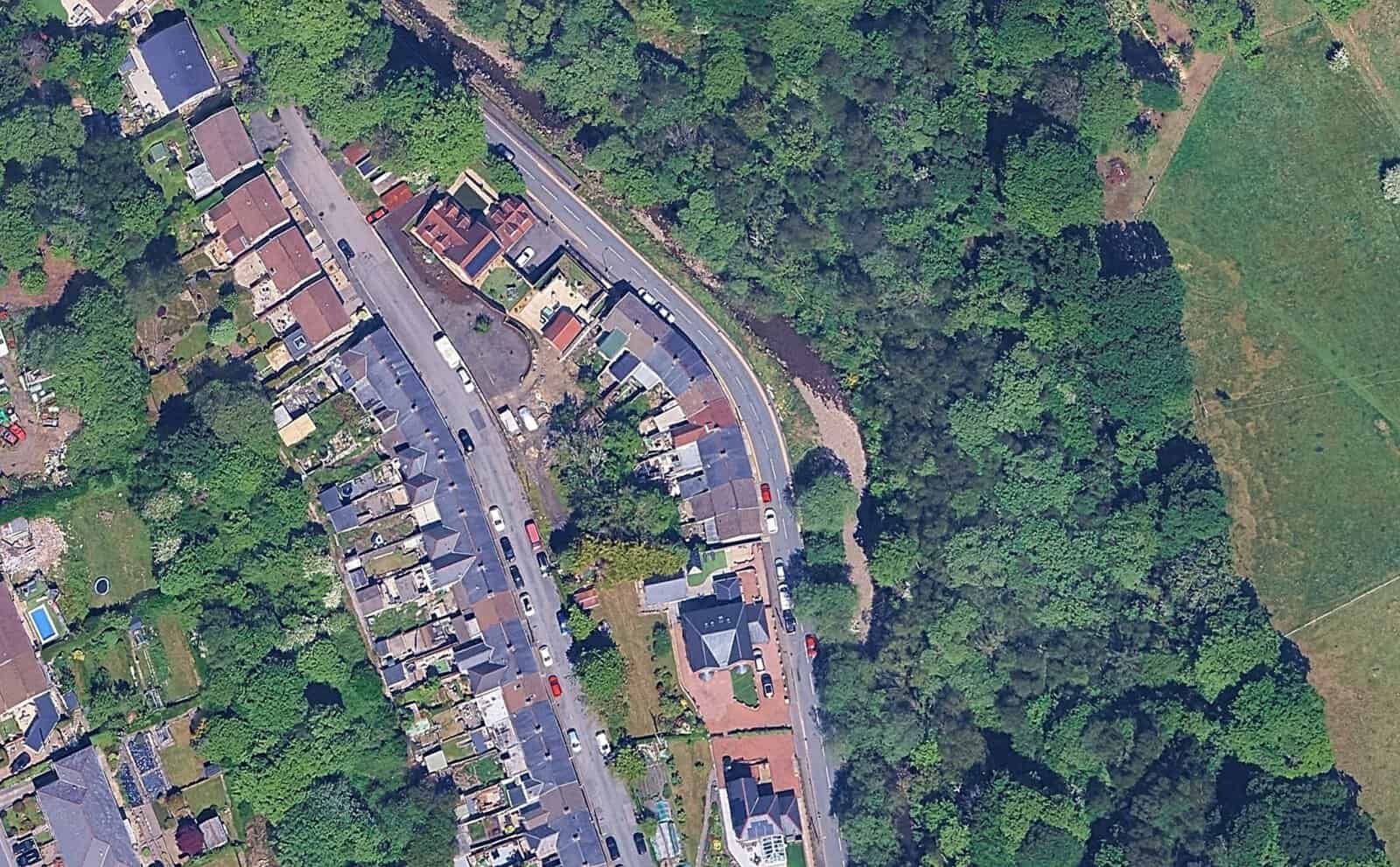
Clydach Terrace in Ynysybwl, Rhondda Cynon Taf, is a row of terraced homes on the valley floor beside the Nant Clydach. On 2nd February 2026 the council's cabinet agreed to buy 14 of them for about £2.57 million, demolish them and turn the site into public space, after Natural Resources Wales had found that no flood defence scheme met the funding rules. The homes flooded to a depth of almost two metres inside in Storm Dennis in February 2020, and flooded again in Storm Bert in November 2024.
Publicly, the decision has been framed as exceptional, a necessary response to worsening flood risk and climate change. The documents behind it say more. Clydach Terrace is an inland case of managed retreat, and nobody chose it as policy. Retreat was reached indirectly, once the flood risk management system had exhausted its own rules.
The council bought the homes using a general power that lets it do anything an individual may do, outside the flood defence funding system altogether.
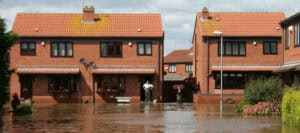
Flood-prone homes at Clydach Terrace
Clydach Terrace sits in a narrow, constrained valley in south Wales, where the Nant Clydach runs immediately alongside a row of terraced houses built on the natural floodplain. The valley leaves little room for floodwater to spread out during intense rainfall, so the risk is concentrated directly against the properties. This is fluvial flooding at its most dangerous. It is fast, deep and right against the front doors.
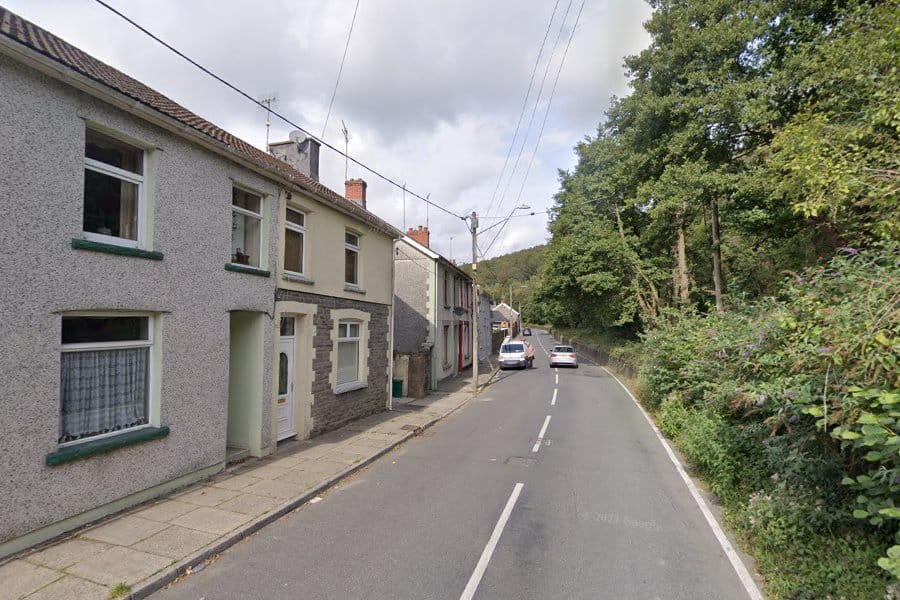
Clydach Terrace flooding has a long history, but Storm Dennis in 2020 exposed the full severity of the hazard. The Natural Resources Wales project brief describes flooding that was "extreme", with "rapid onset" and "internal property flood depths above 6ft at the lowest lying houses". Post-event surveys quantified this further, recording a "Storm Dennis Observed Depth – 1.96m". Storm Bert flooded the terrace again in November 2024, though less severely.
NRW is not neutral about this. The project brief states that these observations "serve to illustrate the significant danger posed by the flooding during Storm Dennis". The risk is framed in terms of safety and danger to life, not simply property damage.
The same document confirms that the danger has not gone away. "Without any flood changes to risk management," NRW concludes, "Clydach Terrace will remain at high risk of flooding". The problem was well understood, formally evidenced and accepted within the flood risk system.
Depth, speed of onset and hazard to life are also the evidence a flood consequence assessment has to deal with when a planning application in Wales sits on land like this. The council's decision covers 14 properties on the terrace, and its announcement describes the residents' position as a danger-to-life scenario.
No national route for inland relocation
Neither England nor Wales has a process or a fund for moving homes away from river flooding. Inland flood risk is managed through appraisal processes built around standards of protection, economic efficiency and long-term maintenance, and Clydach Terrace was assessed within that system. A floodplain community that no scheme can protect has no decision pathway of its own.
England has gone furthest on paper. The National Planning Policy Framework published on 17th August 2026 names relocation in its new flood risk chapter:
Where climate change is expected to increase flood risk so that some existing development may not be sustainable in the long-term, seeking opportunities to relocate development, including housing, to more sustainable locations.
National Planning Policy Framework (August 2026), Policy F2(1)(d)
That is plan-making policy. It lets councils identify places that may need to move, but it provides no money and no procedure for buying homes. And it does not apply in Wales.
In Wales, flood policy for planning sits in Planning Policy Wales and TAN15, reissued in 2025. The 2025 advice note accepts that managed coastal realignment and floodplain restoration can apply "in areas where existing development cannot be sustained in the face of increasing flood risk", but it sets out no route for relocating an existing community. The Welsh Government's national flood strategy of 2020 refers to "recognising the need to move out of harm's way", again without a mechanism or funding. On the coast, owners at least have a policy framework to argue about, although compensation for homes lost to erosion remains minimal.
What flood risk management identified
As the statutory flood risk management authority, Natural Resources Wales controls whether major flood defence schemes can progress to delivery. Its project brief for Ynysybwl shows that a wide range of options was considered at Clydach Terrace.
- Raise or improve the wall. Raising the existing wall to a 2% annual probability standard, or improving it to 1%.
- Maintain what is there. Channel maintenance, upkeep of the existing wall and blockage removal.
- Work upstream. Natural flood management alongside maintenance of the wall.
- Store or pass more water. Offline flood storage, or removing a downstream culvert.
- Warn and adapt. A flood warning system and property flood resilience for each home.
- Remove people and property. Taking the homes out of the highest-risk area altogether.
Ten options, walking away included, is a long list. What ruled them out was the way each one was judged. In June 2025 NRW announced that it would not proceed with a major scheme at Ynysybwl, because neither the flood wall nor buying the homes was economically viable under UK and Welsh Government funding rules, and property purchase would not qualify for Welsh Government funding.
When flood defences fail the viability test
In NRW's appraisal framework, options are assessed against Critical Success Factors (CSFs), the criteria used to decide whether a flood risk management scheme is allowed to progress through the business case process. An option must meet all CSFs to remain viable; failure on any single criterion rules it out entirely.
One of the Critical Success Factors is a benefit-cost ratio above one. A scheme that fails it is ruled out, however serious the danger to life.
Economic performance is central to this assessment. A viable option must be "an economically viable option to manage flood risk, with a Benefit Cost Ratio (BCR), a standard Green Book measure comparing scheme benefits to costs, greater than one". The threshold is explicit and absolute. As the project brief explains, "An option will not be considered viable if it can meet only some or only partially meet a CSF."
In practice this logic narrows the field quickly, and in the options appraisal tables conclusions are often reduced to a single line: "This does not meet the CSFs."
Raised flood defences were explored, but when the council later summarised NRW's findings it recorded that a raised flood wall was "not an economically viable option under the UK and Welsh Government funding rules for flood risk management purposes". The danger remained. The flood defence system could not justify progressing a scheme. England runs a comparable test: the 2026 FCERM funding rules rank schemes by the benefit they return for each pound of government money. The Welsh rules differ in detail, but a few homes in a deep, fast-flowing floodplain can fail either test.
Why the council bought flood-prone homes instead
The risk at Clydach Terrace did not disappear when flood defence options stalled. The problem moved institutions.
The council accepted NRW's conclusions and acted in a different legal capacity, using powers that sit outside the flood risk management funding system. By the time the issue reached cabinet, the language had changed completely. The report refers to "the significant risk to health presented and danger to life at this locality" and acknowledges that "there is no viable proposal available to protect their homes".
Rather than attempting to reopen the flood defence case, the council relied on its general power of competence. The report notes that the authority "has a statutory general power of competence", allowing it "to do anything that individuals generally may do". This is a broad enabling power, not one specific to flood risk, and the report explicitly links its use to flooding and climate impacts. It states that the power would include "protecting communities against the threat of climate change and from a high risk of flooding, through the purchasing of property".
The practical outcome takes a single line: the council would "demolish the properties thereby removing an ongoing flooding threat to residents".
The decision record puts the cost at about £2.57 million, including incidental costs, relocation assistance and legal fees, funded from the council's flood management and wider capital programme. Once bought, the homes will be demolished and the remaining land made good as public realm.
Clydach Terrace works out at roughly £184,000 per home, including fees and help with relocation.
- February 2020, Storm Dennis. Homes flood internally to 1.96 m, with rapid onset and danger to life.
- NRW appraisal. Ten options are tested against the Critical Success Factors, including a benefit-cost ratio above one.
- November 2024, Storm Bert. The terrace floods again, less severely.
- June 2025, no scheme. NRW finds no economically viable option, and buying the homes would not qualify for Welsh Government funding.
- 2nd February 2026, cabinet decision. The council uses its general power of competence to buy 14 homes.
- Clearance. The homes are to be demolished and the land turned into public space.
This is managed retreat in effect, even if it is never labelled as such.
What happens to the residents and the land
The residents are being bought out, with help to relocate, and the terrace will be cleared rather than rebuilt. Repeated flooding had left the homes effectively uninsurable, and Herald.Wales reported that the council hoped residents would move out by around September or October 2026, before the winter weather.
Compensation is harder. One resident told Herald.Wales that the purchase price was not enough to buy an equivalent home and that he might have to leave the village. That is one resident's view rather than a finding, but it matches a wider pattern. Flood risk affects house prices, and a home with a record of internal flooding is worth less than a similar one on higher ground. Flood Re keeps insurance available for many older homes, but it cannot make a home safe, and it cannot restore the value lost to repeated flooding.
For anyone buying in a valley like this, the flood history matters as much as the flood map. A flood risk survey before buying a house checks the recorded flooding, the condition and standard of any defences, and the policy position for the area before contracts are exchanged.
Managed retreat by default, not by design
Large-scale public buyouts of flood-prone homes are not unknown in the UK, but they are overwhelmingly associated with coastal erosion, where specific policy mechanisms exist to support them and shoreline management plans at least set out which frontages will be defended. Inland fluvial flooding has nothing similar.
Clydach Terrace looks exceptional because the system offers so few ways to resolve a case like it. Retreat emerges only once flood risk management rules have been exhausted and local government intervenes using powers never designed as a substitute for national flood policy.
Retreat should not be the default response to flood risk. But when existing systems cannot accommodate an extreme case, this is how it happens: late, after years of exposure, once engineering solutions have failed economic tests and the human consequences can no longer be set aside. Nothing about it was early or strategic.
No document ever states that Clydach Terrace should be abandoned. Instead, the decision emerges incrementally: through appraisal thresholds, stalled business cases and, finally, a council stepping in to remove people from harm.
The evidence that justified clearance here would also weigh against new homes on similar ground nearby. Wherever development is proposed on a valley floor, residual flood risk behind an ageing wall has to be tested against current flows, not the standard the wall was built to. In England that is the job of a flood risk assessment for planning; in Wales, of a flood consequence assessment under TAN15.
Other inland floodplain communities will face the same choice. The question Clydach Terrace leaves is whether they too will have to wait until managed retreat is the only option left.
Frequently asked questions
Why weren't all 16 house numbers on Clydach Terrace bought?
The decision covers numbers 1 to 16 excluding 6a and 6b, which makes 14 properties. The council said 6a and 6b stand higher than the rest of the terrace and are not at significant risk of flooding, so they were left out of the purchase.
Can the land at Clydach Terrace be built on again?
The council's plan is to demolish the homes and make good the remaining land as public realm, not to redevelop it. Any future proposal for new homes on the site would need a flood consequence assessment under TAN15, and the recorded internal depths of almost two metres would count heavily against it.
About the author. Jackie is a co-founder and Director of Unda with 30+ years in flood risk, and sits on CIWEM's South Eastern Branch committee. Unda has been trading since 2014, is a CIWEM Business Partner with CIWEM member and chartered (C.WEM MCIWEM) consultants, and has delivered 5,000+ flood risk assessments and drainage strategies across England and Wales.
Jackie Stone · MSci, BSc (Hons), DIC, CIWEM Environmental Partner
Latest news



One of our experienced Flood Risk Consultants will get back to you within 60 minutes
