What Is a French Drain? How It Works and When It Isn’t Enough
Estimated reading time 17 minutes
A French drain is a gravel-filled trench, usually with a perforated pipe in the bottom, that collects water from the surrounding ground and carries it away by gravity. It is one of the simplest fixes for a waterlogged lawn, a wet patio edge or water running towards a wall. What it does not do is make water disappear. A French drain moves water from one place to another, and where that water ends up decides whether the drain works, whether it is lawful and whether it moves the problem next door.
Garden drainage is mostly common sense and a spade. An extension or new build is different: the drainage then has to be proved to the council, usually in a surface water drainage strategy for planning, and a trench of stone does not prove anything on its own.
A French drain moves water. It does not make water disappear, and it is not a soakaway.
What is a French drain?
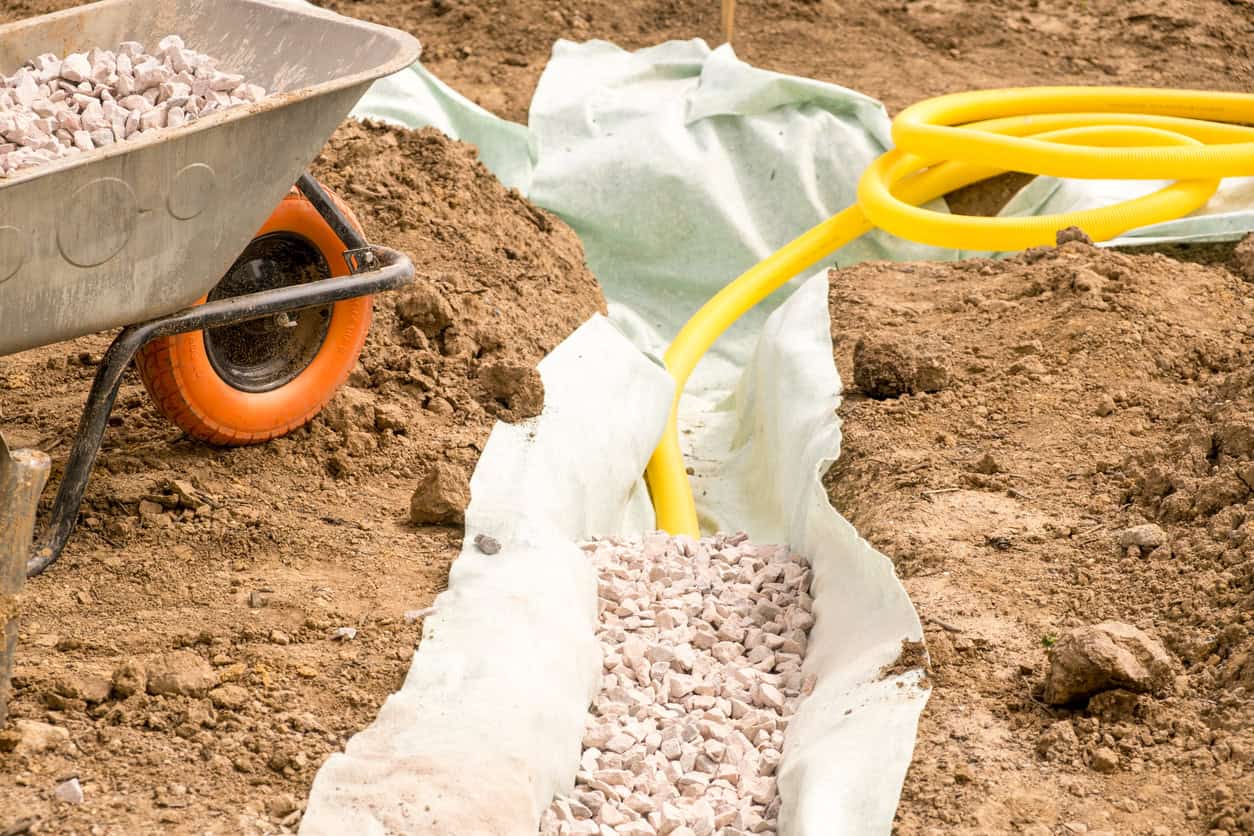
A French drain is a trench backfilled with clean stone, usually wrapped in a geotextile membrane and often laid around a perforated pipe. Water in the surrounding soil seeps sideways into the stone, where it moves far more freely than through soil, and the pipe takes it along a gentle fall to an outlet. A drain built without a pipe is called a pipeless, stone-only or rubble drain.
The name has nothing to do with France. It comes from Henry Flagg French, a New England lawyer and judge who described the technique in his book Farm Drainage, published in 1859. He drained farmland with trenches and lines of clay tiles laid with small gaps for water to enter. Perforated plastic pipe has since replaced the tiles, and a geotextile now does the job once done by stone graded from coarse in the middle to fine at the edges. His son, Daniel Chester French, sculpted the seated Abraham Lincoln in the Lincoln Memorial.
How does a French drain work?
Water takes the easiest route. Clean stone has far more open space between its particles than soil does, so water in the ground around the trench drains into it, collects at the base and flows along the pipe towards the outlet. The trench only keeps working if its base falls continuously towards that outlet and the stone stays free of silt.
Most domestic French drains fall within a fairly narrow range. The figures below are typical, not a design: the ground, the amount of water and the outlet all change them. The land drain and French drain calculator works out pipe, stone and membrane quantities for a given trench, and the drainage fall calculator checks the gradient.
- Trench. Usually 150 to 450mm wide and 450 to 900mm deep, at the deeper end where the aim is to intercept groundwater rather than surface wetness.
- Stone. Clean, single-size stone, commonly 20 to 40mm, with no fines that could fill the gaps between the stones.
- Membrane. A non-woven geotextile lines the trench and folds over the top of the stone, letting water in while keeping soil out. It is the main defence against silting.
- Pipe. A perforated pipe, typically 80 to 160mm in diameter, on a bed of stone at the base of the trench, with rodding eyes or an inspection chamber at changes of direction so it can be cleaned.
- Fall. A continuous gradient, typically between 1 in 100 and 1 in 200, so water runs towards the outlet and never sits in a dip.
- Cover. Topsoil and turf, or a gravel finish where surface water also needs to get in from above.
French drain, soakaway, land drain or filter drain?
These terms overlap, and merchants, contractors and guidance documents all use them loosely. The useful distinction is what each one does with the water. A French drain and a land drain collect water and move it somewhere else. A soakaway stores water and lets it soak into the ground. A filter drain is the sustainable drainage term for a stone-filled trench that collects, filters and conveys surface runoff.
| Feature | What it does | Where the water goes | Typical use |
|---|---|---|---|
| French drain | Collects water from the surrounding ground and conveys it | To an outlet: soakaway, ditch, watercourse or sewer | Gardens, patios, beside walls, behind retaining walls |
| Land drain (field drain) | A perforated pipe network that lowers the water table across an area | To a ditch or watercourse | Farmland, sports pitches, large lawns |
| Soakaway | Stores water underground and lets it infiltrate | Into the ground | Roof and paved-area runoff on permeable ground |
| Filter drain | A stone trench that intercepts, filters and conveys surface runoff | Along the trench to the next drainage component or an outfall | Road edges, car parks, new development |
| Infiltration trench | A stone trench with no pipe outlet that lets water soak in along its length | Into the ground | Permeable ground with room for a long trench |
In practice a French drain often feeds a soakaway: the trench gathers the water and a pit or crate at its end lets it soak away. That arrangement only works where the ground is permeable enough, which is what a BRE 365 infiltration test measures. Land drains are the agricultural relatives, and finding old ones on a building plot raises its own questions, covered in land drains on a development site. Filter drains are a recognised component in CIRIA's SuDS Manual (C753), and water companies set their own design rules for the ones they adopt: United Utilities' filter drain guidance, for example, requires a longitudinal slope of between 1 in 50 and 1 in 400.
Where does a French drain help?
A French drain helps wherever water is moving through the ground towards somewhere it is not wanted, and there is somewhere lower for it to go. It works best on ground that drains reasonably well, on sites with a natural fall, and where the water is arriving from the side rather than falling straight onto a hard surface.
- Waterlogged lawns. A herringbone of narrow drains feeding a main run can take standing water off a lawn, provided there is an outlet lower than the lawn.
- Water against a wall. A drain alongside a wall collects groundwater before it reaches the masonry, keeping the ground next to the building drier.
- Retaining walls. Stone and a pipe behind a retaining wall relieve the water pressure that would otherwise push against it.
- The foot of a slope. A drain laid across the slope, often called a curtain or interceptor drain, catches water seeping downhill before it reaches a patio, path or building.
- Paved edges. A gravel-topped drain along the edge of a patio or drive can collect runoff, as long as the water still has a lawful outlet.
Where doesn't a French drain work?
A French drain fails where water cannot get into it, cannot get out of it, or keeps arriving faster than it can leave. Heavy clay, a high water table, flat ground and the lack of any outlet are the four common causes. In each case the trench fills and holds water, and the ground around it can end up wetter than before.
On clay, a French drain that ends in a soakaway usually just collects water with nowhere to go.
Clay soils
Clay has very low permeability, so water reaches the trench slowly. That alone is not fatal. A French drain is often a sensible answer on clay, because it gives water a faster route through the ground than the clay itself does. The failure comes when the drain ends in a soakaway dug into the same clay. Infiltration below about 10⁻⁶ m/s is generally impractical, and most clays sit well below that, so the stone becomes an underground pond. The free soakaway ground conditions checker gives an early read on the geology under any postcode.
High groundwater
Where the water table sits close to the surface, a French drain collects groundwater as well as rainwater, and it can keep running for weeks after the rain stops. A garden drain cannot lower the water table across a neighbourhood, so the outlet has to cope with a steady flow for as long as the groundwater stays high. Perched groundwater behaves differently again, which is why a winter water level tells you more than a trial pit dug in a dry month.
Flat sites and no outlet
A French drain needs fall. On a flat site the only way to get it is to start shallow and finish deep, and by the far end the pipe can sit below any ditch or sewer it might have discharged to. Without a lower outlet the options shrink to a pump or a soakaway, and a soakaway is only an option on permeable ground.
Foul water
A French drain must never take effluent from a septic tank or treatment plant. That needs a drainage field designed and tested to BS 6297 and compliant with the general binding rules for small sewage discharges.
Where does the water from a French drain go?
Every French drain needs a lawful outlet. The outlet, not the trench, decides whether the drain is legal. For water from buildings and paved areas, Building Regulations requirement H3 sets an order of priority: a soakaway or other infiltration first, then a watercourse, and a sewer only where neither is reasonably practicable. That same order is the sensible starting point for a garden drain.
- Into the ground. A soakaway or infiltration trench at the end of the drain, on ground that passes an infiltration test. Building control guidance places soakaways at least 5m from a building or road.
- A ditch or watercourse. Discharging to a ditch makes the water part of a watercourse system with its own rules, and the owner of the land beside it is a riparian owner with duties to keep it flowing. An outfall built into an ordinary watercourse can need ordinary watercourse consent from the Lead Local Flood Authority or internal drainage board under section 23 of the Land Drainage Act 1991. On a main river the Environment Agency may require an environmental permit.
- A public surface water sewer. Only with the water company's agreement, given before the connection is made. A connection to the public sewer requires notice under section 106 of the Water Industry Act 1991, an unauthorised connection is an offence, and a French drain must never go into a foul sewer. The section 106 right to connect explains how notice works.
The neighbour's garden is not on the list. Water may follow the natural slope of the land, but a drain that gathers water from across a garden and releases it at one point on the boundary is concentrating a flow the neighbour never had to take.
A French drain that discharges at the boundary has not solved a drainage problem. It has handed it to the neighbour.
For new development, the order runs to five tiers under the national standards, starting with collecting rainwater for reuse; the SuDS hierarchy sets it out. For an existing house, where your surface water drain goes and who owns it explains which parts of the run are yours.
Do you need permission for a French drain?
A French drain in an existing garden does not normally need planning permission or Building Regulations approval. Permission comes in through the outlet and the building: connecting to a sewer, building an outfall into a watercourse, taking roof water into the drain or digging next to a listed building all bring in other regimes, and redirecting water onto a neighbour can bring liability.
You must let water flow naturally.
Environment Agency, Owning a watercourse (updated 12 February 2026)
That principle runs through the government guidance on owning a watercourse, which also warns riparian owners not to build anything that could divert water and increase flood risk to other people's property, or face paying damages. The same logic applies to a garden drain. Water is generally allowed to follow the natural fall of the land, but collecting it artificially and discharging it onto a neighbour's land can be a private nuisance, and whoever caused the damage can be liable for putting it right.
- Building Regulations. Approved Document H covers drainage from buildings and paved areas (Part H). A drain that only takes water from a lawn sits outside it; feeding roof downpipes or a new patio into the drain brings it in. Approved Document C separately requires subsoil drainage where groundwater could affect a building, and an active subsoil drain cut during excavation to be re-laid, re-routed or run to another outfall.
- Outlets. The sewer and watercourse consents in the previous section apply whatever the drain is for. A garden drain gets no exemption.
- Listed buildings. Excavating against a listed building can need listed building consent.
- Front gardens. Laying more than 5m² of impermeable surface that drains to the road needs planning permission; surfacing that drains to a lawn, border or soakaway does not, as the government's front garden paving guidance explains. Paving over gardens covers the flood side.
When a French drain is part of a new development
Once a French drain appears on an extension or new-build application, surface water stops being a garden matter. Since 17 August 2026, NPPF Policy F8 has required drainage on development of any size to be designed to Defra's National Standards for Sustainable Drainage Systems, and a trench labelled "French drain" on a site plan shows almost nothing they ask for.
The standards expect a drainage design to show where the water goes under the destination hierarchy, how fast it leaves the site, how much is stored for the 1% annual exceedance probability storm with climate change, how water quality is protected and who maintains each part. A French drain answers none of those on its own. An infiltration design needs an infiltration test; a watercourse discharge needs a controlled rate; both need calculations, not a label. What the national standards require goes through each one.
A French drain shown as "the drainage" on a planning application will usually not satisfy a Lead Local Flood Authority.
The cost shows up in the programme and the budget. An application without a credible surface water strategy can be delayed at validation, draw an LLFA objection, be refused, or be approved with a pre-commencement drainage condition that stops work starting until a strategy is approved. Building control sign-off does not discharge that condition, as what drainage is needed for planning permission explains. And if a drain built anyway sends water onto a neighbour or into a sewer without consent, the developer carries the liability or the offence, and unconsented works in an ordinary watercourse can bring a fine of up to £5,000 plus £40 a day while the breach continues under section 24 of the Land Drainage Act 1991.
None of this rules a French drain out. Filter drains are a recognised SuDS component and often appear in approved schemes, carrying water to an attenuation tank or an infiltration feature. The difference is that the strategy proves the destination, rate and storage first, and then chooses the components.
When you need a drainage strategy instead
A surface water drainage strategy is the document that answers the questions a French drain cannot: where the water goes, at what rate, with how much storage and who maintains it. Unda prepares surface water drainage strategies for planning across England and Wales, from single-plot extensions to housing schemes, including the infiltration testing an infiltration design depends on. Where drainage sits alongside foul drainage, flood risk or the discharge of a condition, the drainage strategies page sets out each service. Whether a site needs a flood risk assessment as well is covered in do I need both an FRA and a drainage strategy?
Frequently asked questions
Can a French drain go right next to a house wall?
It can, but it must not undermine the wall. Many older houses have shallow footings, so a trial hole to find the depth of the foundation comes first, and the trench base normally stays above the underside of the footing unless an engineer has designed otherwise. On shrinkable clay, drying the ground beside a foundation can also cause movement, so take structural advice before a deep drain goes in next to a building.
Can I connect my downpipes to a French drain?
Not into the perforated section beside the house. A perforated pipe releases water along its length, so roof water fed into it next to the wall goes straight back into the ground the drain is meant to be drying. Downpipes should run in solid pipe to a soakaway at least 5m from the building, or to the next outlet in the Approved Document H order, and that work falls under Building Regulations.
How long does a French drain last?
A well-built French drain can work for many years, but silt is what eventually ends it. Fine soil washing into the stone slowly fills the gaps, which is why the geotextile wrap matters and why muddy surface runoff is better caught in a channel or silt trap first. Rodding eyes or an inspection chamber let the pipe be jetted; once the stone itself has silted up, the fix is to dig the trench out and replace the stone.
What can I do about water coming from a neighbour's land?
Water following the natural slope from higher land generally has to be accepted by the land below, but nothing stops you intercepting it on your own side. A French drain or interceptor drain along the boundary, discharging to a lawful outlet on your land, is the standard approach. Blocking the flow with a wall or raised bed so that it backs up onto the neighbour's land is not. If the water comes from a neighbour's new paving, extension or downpipe rather than the natural slope, that is a different matter, and the local council or a solicitor is the place to start.
A French drain is a good tool for moving water a short distance to somewhere that can take it. If the plan is to build rather than just to drain a lawn, the starting point is a compliant surface water drainage strategy, with any French drain as one part of it.
About the author. Edward is a co-founder and Director of Unda with 20+ years in flood risk and drainage, and a national-press commentator on flooding. Unda has been trading since 2014, is a CIWEM Business Partner with CIWEM member and chartered (C.WEM MCIWEM) consultants, and has delivered 5,000+ flood risk assessments and drainage strategies across England and Wales.
Edward Bouët · BSc (Hons)
Latest news





One of our experienced Flood Risk Consultants will get back to you within 60 minutes
