New Home Approved in Flood Zone 3 Where Tidal Defences Settled Nothing
The defences held, and that settled nothing. A new home proposed for a constrained site in west London sat behind formal tidal defences, outside every modelled breach extent, and still inside Flood Zone 3. Policy asks a defended site the one question defences cannot answer: whether the development could go somewhere at lower risk instead. Unda's Sequential and Exception Test answered it. Permission was granted.
| Client | Developer |
| Location | West London, in the defended tidal floodplain of the Thames |
| Watercourse | River Thames (tidal reach) |
| Flood risk | Flood Zone 3 · tidal, defended |
| Development | 1 dwelling (new build, constrained urban site) |
| Service | Sequential and Exception Test report — prepared alongside the site's flood risk assessment for planning |
| Outcome | Approved |
Defended, and still in Flood Zone 3
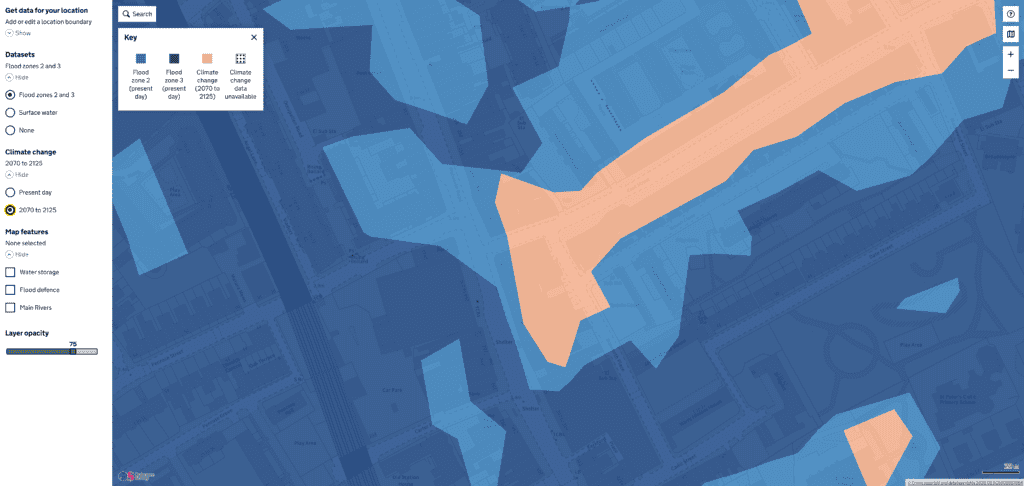
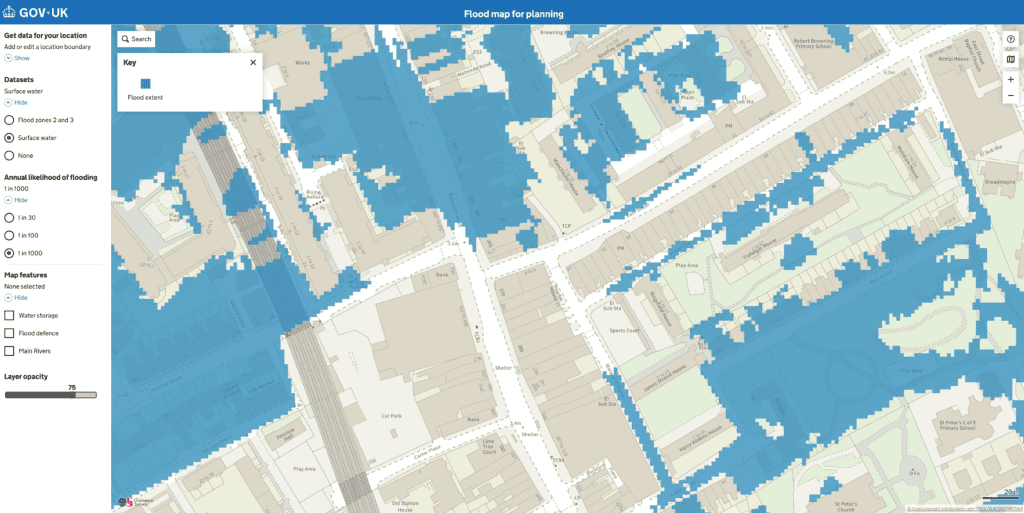
A developer was preparing a planning application for one new dwelling on a tight urban plot in west London. The site lies in the defended tidal floodplain of the River Thames: Flood Zone 3 on the Environment Agency's flood map for planning, and inside an area benefiting from defences.
That combination is ordinary along the tidal Thames, and it catches developers out more often than it should. The flood map shows land as it would flood if the defences were not there, and the defences themselves are real, built for a surge larger than the river has produced since. A site can be well protected in practice and still sit in the highest flood zone on the map planning policy runs on.
Residential use is classed as more vulnerable development, and in Flood Zone 3 that sets both tests running: the Sequential Test first, the Exception Test behind it.
Why the defences settled nothing
The client's reading was fair. Defences in place, the site outside every modelled breach extent, nothing in the technical evidence pointing the other way: the flood risk case looked closed before it opened.
It was not. The Sequential Test never asks whether a site can be made safe; it asks about location, and it asks that of the flood zone rather than of the residual risk behind the wall. Engineering, however accomplished, answers a different question. The September 2025 update to the planning practice guidance had restated what makes an alternative site reasonably available, which left a loose answer harder to defend than it once was.
An application without a structured sequential case draws a further information request at best, a refusal on sequential grounds at worst, after the fee and the programme have gone.
A search area sized for one home
The area of search was the binding constraint, and for one dwelling it cuts both ways. Drawn across the whole of London, it compares the site with land serving a housing market this house would never serve, which gives a case officer nothing usable. Drawn around a few neighbouring streets, it reads as self-serving, sized to guarantee its own conclusion. Both versions fail, differently.
Unda set the area to the local housing market the dwelling would sit in: for one home, a few neighbourhoods rather than a borough. One home is not a strategic allocation, and the alternatives worth testing were sites capable of taking the same form and scale of development in the same part of west London. Scale narrows the search; it does not eliminate it.
Each surviving alternative was put to the questions the test turns on: whether it suited the same development, whether it met the same need, and whether it had a realistic prospect of delivery in a comparable timeframe. A site that looks vacant on a map is not necessarily available in planning terms. That distinction did most of the work. None of the alternatives cleared all three.
Safe for the building's lifetime
The second test has two limbs, each answered on its own evidence: whether the scheme carried wider sustainability benefits, and whether it could be made safe across its lifetime without pushing flood risk onto anyone else.
Behind defences the risk that matters is residual, so the safety case was built around what happens if they are overtopped or breached. Refuge above the flood level within the building, resilient construction where water could reach it, drainage designed to hold its own rainfall rather than transfer it downstream. That point carries more weight in London than it once did, with the 2025 to 2030 London Surface Water Strategy pressing on urban rainfall.
The evidence kept three questions deliberately apart: whether the location was sequentially appropriate, whether the site could be made safe, and where the planning balance fell. Flood risk arguments go wrong when those get run together, because a strong answer on safety starts doing work meant for location.
Permission granted on the policy case
The council granted permission.
Unda issued a Sequential and Exception Test report alongside the site's flood risk assessment, which set out the area of search and why it was drawn there, the alternatives and why each was discounted, and the safety case for the building's lifetime. Flood risk evidence was one part of a wider application, and the decision rested on the whole.
What changed was the footing the application stood on. Rather than a case resting on mitigation and defences, the submission carried a reasoned answer to the location question, which is the one the Sequential Test actually asks.
What this means for similar sites
Defences change the residual risk. They do not change the flood zone, and the Sequential Test is applied to the zone. Any site behind defences should expect to make the location case in full, however reassuring its technical evidence, which is part of why a flood zone describes land rather than what will happen to a building on it.
Most of these assessments are won or lost on the area of search, and recent judgments have turned on how far it should reasonably be expected to reach. London adds a second picture. The tidal case and the surface water case now arrive together on most urban sites, and an assessment that answers one has answered half the question.
About the author. Edward is a co-founder and Director of Unda with 20+ years in flood risk and drainage, and a national-press commentator on flooding. Unda has been trading since 2014, is a CIWEM Business Partner with CIWEM member and chartered (C.WEM MCIWEM) consultants, and has delivered 5,000+ flood risk assessments and drainage strategies across England and Wales.
Edward Bouët · BSc (Hons)
Unda's Sequential and Exception Test report gives a planning authority the location case that a defended Flood Zone 3 site cannot make from its defences alone.
Site in Flood Zone 3 behind defences?
Send the site address and what is proposed for a tailored quote from Unda's experienced consultants within 60 minutes on a working day.
Start a quoteRelated projects
- Village Homes Approved After Flood Refusal: a two-tier area of search accepted for homes in Flood Zone 3 after an earlier refusal.
- Coordinated Flood Risk Evidence for Infill Housing: flood risk, drainage and sequential evidence aligned for a west London infill dwelling.
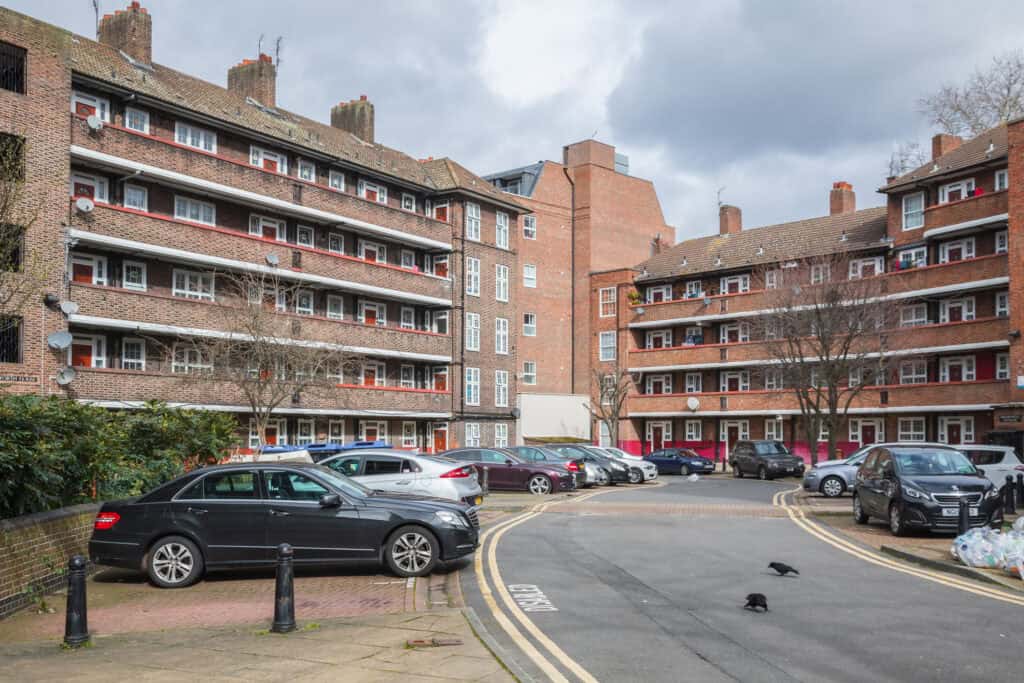
Residential apartment complex with parked cars and a curved road in a flood zone area.
Flood map showing flood zones and tidal defences in the area of the new home.
Flood risk map showing areas in Flood Zone 3 with tidal defences in place. 