Defra’s Role in Flood Risk Management: Policy, Funding and Planning
Estimated reading time 13 minutes
The Department for Environment, Food and Rural Affairs (Defra) is the government department that leads flood risk management in England. It writes national flood policy, owns the legislation and decides how much public money goes into flood defences, and on what terms. It does not build defences, issue flood warnings or decide planning applications. Those jobs sit with the Environment Agency, councils and the other bodies that work inside the rules Defra sets.
The official name for this area of policy is flood and coastal erosion risk management (FCERM), and Defra's part in it reaches a development site indirectly, usually as Environment Agency flood data or as the drainage standard a council checks a scheme against, and occasionally as a funding decision that settles whether a defence gets built upstream at all. The sections below cover what Defra does, how it divides the work with the Environment Agency, where the money goes, what has changed since 2025 and what it all means for a planning application. Flood policy in Wales, Scotland and Northern Ireland is devolved, so this is about England.
Defra is funding £1.4 billion of flood defence work in 2026/27, the first year of a £7.9 billion ten-year programme meant to better protect 840,000 properties by 2036.
What does Defra do in flood risk management?
Defra is a ministerial department, headed by the Secretary of State for Environment, Food and Rural Affairs. Dame Angela Eagle has held the post since 20 July 2026, when she replaced Emma Reynolds. On flooding, Defra's responsibilities come down to five jobs: policy, legislation, funding, technical standards and oversight of the Environment Agency, which delivers most of the work on the ground.

- Policy and strategy. Ministers approved the National FCERM Strategy for England, which the Environment Agency prepared under section 7 of the Flood and Water Management Act 2010, and adopted it in September 2020.
- Legislation. Defra owns the Flood and Water Management Act 2010 and the Land Drainage Act 1991, and decides when their provisions come into force.
- Funding. It sets the capital settlement and the rules for spending it, paid out as Grant in Aid through the Environment Agency.
- Standards. It published the National Standards for Sustainable Drainage Systems in June 2025.
- Oversight. It sponsors the Environment Agency and co-funds the joint FCERM research programme with it.
None of this reaches a developer with Defra's name on it. By the time it touches a site it has become Environment Agency mapping or a council's drainage checklist, or a line of planning policy written by another department, which is why a flood risk assessment for planning has to be current on all three. Defra also works across government through the Floods Resilience Taskforce, set up in September 2024 with the Ministry of Housing, Communities and Local Government, the Cabinet Office, the Environment Agency, the Met Office and emergency responders.
How do Defra and the Environment Agency split the work?
Defra decides and the Environment Agency delivers. The Agency is a non-departmental public body which Defra sponsors and funds, but which runs its own operations at arm's length from ministers. It holds a strategic overview of every source of flooding, manages flood risk from main rivers, the sea and large reservoirs, builds and maintains defences, issues flood warnings and advises planning authorities. Defra sets the policy and the budget it works to.
| Question | Defra | Environment Agency |
|---|---|---|
| Who sets flood policy? | Defra ministers, answerable to Parliament | Advises ministers and prepares the national strategy |
| Who pays for defences? | Sets the settlement and the funding rules | Allocates Grant in Aid to schemes and builds its own |
| Who manages rivers and the sea? | No assets of its own | Main rivers, the coast and large raised reservoirs |
| Who warns the public? | No operational role | Flood warnings, forecast jointly with the Met Office |
| Who comments on planning applications? | Not consulted on individual sites | Statutory consultee in Flood Zones 2 and 3 and within 20 metres of a main river |
The national strategy is the document that binds the two together. Its stated vision is:
a nation ready for, and resilient to, flooding and coastal change – today, tomorrow and to the year 2100
National Flood and Coastal Erosion Risk Management Strategy for England, Environment Agency, 2020
The Environment Agency wrote it, but ministerial adoption is what gives it force: every risk management authority has to act consistently with it. The roadmap that sits under the strategy runs out in 2026. The Agency's FCERM report for 2025 to 2026 records over 90% of its actions as complete or on track, but it does not set out what replaces the roadmap after 2026. How the Agency uses that remit on live applications is covered in the guide to the Environment Agency in planning.
Who carries out Defra's flood policy on the ground?
A chain of bodies that the Flood and Water Management Act 2010 calls risk management authorities. Below the Environment Agency sit Lead Local Flood Authorities (LLFAs), internal drainage boards, water and sewerage companies, highway authorities and district councils, each with a different source of flooding. The local planning authority then applies national policy to individual sites, advised by the Environment Agency and the Lead Local Flood Authority.
Defra
Sets national flood policy, owns the legislation and funds the capital programme.
Government departmentEnvironment Agency
Strategic overview of all flood sources; main rivers, the sea and reservoirs; allocates Grant in Aid.
Sponsored by DefraOther risk management authorities
LLFAs, internal drainage boards, water companies, highway authorities and district councils.
Flood and Water Management Act 2010Local planning authority
Applies the NPPF to each application, advised by the Environment Agency and the LLFA.
Decides the applicationThe applicant
Evidences the site: flood risk assessment, Sequential Test and drainage strategy.
Carries the burden of proofFrom a site, the chain is read upwards, because the source of flooding decides which body has a say. The Lead Local Flood Authority covers surface water, groundwater and ordinary watercourses and has been a statutory consultee on major development drainage since April 2015. An internal drainage board controls discharges and works in its drainage district. The water company decides sewer connections, and the Environment Agency covers main rivers. Each authority's duties are set out in more depth in who is responsible for managing flood risk in England.
The map of councils is also moving. Local government reorganisation will replace 134 county and district councils with 38 unitary authorities between 2027 and 2028, and where a county splits into several unitaries its Lead Local Flood Authority role has to be divided and rebuilt.
Not sure which authority your site answers to?
A flood risk assessment identifies every source of flooding and every consultee your application will face. Get a free quote within 60 minutes.
Get a free quoteHow does Defra decide where flood defence money goes?
Through a funding policy it published on 14 October 2025 and applied from April 2026. Government pays all of the first £3 million of an eligible new or improved scheme and 90% of the cost above that, and pays in full to refurbish existing defences. The Environment Agency then allocates the money to schemes that risk management authorities put forward.
- The settlement. The June 2025 Spending Review fixed £7.9 billion of capital for 2026/27 to 2035/36. Added to the £2.65 billion spent over the two years before, that is the £10.5 billion figure often quoted.
- The rules. Defra's policy sets the funding rates and ring-fences shares: at least 20% of investment to the most deprived fifth of communities, 40% to the two most deprived fifths, and at least £300 million over ten years for natural flood management.
- The bids. Risk management authorities put forward schemes with a business case. From 2026, charities, landowners and other organisations can apply as well.
- The allocation. The Environment Agency scores the schemes and allocates Grant in Aid. The 2026 funding guidance explains how schemes are now compared.
- The reporting. Progress is published every year. The first year of the new programme, and where its £7.9 billion goes scheme by scheme, is tracked separately.
Delivery has fallen short of promises before, and the National Audit Office warned in 2023 that the 2021 to 2027 programme would miss its target by a wide margin. Maintenance competes for the same money: in April 2026, 93% of the Environment Agency's high-consequence assets were in their required condition, which met the annual target but not the 98% long-term goal.
Over 150,000 properties were better protected between April 2021 and March 2026, against an original promise of 336,000.
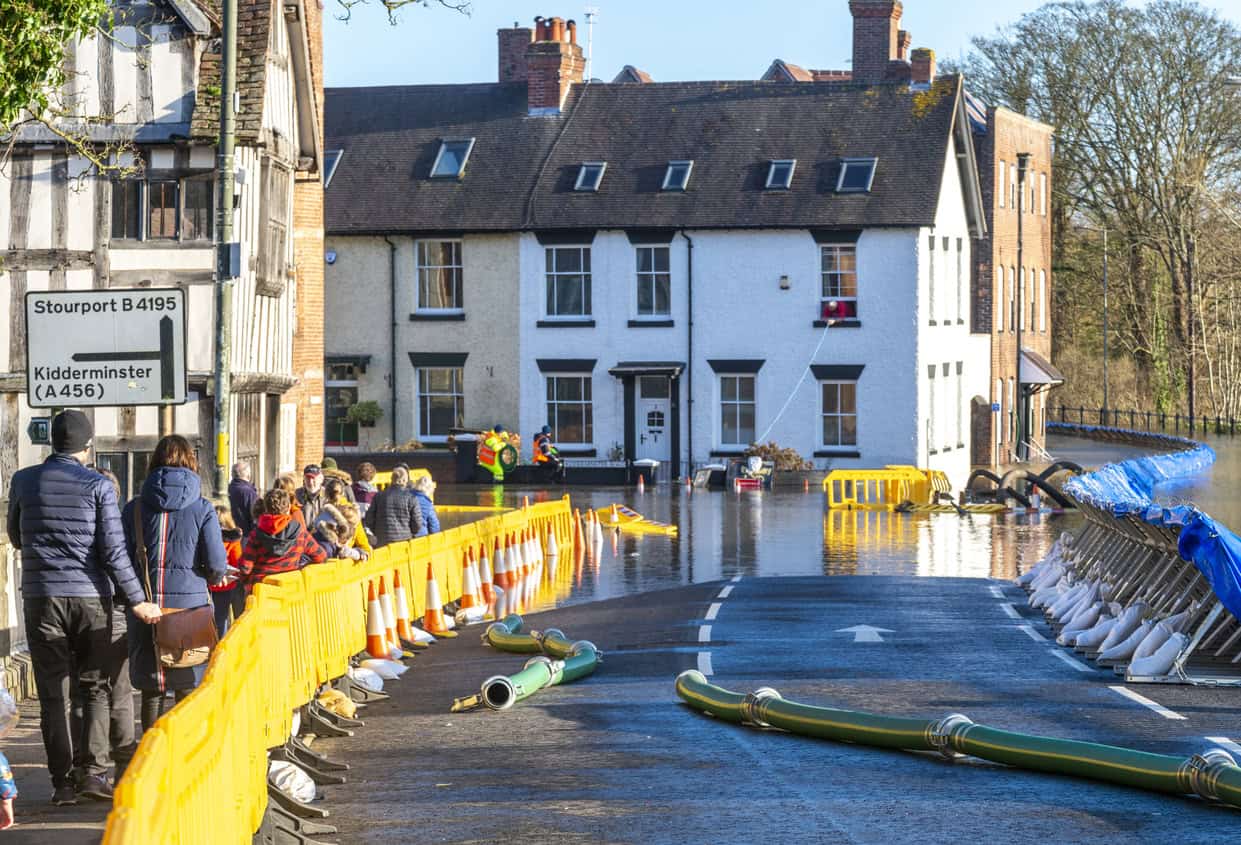
New defences do not move a site out of a flood zone. The Flood Map for Planning shows flood zones as if defences were absent, by design, so the land behind Bewdley's barriers stays in Flood Zone 3 and the Sequential Test still applies to it. What a defence changes is the residual risk case, meaning what happens to the site if the defence is overtopped or breaches. The mapping logic is explained in why a site stays in a flood zone after new defences are built, and the Severn defences at Shrewsbury, Ironbridge and Bewdley show what 25 years of spending has and has not changed.
What has Defra changed for development since 2025?
Three Defra decisions reach a planning application directly: new national drainage standards, a decision not to make them a separate legal approval, and funding rules that favour maintenance and natural flood management. The August 2026 NPPF, written by the Ministry of Housing, Communities and Local Government, is what turned the drainage standards into a planning requirement.
| Date | Change | What it means for development |
|---|---|---|
| 19 June 2025 | Defra publishes the National Standards for Sustainable Drainage Systems | The design benchmark for new drainage, replacing the 2015 technical standards |
| 14 October 2025 | New FCERM funding policy and £10.5 billion to 2036 | Funding weighted towards deprived areas and maintenance; bids open to charities and landowners |
| 12 December 2025 | Government response to the Environmental Audit Committee declines to commence Schedule 3 | SuDS are approved through planning, not by a separate SuDS approving body as in Wales |
| 18 March 2026 | The Land Use Framework is published | Advisory only; not planning policy and not a material consideration |
| 1 April 2026 | New funding rules take effect | Schemes approved before 31 March 2026 keep the old rules |
| 20 July 2026 | Dame Angela Eagle becomes Environment Secretary | The outstanding decision on Schedule 3 now rests with her |
| 17 August 2026 | The new NPPF makes Policy F8 apply Defra's 2025 standards | Minor schemes, as well as major ones, need drainage designed to the standards |
Defra also owns water industry policy, which is changing in parallel. The Clean Water Bill announced in the King's Speech on 13 May 2026 would replace Ofwat with a single water regulator. It leaves the Environment Agency's role as flood risk consultee untouched, as the Cunliffe review explainer sets out, so an application in 2026 still meets the same flood consultees as before.
What does Defra's role mean for a planning application?
Defra never comments on an individual application, but its data, standards and funding sit behind almost every flood objection. An assessment built on superseded mapping, the wrong climate change allowances or drainage that misses the 2025 standards will draw an objection from the Environment Agency or the Lead Local Flood Authority. A scheme that cannot show it will be safe for its lifetime now meets NPPF wording that says it should be refused.
The costs land on the applicant. An objection normally stops determination until it is resolved, and each round of further information adds weeks. A refusal is worse: it can cost a site purchase that was conditional on permission, or push the scheme into an appeal fought on evidence that should have been in the first submission. With 6.3 million properties in England already at flood risk, 4.6 million of them from surface water, planning authorities have every reason to apply the tests strictly.
- Current flood data. Use the Flood Map for Planning as it stands now; the May 2026 update added surface water climate change extents and depth bands.
- The Sequential Test. Where a site is in Flood Zone 2 or 3, Sequential Test and Exception Test reports need a defensible area of search from the start.
- Drainage to the national standards. Policy F8 applies to every scheme, so a surface water drainage strategy designed to the 2025 standards is now standard evidence.
- Residual risk behind defences. A defended site still needs overtopping and breach scenarios, and, where the depth and speed of flooding warrant it, safe access and a flood warning plan.
The evidence a consultee asks for after an objection is the same evidence that would have prevented it, so the cheaper route is to submit it first time. A flood risk assessment for your planning application, built on current Defra and Environment Agency data, removes the usual grounds for objection before the consultees see it.
Submitting a planning application in a flood risk area?
Get the flood risk and drainage evidence right before the Environment Agency or the Lead Local Flood Authority reads it. Free quote within 60 minutes.
Get a free quoteFrequently asked questions
Is the Environment Agency part of Defra?
Not directly. The Environment Agency is a non-departmental public body with its own board and chief executive. Defra sponsors it, sets its budget and answers for it in Parliament, but the Agency runs its operations at arm's length and its staff are not Defra civil servants.
What does Defra stand for?
Department for Environment, Food and Rural Affairs. It was formed in June 2001 from the Ministry of Agriculture, Fisheries and Food and parts of the Department of the Environment, Transport and the Regions. Flooding sits alongside farming, food, water, the natural environment and animal health in its remit.
Does Defra cover flood risk in Wales and Scotland?
It does not, because flood risk management is devolved. In Wales it is the Welsh Government, with Natural Resources Wales advising on planning under TAN15; in Scotland the Scottish Government and SEPA; and in Northern Ireland the Department for Infrastructure.
Can Defra overrule a planning decision on flood risk?
No. Call-in powers belong to the Secretary of State for Housing, Communities and Local Government, not to Defra. Where a council is minded to approve major development in a flood risk area against a sustained Environment Agency objection, it has to consult that Secretary of State before granting permission, and the application can then be called in.
Who has to maintain a watercourse or flood defence?
Often the landowner. Flood and land drainage powers are permissive, so the House of Commons Library notes that the authorities involved have no duty to act. A landowner beside a watercourse has riparian responsibilities for the stretch on their land, and a private defence stays its owner's to repair.
About the author. Edward is a co-founder and Director of Unda with 20+ years in flood risk and drainage, and a national-press commentator on flooding. Unda has been trading since 2014, is a CIWEM Business Partner with CIWEM member and chartered (C.WEM MCIWEM) consultants, and has delivered 5,000+ flood risk assessments and drainage strategies across England and Wales.
Edward Bouët · BSc (Hons)
Latest news



One of our experienced Flood Risk Consultants will get back to you within 60 minutes
