Sewage Capacity and Planning: Why Water Infrastructure Now Decides What Gets Built

Estimated reading time 16 minutes
Channel 4's Dirty Business was reviewed as a "blast of controlled fury" aimed at Britain's water industry. The drama was about sewage. The consequence for anyone trying to build is narrower and far more practical: in parts of England, sewage capacity and planning are now the same conversation. Where a treatment works has no headroom, a scheme can be delayed, phased or objected to long before anyone argues about outfalls and river quality.
That shift has happened fast, and the commentary has not caught up. This article sets out what wastewater capacity does to a planning application, who really gets consulted, what the right to connect does and does not guarantee, and why the gap between a planning timetable and a water company's investment cycle decides most of these cases.
The Home Builders Federation counted nearly 30,000 homes held up by wastewater capacity in England, 7,000 of them affordable, with developers paying £2.3bn to water companies since 2020.

Sewage capacity is a constraint before it is a scandal
Sewage capacity limits development because the network was built for a smaller, less paved country. Much of England still runs on combined sewers, which carry foul water and surface water in the same pipe. When rainfall exceeds what the pipe can take, a combined sewer overflow acts as a relief valve rather than letting sewage back up into homes. Those discharges are permitted in defined circumstances, because the alternative is sewage in the street, and that permission is the root of most of the confusion about what a spill actually represents.
The mechanics are engineered, not mysterious, and understanding how foul, surface and combined sewers work is the starting point for understanding the constraint. What has changed is the loading. More hard surfacing, higher densities and heavier rainfall push more water into the same pipes. Every new connection adds to the flow those pipes carry before it rains at all. Where the network is already surcharging, the result the public sees is sewer flooding.
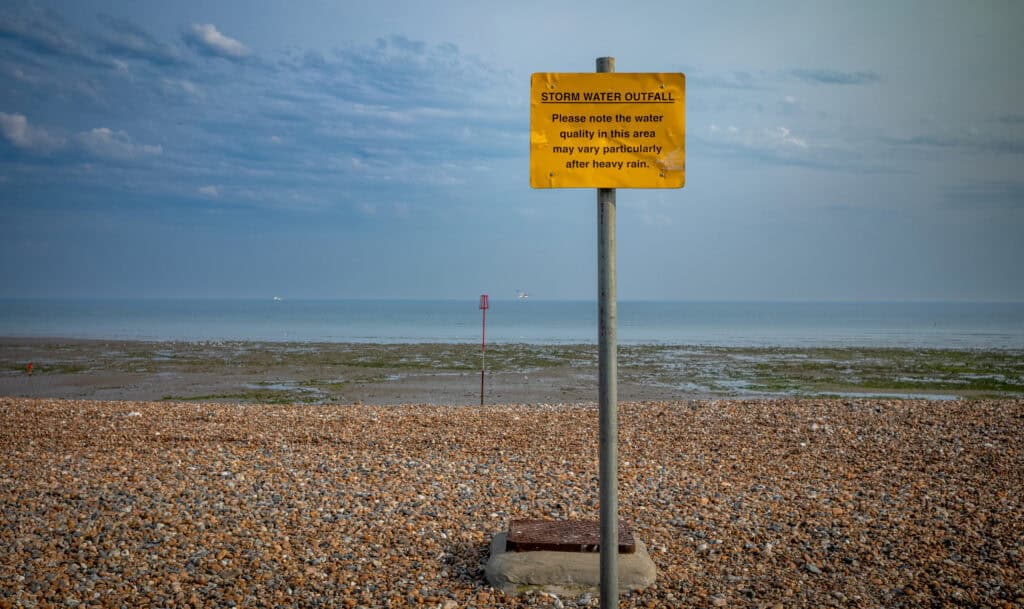
The Environment Agency's 2025 monitoring data recorded 291,492 spills from storm overflows, a 35% fall on 2024, with total spill duration down 48%. The Agency attributed much of that improvement to a dry 2025 following a very wet 2024 rather than to the network having got materially bigger. Against Defra's Storm Overflows Discharge Reduction Plan, 33.7% of overflows met the ten-spill proxy in 2024-25, up from 22.6% two years earlier, while performance at designated bathing waters fell from 55.3% to 44.8%.
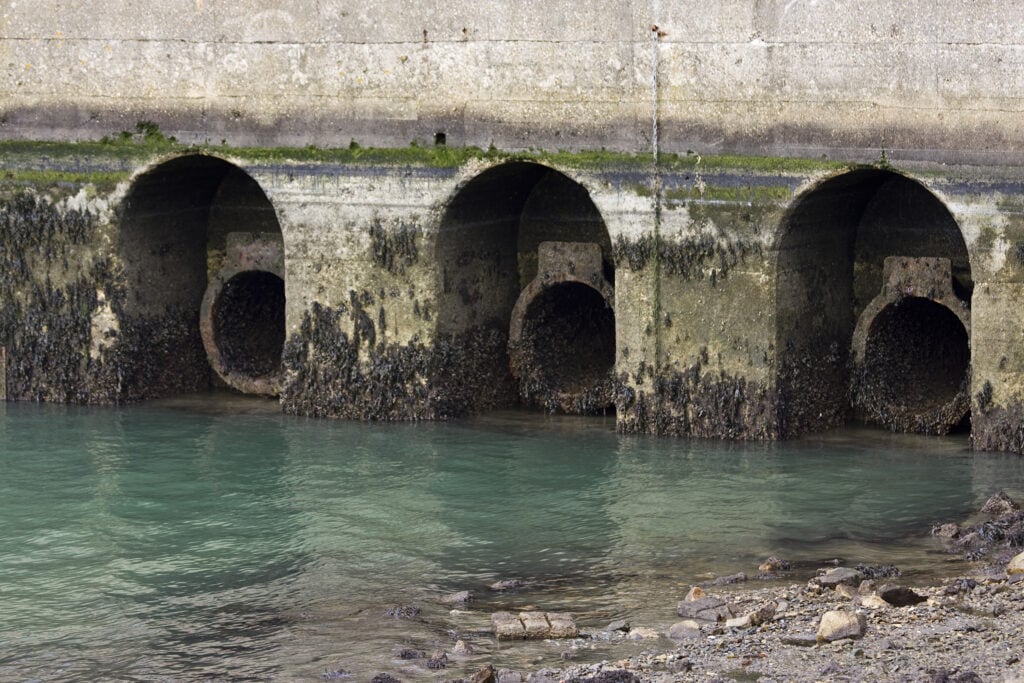
For a developer, the number that matters is not the national spill count. It is whether the works serving the site has permitted headroom left, and whether the sewer between the site and that works can carry the flow. That question is answered at catchment level, and it is answered before determination. If it comes back badly, the fix is a foul drainage strategy that stands up at planning, not a stronger argument at committee.
Are water companies statutory consultees on planning applications?
No. Water and sewerage companies are not statutory consultees on individual planning applications in England. The Government confirmed this in its response to the statutory consultee consultation on 17 August 2026, which states that water companies "are not statutory consultees on individual planning applications, they are local plan consultation bodies", prescribed instead under the requirement-to-assist arrangements for the new plan-making system.
This matters because the opposite is widely assumed, including in earlier commentary on this site. The Ministry of Housing, Communities and Local Government has also rejected the recommendation that water companies be made statutory consultees on all major development, on the basis that water capacity is better handled strategically than application by application. For how the undertakers do fit into the system, see our guide to water companies and the planning process and our explainer on statutory consultees in planning.
| Body | Status on a planning application | What it does in practice |
|---|---|---|
| Lead Local Flood Authority | Statutory consultee on major development for surface water drainage | Reviews the drainage strategy and objects where SuDS or attenuation are inadequate |
| Environment Agency | Statutory consultee on flood risk in Flood Zones 2 and 3 and other prescribed cases | Reviews the flood risk assessment for planning and can object, holding up determination |
| Water and sewerage company | Not a statutory consultee on individual applications; a local plan consultation body | Consulted at the authority's discretion; comments on network and treatment capacity carry weight as a material consideration |
So the real position is softer, and less predictable, than "statutory consultee" suggests. Authorities in constrained catchments consult the undertaker as a matter of routine, and their capacity comments are treated as material. Authorities elsewhere may not consult them at all. Neither is a legal error. That is why the same drainage question can decide a case in one district and go unasked in the next.
What happens when a treatment works has no headroom
When a water recycling centre or treatment works is at its permitted limit, three things follow in sequence: the undertaker says so, the authority decides how much weight to give it, and the applicant either removes the load, phases the scheme, or waits for funded capacity.
Anglian Water told Cambridgeshire applicants in January 2025 that Foxton Water Recycling Centre "is not equipped to handle further capacity without breaching environmental legislation". That held up schemes as small as 16 homes at Orwell. In October 2025 Cambridge City Council passed a motion recording objections on wastewater capacity grounds and warning that capacity was becoming a potential obstacle to all development in the area. At least 5,600 homes hang on moving the city's treatment plant.
Capacity enquiry
Pre-application enquiry to the sewerage undertaker on the receiving works and the network serving the site.
Headroom?
The undertaker confirms whether permitted treatment headroom and network capacity exist for the proposed foul flow.
Outcome
The response splits the application into one of the two routes below.
Headroom available
Permission is conditioned on an agreed connection point and the drainage details. The scheme proceeds on the planning timetable.
No headroom
Three routes: cut the foul flow by separating surface water; phase occupation against a dated upgrade; or wait for the upgrade to be funded through the regulatory investment cycle.
The routes out are not exotic. Taking surface water out of a combined system cuts the load a constrained works has to treat more than anything else you can do on site. The discharge hierarchy expects it anyway, which is why a surface water drainage strategy for planning often does as much for a foul capacity problem as anything aimed at the foul system itself. Phasing ties occupation to a dated upgrade, which is a workable answer where the upgrade is already programmed and an empty promise where it is not. Where an upgrade is genuinely needed, the funding route is Ofwat's demand growth investment mechanism, not a planning condition.
- A pre-application capacity enquiry to the sewerage undertaker establishes whether the receiving works and the network between it and the site have headroom for the proposed flow.
- A capacity response is issued, ranging from unconstrained, through constrained subject to phasing, to no capacity available within the current investment period.
- The drainage strategy is revised to reduce foul flow, usually by removing surface water from the combined system and by confirming the discharge hierarchy. Foul flows are derived to Building Regulations Part H and the undertaker's own design standards.
- The authority conditions the permission, commonly requiring an agreed connection point, a phasing plan, or a Grampian condition tied to the upgrade. Those conditions then have to be discharged before development can begin.
- Where an upgrade is required, the undertaker bids for it through the investment cycle, and that timetable becomes the scheme's timetable.
The right to connect, and why the Government is reviewing it
Section 106 of the Water Industry Act 1991 gives the owner or occupier of premises the right to connect drains and private sewers to the public sewer. The undertaker may refuse only within 21 days, and only where the drain does not meet reasonable standards of construction or where the connection would be prejudicial to its sewerage system. Our explainer on the Section 106 sewer connection sets out how the application itself works, and Section 104 adoption covers what happens to the pipes afterwards.
The right to connect is genuine, but it is not a guarantee of treatment capacity. It settles whether a pipe may be joined to the network. It does not create headroom at the works downstream, and it does not stop a local planning authority weighing a capacity objection when it determines the application. That distinction is the most common misunderstanding in this area, and it is why a connection enquiry and a planning drainage strategy are not substitutes for one another.
Defra's white paper, A new vision for water, published on 20 January 2026, commits to reviewing the right to connect so that it "supports and enables the government's housing delivery objectives". Until that review reports, nothing has changed. The 1991 Act still governs.
Does the regulator's credibility change planning risk?
Yes, indirectly but in ways you can feel. Planning decisions rest on assumptions about enforcement: that discharge permits mean something, that capacity limits get dealt with before growth proceeds, and that mitigation works as designed. Where those assumptions look shaky, authorities turn cautious and the applicant carries more of the risk.
Enforcement has moved, but slowly
The National Audit Office concluded in April 2025 that regulators had failed to deliver a trusted and resilient water sector. The Water (Special Measures) Act 2025 received Royal Assent on 24 February 2025, introducing pollution incident reduction plans and automatic penalties, and made obstructing an investigation an offence.
Enforcement has also become expensive. Ofwat fined Thames Water £122.7m in May 2025, the largest regulatory penalty imposed on a water company. Thames Water's own position remains unresolved, and we set out what that means for flood risk and drainage in our review of the Thames Water crisis. The wider point is that penalties are a poor substitute for capacity: a fine changes a balance sheet, not a permitted flow.
Behind all of it sits the regulatory rebuild. The Independent Water Commission reported in July 2025 with 88 recommendations, including scrapping Ofwat; the January 2026 white paper confirmed a single regulator; and a Clean Water Bill was announced in the King's Speech on 13 May 2026. What that means for planning is covered in more detail in our analysis of what abolishing Ofwat means for planning. The short version is simple. A regulator being rebuilt is a regulator whose decisions are harder to predict, and that lengthens every infrastructure timetable resting on them.
Growth without sequencing
The planning system assumes infrastructure arrives broadly in step with growth. Wastewater infrastructure does not work on that timescale. Treatment works and network reinforcement are capital projects with their own permitting, and they are funded in five-year regulatory periods, not in the months a planning application takes.
Planning permission is decided in months. A treatment works upgrade is designed, funded and commissioned across a five-year investment period.
Ofwat's PR24 final determinations allowed £104bn for 2025 to 2030, including £10.2bn for storm overflow upgrades. In August 2026 Ofwat provisionally approved a further £3.39bn of the £4.3bn companies had claimed through the cost-change process, of which £477m was growth-related investment, with final decisions due in December 2026. Sewerage undertakers must also maintain statutory drainage and wastewater management plans under sections 94A to 94D of the Water Industry Act 1991, which address system capacity, future demand, and the sequence and timing of planned measures.
The Government has been working the problem from the other end. Its Water Delivery Taskforce announced in July 2026 that 18,771 homes had been unlocked after Anglian Water objections were resolved, at Spitalgate Heath, the Tendring Colchester Borders Garden Community, Beccles, Baldock and Dunton Hills, taking the cumulative figure past 55,000. That is real progress. It is also an admission that the sequencing does not happen on its own.
What Dirty Business does effectively is expose the gap between infrastructure assumptions and infrastructure reality. In planning, we often proceed on the basis that capacity will follow consent. But wastewater networks, treatment works and regulatory frameworks operate on longer cycles. If growth is not carefully sequenced against demonstrable capacity, environmental risk is not accidental — it is predictable.
Jackie Stone · Director, Unda
This is why Dirty Business mattered beyond the ratings. It moved water infrastructure from background utility to political subject, and political subjects get picked over. Planning committees now ask capacity questions they would once have left to the drainage officer. Residents read drainage strategies. A scheme that cannot answer the capacity question early will answer it late, in public, and at cost.
What to get right before you apply
The capacity question is answerable in advance, and answering it early costs a fraction of answering it at committee, where the only options left are deferral, a reduced scheme or a refusal. Six things matter most on a constrained catchment.
- Ask the undertaker first. A pre-application capacity enquiry costs little and tells you whether the works and the network can take the flow. Do it before the layout is fixed, not after.
- Separate surface water from foul. Removing surface water from a combined system is the largest single reduction you can make to the load a constrained works has to treat.
- Check the catchment, not the postcode. Capacity is a catchment property. Two sites a mile apart can sit on different works with entirely different headroom.
- Read the drainage and wastewater management plan. The undertaker's statutory plan sets out where capacity is short and when investment is programmed, which tells you whether phasing is realistic.
- Budget for phasing, not for argument. Where headroom is genuinely absent, a dated phasing plan agreed with the undertaker beats a refusal and an appeal.
- Keep the evidence consistent. A foul strategy that contradicts the surface water strategy or the flood risk assessment invites an objection from a different consultee. A CON29DW drainage and water search is a useful early cross-check on what the undertaker's records actually show.
Facing a capacity objection?
Our experienced consultants prepare foul and surface water drainage strategies that answer the undertaker's capacity question with evidence, not assertion. Free scoping and a fixed quote within the hour.
Get a drainage strategy quoteWhere a site's constraint turns out to be broader than the sewer, our drainage strategies for planning cover foul, surface water and combined schemes together, and the same evidence usually settles the nutrient neutrality and water neutrality questions that travel with them.
Frequently asked questions
Can a water company stop my development going ahead?
Not directly. A water and sewerage company cannot refuse planning permission, and it is not a statutory consultee on individual applications in England. What it can do is tell the local planning authority that the receiving works or the network has no headroom for the proposed flow. That representation is a material consideration, and in a constrained catchment it is frequently the one that decides whether permission is granted, conditioned or refused.
Who pays for a treatment works upgrade if capacity is short?
The upgrade itself is funded through the water company's regulated investment programme, not by the applicant. Where growth creates the need mid-period, the company bids for it through Ofwat's demand growth investment mechanism. Developers do contribute through infrastructure charges and any requisitioned works under the Water Industry Act 1991, but treatment capacity is not something a developer can simply buy forward.
How long does a capacity constraint usually delay a scheme?
It depends entirely on whether the upgrade is already programmed. Where it is, phasing can tie occupation to a known date. Where it is not, the scheme is waiting on a funding decision inside a five-year regulatory period, and the honest answer is years rather than months. That is why the capacity enquiry belongs at pre-application stage.
Is this the same problem as nutrient neutrality?
They are related but distinct. Nutrient neutrality is a habitats regulations issue affecting 74 local planning authorities across 27 river catchments, and it concerns the nutrient load reaching a protected site. Wastewater capacity is a physical and permitting question about whether the works and the sewer can take the flow at all. A site can be clear on one and blocked on the other.
Does a Section 106 connection right mean I have capacity?
No. Section 106 of the Water Industry Act 1991 gives a right to connect to the public sewer, subject to a narrow 21-day refusal power. It settles the connection, not the treatment capacity downstream, and it does not prevent a local planning authority from weighing a capacity objection when it determines the application.
What should a drainage strategy include on a constrained catchment?
The undertaker's capacity response, the assumed foul flow and how it was derived, the discharge hierarchy applied to surface water with evidence for each rejected option, the proposed connection point, and a phasing plan where one is needed. A strategy that states a connection point without evidencing the flow the works has agreed to accept will usually be sent back.
About the author. Jackie is a co-founder and Director of Unda with 30+ years in flood risk, and sits on CIWEM's South Eastern Branch committee. Unda has been trading since 2014, is a CIWEM Business Partner with CIWEM member and chartered (C.WEM MCIWEM) consultants, and has delivered 5,000+ flood risk assessments and drainage strategies across England and Wales.
Jackie Stone · MSci, BSc (Hons), DIC, CIWEM Environmental Partner
Latest news




One of our experienced Flood Risk Consultants will get back to you within 60 minutes