What have the Romans ever done for us? Aside from the drainage, obviously
Estimated reading time 11 minutes
Ask a Roman what they ever did for us and you would probably get a shrug and a wave at, well, everything. Put the same question to a flood-risk engineer, though, and the answer turns oddly specific: a startling amount of the drainage. A Roman drainage system was hardly ever one clever gadget. It was a whole way of bending ground, streets, rooftops and even the law so that water always had somewhere sensible to be: off the bits people wanted to use, and away to somewhere it could sulk quietly rather than ruin the afternoon. Two thousand years on, that is more or less the trick modern sustainable drainage is trying to relearn.
So here is the tour. What the Romans built, what they genuinely understood about water, and the handful of ideas a modern drainage strategy still quietly borrows, ending with the one spectacular failure they never quite lived down.
Rome's first great sewer, the Cloaca Maxima, is still moving water into the Tiber some 2,500 years after it was dug, which makes it older than most countries.
Yes, all right, but apart from the drainage…
The joke, of course, is from Monty Python's Life of Brian, where "what have the Romans ever done for us?" keeps tripping over its own punchline. Watch it as an engineer, though, and one thing leaps out: an awful lot of that famous list is plumbing. The aqueduct. Sanitation. The fresh-water system. Public health. That is not the writers padding for laughs. Moving, supplying and draining water was something Rome did better than anyone would manage again for well over a thousand years.
All right, but apart from the sanitation, the medicine, education, wine, public order, irrigation, roads, the fresh-water system and public health, what have the Romans ever done for us?
Reg, Monty Python's Life of Brian (1979)
Behind the gag sits some genuinely sharp thinking. Vitruvius opened his famous manual on building not with grand columns but with mud: pick high, well-drained ground, steer clear of the stagnant marshy stuff, and work out where water wants to go before you lay a single stone. Prevention before cure, which is precisely the logic behind today's sequential, risk-based approach of steering development away from the worst flood hazard before anyone reaches for a wall. The Romans had also twigged that floods are not purely bad luck. Augustus had junk and illegal building cleared out of the Tiber because it was making floods worse, and Roman law let you sue a neighbour who shoved their water onto your land. The rule that your runoff is your problem, not the person next door's, turns out to be Roman.
Rome was built on a swamp (and a very big drain): the Cloaca Maxima
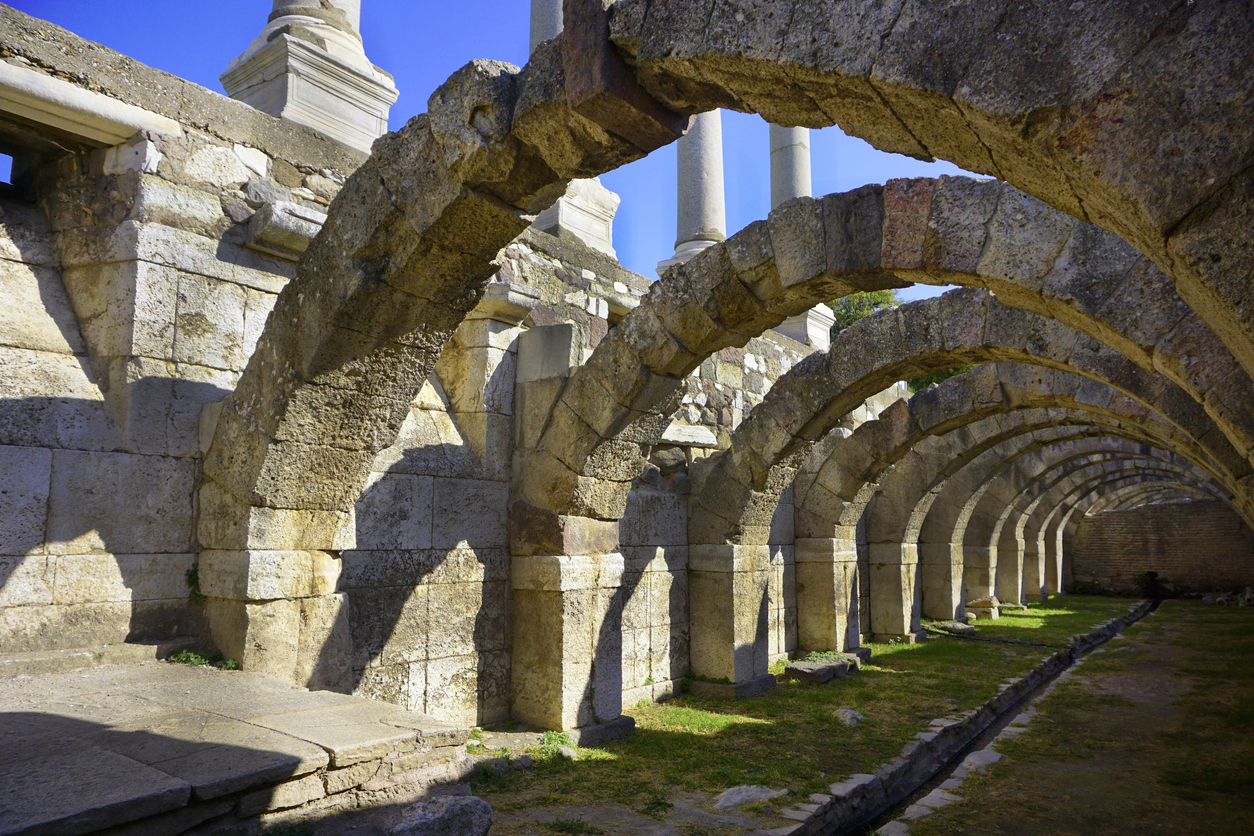
Rome, gloriously, sits on drained ground. The Cloaca Maxima, a name that means "greatest drain" with no false modesty whatsoever, was dug from the late 6th century BC to empty the boggy, flood-prone valley that would become the Roman Forum, turning an unpromising swamp between the hills into land you could build a civilisation on. Its first job was not sewage at all. It was land drainage; the waste came later, once there was a handy channel to take it. The Romans were so pleased with it that they gave it its own goddess, Cloacina, to watch over the Great Drain. That is how seriously they took their drainage.
It began as an open ditch and was gradually walled in and roofed over as the city rose above it, growing to around three metres high and four and a half across, built first from blocks of volcanic tufa and later reinforced with Roman concrete. In 33 BC Agrippa had the whole system inspected and scrubbed out, an early reminder that a drain is only ever as good as its ongoing maintenance. London's Thames Tideway "super sewer" is the same instinct two millennia on: one enormous interceptor to stop a city's drainage swamping its river.
When the Tiber flooded, the great sewer ran backwards, calmly posting river water up into the very streets it was meant to drain.
In Pompeii, the street was the drain
Roman town planners had a wonderfully blunt answer to stormwater: make the street do it. At Pompeii the roads were dished and pitched to follow the natural slope, so rain and slop ran straight down them and out through the walls. And because a road doubling as an open drain is no fun to cross in sandals, they laid raised stepping stones, an ancient pelican crossing, set just far enough apart for cart wheels to roll through the gaps.
- Twenty times the crossing stones: Pompeii has roughly twenty times more stepping stones than any other known Roman city, which tells you a great deal about how much water, and how much else, sluiced down its streets.
- Rain dealt with on the spot: roofs and courtyards drained to cisterns before any overflow reached the street, catching rain right where it fell. Today we call that source control in modern SuDS; the Romans just called it Tuesday.
- Not a pump in sight: the town's fall from its upper gate flushed the whole lot by gravity alone.
Why Roman roads outlived the Romans: they kept their feet dry
Everyone admires Roman roads for their surfaces. The real secret is that they were built, above all, to drain. The carriageway was raised on an embankment (the agger) and humped in the middle so water ran off the crown into ditches on either side, while the layered stone underneath let whatever was left soak away rather than pool. Keep the structure dry and it lasts; the thing that kills a road is water, not wheels.
You can see the same idea in any decent bit of hard-standing today: get the water off, and out of the make-up. A permeable surface does it by letting rain drop straight through rather than shedding it sideways, but the golden rule, never let water sit in the layers, is one a Roman road gang would happily nod along to.
The plot twist under the theatre floor: Catania, 2026
The cleverest Roman drainage is often the stuff you cannot see. In 2026 a ground-penetrating radar survey slipped beneath the orchestra of the Roman theatre at Catania, in Sicily, and traced a hidden set of vaulted channels, built to catch groundwater as it welled up through the porous lava and the buried Amenano river and whisk it away, so the show could go on with dry feet. It is the very same headache a groundwater flood risk assessment wrestles with on a soggy site now: before you can use the space on top, you have to master the water underneath.
The Romans were thinking about the water under our feet, not just the water falling on our heads.
Feeling ambitious? Drain an entire lake
When the Romans got bored of draining valleys, they drained lakes. To hold back floods and win farmland they bored emissary tunnels straight through the hillsides: the outlet cut for the Alban Lake around 398 BC, and Claudius's monster tunnel to lower the Fucine Lake, the longest tunnel in the ancient world, sunk with dozens of vertical shafts and a frankly heroic disregard for the odds. Out in the countryside, the tidy grid of ditches that came with Roman land division moonlighted as a drainage network, marshalling runoff across whole valleys. Draining land at scale was not a stunt for them. It was a habit.
The one that got away: the Tiber
For all the swagger, Rome never did beat its own river. The Tiber flooded every few years, and on its worst days you could have rowed a boat down the high street. The Romans had two lines of defence, and each came with a fatal catch worth spelling out, because both are still with us today.
- Walls work, until they don't: earth and later concrete embankments held right up to the moment they were overtopped, and by pinching the river they could make the flooding worse somewhere downstream. The eternal bargain of hard, linear defence.
- Gravity cuts both ways: with no pumps, a swollen river simply barged back up the drains, exactly the river flooding trick that tide-locked and river-locked outfalls still have to fight.
- So the city just… rose: century after century of flood silt and deliberate infill jacked Rome up metre by metre. The Pantheon's floor, built below street level in 25 BC, now sits neatly at street level, the ground having climbed up to meet it.
Raising the ground and learning to live with the water, rather than out-muscling it, is what we would now call resilience by accommodation, and it is very much back in fashion: raised finished-floor levels, freeboard and flood-resilient building. It is also the whole argument for learning to live with water instead of betting the house on a wall that always holds.
What we quietly nicked from the Romans
Strip away the togas and the Roman approach looks suspiciously like a modern surface-water management train: catch the rain where it lands, move it under control, hold a bit back, and let the rest go slowly and politely. The moves below are all Roman. Only the names have had a makeover.
| Roman practice | Modern equivalent | The shared principle |
|---|---|---|
| Impluvium and cisterns catching roof water | Rainwater harvesting and source control | Deal with rainfall close to where it lands |
| Cambered streets and roadside ditches | Swales, gullies and permeable paving | Give surface water a managed path |
| Groundwater channels under buildings | Groundwater assessment and land drainage | Control the water table beneath a build |
| Discharging the surplus slowly to the Tiber | The SuDS discharge hierarchy | Release at a controlled rate, not all at once |
| Vitruvius siting away from marsh | Sequential, risk-based flood-zone approach | Steer development away from the hazard first |
| Agrippa's inspections of the sewers | Maintenance and adoption arrangements | A drainage system only works if it is kept up |
The modern rulebook just tidies these instincts up: the SuDS hierarchy for where water should go, and the four pillars of SuDS for what a scheme has to pull off. But the underlying moves are ancient. Two thousand years later the job has not changed: give water somewhere to go before it picks somewhere itself, usually your ground floor. That, in the least Roman language imaginable, is what a drainage strategy and a flood risk assessment are for, turning these very old ideas into a scheme a planner will actually sign off.
Frequently asked questions
Is the Cloaca Maxima really still working?
Astonishingly, yes, in part. Bits of the original channel still carry rainwater and drainage down to the Tiber, which makes it one of the oldest pieces of infrastructure anywhere still doing the job it was built for, though Rome's sewage now heads off to modern treatment rather than straight into the river.
Did the Romans actually invent the sewer?
Not quite. Covered drains were running under the Indus Valley and Minoan Crete long before Rome turned up. What the Romans did was supersize and standardise the idea: big trunk sewers, cambered streets, spare aqueduct water to flush them, and the sheer organisation to keep the whole lot working across an empire.
Were Roman sewers "combined", like Britain's Victorian ones?
Pretty much. The same conduit took rain and waste together, just like most Victorian systems, which is exactly the model the UK is now trying to escape, because combined sewers spill over in heavy rain. It is a big reason new development is expected to keep surface water separate.
How did the Romans judge flood risk with no gauges or maps?
By memory, marks and good instinct. They noted the big floods, could see how high the water had reached last time, and chose their ground accordingly. Not quite the return-period statistics behind a modern assessment, but the basic habit, reading a site's flood history before you build on it, is one we have kept.
Latest news



One of our experienced Flood Risk Consultants will get back to you within 60 minutes
