Urban Greening Factor: How It Works and What Changes in 2026
Estimated reading time 14 minutes
The urban greening factor is a planning score that measures how much of a development site is covered by vegetation, water and other green surfaces, weighted by the quality of each. A major scheme in London has to reach 0.4 if it is mainly residential or 0.3 if it is mainly commercial, and the draft London Plan published in July 2026 adds a 0.2 target for industrial development. Outside London, the 2026 NPPF now points local plans towards Natural England's version of the same tool, and councils including Manchester and Rochdale have draft policies that would apply it.
Of 494 London schemes with a recorded score, the typical result sat exactly on the target: a median of 0.4 for residential blocks and 0.3 for commercial schemes.
Those figures come from the GLA's March 2026 evidence review, which found most developments meet the target and stop there. The score also shapes drainage design. Rain gardens and other vegetated sustainable drainage systems (SuDS) score well, while permeable paving barely registers, which matters to anyone preparing a surface water drainage strategy for planning alongside the landscape plan. The final section of this article covers that overlap.
What is the urban greening factor?
The urban greening factor (UGF) turns a site's landscaping into one number. It usually falls between 0 and 1. Each type of surface has a factor, from 1 for semi-natural vegetation and open water down to 0 for concrete and asphalt, and each factor is weighted by area. A higher score means more of the site is green, and that the greening is of better quality.
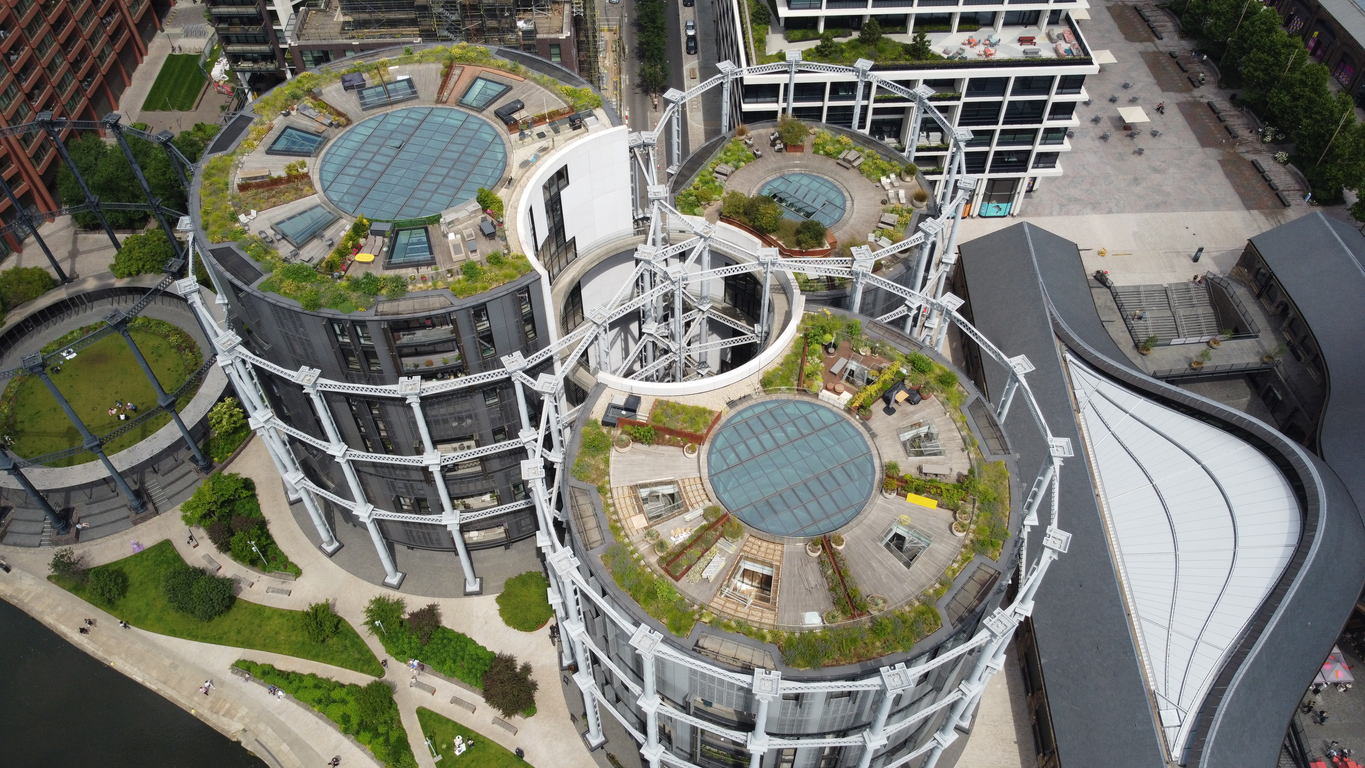
The idea started with green space factor tools trialled in Sweden and later used in Southampton, the London Borough of Sutton and Swansea. The London Plan 2021 made it a requirement for major developments in London through Policy G5, and Natural England published a national version for England in January 2023.
Species-poor lawn scores 0.4 and species-rich grassland scores 1, so a lawn needs twice the area to count for the same amount.
That weighting is deliberate: the GLA's guidance says it rewards higher-quality greening over large areas of low-quality features. Three other things separate the score from a simple green-space percentage:
- Rainfall as a proxy. The GLA weights each surface by its potential for rainwater infiltration, which it uses as a proxy for how natural and functional that surface is. It is the same principle that sits behind sponge-city planning.
- Designed in, not added on. Policy G5 expects greening to be a fundamental element of site and building design, which is why the score is set at application stage.
- Separate from biodiversity net gain. The score sits alongside the statutory biodiversity metric rather than replacing it, and the two are reported separately.
How is an urban greening factor score calculated?
Measure each surface type in square metres, multiply each area by its factor, add the results together and divide by the total site area. The total covers everything inside the red line, including land the applicant does not control, such as an adopted road. Figures go in unrounded.
- Divide the site within the red line into surface-cover types, using a colour-coded plan.
- Measure each surface type in square metres.
- Multiply each area by the factor for its surface type.
- Add the weighted areas together.
- Divide the total by the site area to give the score.
The draft London Plan includes its own worked example: an office with a 600 m² footprint on a 1,000 m² site, roofed entirely with an extensive green roof that meets the Green Roof Organisation (GRO) Code.
| Surface cover | Area (m²) | Factor | Weighted area |
|---|---|---|---|
| Extensive green roof (meets GRO Code) | 600 | 0.7 | 420 |
| Car parking (sealed) | 250 | 0 | 0 |
| Open water (semi-natural) | 100 | 1 | 100 |
| Amenity grassland | 50 | 0.4 | 20 |
| Total | 1,000 | Not applicable | 540 ÷ 1,000 = 0.54 |
At 0.54 the office clears the 0.3 commercial target comfortably, and most of that comes from the roof; on a dense urban site with little ground left over, a green roof is the usual way to lift a score. The factor tables themselves differ between London and Natural England's national model, sometimes by a wide margin.
| Surface cover | London (draft London Plan Table 5.1) | England (Natural England model) |
|---|---|---|
| Semi-natural vegetation, wetland or open water | 1 | 1.0 |
| Standard trees in connected tree pits | 0.8 | 0.9 |
| Intensive green roof | 0.8 | 0.8 |
| Extensive green roof meeting the GRO Code | 0.7 | 0.5 (0.7 if biodiverse) |
| Rain gardens and other vegetated SuDS | 0.7 | 0.7 |
| Green walls | 0.6 | 0.5 |
| Amenity grassland | 0.4 | 0.4 |
| Sedum mat roof not meeting the GRO Code | 0.3 | 0.3 |
| Unplanted detention basins | 0.2 | 0.5 (with open swales) |
| Permeable paving | 0.1 | 0.2 porous, 0.1 partially sealed |
| Sealed surfaces | 0 | 0.0 |
A landscape masterplan on its own is not enough: London applications need a separate colour-coded greening plan and a completed calculation table.
The same layout can therefore score differently depending on which table the council uses. A scheme relying on extensive green roofs does better under the London factors, while one with open swales and gravel surfacing gains under Natural England's. Councils outside London tend to point to Natural England's model and calculator spreadsheet.
What score does a development need?
In London, predominantly residential schemes need 0.4 and predominantly commercial schemes 0.3, and the draft London Plan adds 0.2 for predominantly industrial development. On mixed-use schemes the use class with the most floorspace sets the target. Natural England recommends the same 0.4 and 0.3 for major development in England, as a minimum rather than a ceiling.
| Development type | London Plan 2021 (Policy G5) | Draft London Plan 2026 (Policy GHR7) | Natural England model for England |
|---|---|---|---|
| Predominantly residential | 0.4 | 0.4 | 0.4 (0.5 suggested on greenfield sites) |
| Predominantly commercial | 0.3 | 0.3 | 0.3 |
| Predominantly industrial (B2 and B8) | Excluded | 0.2 | No separate target |
Residential in London includes student accommodation, co-living and assisted living, while the 0.3 figure covers everything else, including hotels and institutional buildings. Natural England's model applies first to major development: 10 or more homes or a site of 0.5 hectares, or for other uses 1,000 m² of new floorspace or a site of 1 hectare.
Industrial schemes in London averaged 0.22 in the GLA's dataset, even though the 2021 Plan set them no target.
That figure helped justify the new industrial target, and the same review heard that transport infrastructure and roof constraints were the main barriers on industrial sites, so much of a 0.2 score is likely to come from boundary planting, drainage features and whatever roof area can carry greening.
What changes under the draft London Plan 2026?
The Mayor published the draft London Plan in July 2026, and consultation closed on 15 October 2026. Policy G5 becomes Policy GHR7, Green Infrastructure and Urban Greening Factor, which keeps the method and the factor table but changes who it applies to and how the targets are framed. The London Plan 2021 remains the statutory plan until the new one is adopted.
- Industrial schemes come in. Predominantly industrial development, previously exempt, gets a 0.2 target.
- Fixed targets. The 2021 wording called the scores interim and asked boroughs to develop their own. The draft sets 0.4, 0.3 and 0.2 as the targets, in line with the evidence review's recommendation to drop the requirement for borough-specific scores.
- Greening that answers local problems. Applicants are asked to use London's green infrastructure and nature recovery evidence to choose the type of greening, citing broad-canopy trees where heat risk is high and green SuDS where flood risk is the issue.
- Maintenance secured. Planning conditions or obligations may be used to secure management and maintenance of the greening.
- Fire safety for green walls. Any green wall has to comply with fire safety regulations and the plan's security and safety policy.
UGF and BNG approaches are complementary, and greening included as part of development will also count towards BNG requirements.
Draft London Plan 2026, paragraph 5.86
The review behind these changes surveyed planners, consultants and developers, and more than half of respondents said the policy made other design goals harder, especially play space and rooftop solar panels, and long-term maintenance was a recurring concern. Intensive green roofs appeared in eight of the ten case studies, which shows how often the score depends on the roof.
Is the urban greening factor used outside London?
Yes, and its reach is growing. Natural England's urban greening factor is one of five headline standards in its Green Infrastructure Framework and is voluntary on its own, but the NPPF published in August 2026 changes its standing. Policy N1 tells local plans to set standards for green infrastructure that draw on Natural England's standards, and Policy PM13 names green infrastructure as a case for adapting national standards.
The 2026 NPPF directs local plans to set green infrastructure standards drawing on Natural England's, and the urban greening factor is one of them.
Several councils have draft policies that would make a score a requirement, so an applicant outside London may soon need one where none was asked for before:
- Manchester. Policy EN 6 of the Regulation 19 Local Plan (August 2026) sets 0.4 for residential and 0.3 for other major development, asks most smaller applications for greening too, and prioritises permeable paving where it cuts discharges to combined sewers, along with features tied to the surface water strategy.
- Rochdale. The draft Local Plan (November 2025) requires major schemes to use the national calculator and reach 0.4 for residential, 0.3 for non-residential and 0.2 on previously developed land.
- Trafford and Oxford. Trafford's Regulation 18 draft asks for a calculation to Natural England's guidance, and the Oxford Local Plan 2045 submission draft includes an urban greening factor policy for major development.
- Wales. Swansea uses its own Green Space Factor tool in the city centre, built on the same weighting principle.
The NPPF also applies directly to decisions. Policy N2 expects development to use green infrastructure and nature-based solutions to secure several benefits at once, including surface water management. A greening score is one way to show that has been done, even where the local plan predates the new framework. The wider changes in the August 2026 NPPF also made Defra's national standards for SuDS a planning requirement under Policy F8.
What happens if a scheme misses its target?
A score below target conflicts with development plan policy. The planning authority will expect a reason. The GLA's guidance says the applicant should justify the shortfall. Without a convincing justification, a missed score counts against the scheme. It can contribute to a refusal.
An intensive green roof scoring 0.8 needs at least 150 mm of settled substrate, and a structure designed to carry it.
The cost goes well beyond a lower number on a drawing:
- A justification that has to stand up. Draft policies in Manchester and Rochdale accept a lower score only where it is fully justified, for example by contamination or other infrastructure on the site.
- Off-site greening or a payment. In London a shortfall can be met through nearby greening or a contribution, which adds cost the appraisal may not have carried.
- Late redesign. Adding a green roof after the frame is designed turns a landscape change into a structural one, with the delay and cost that brings.
- Obligations that outlast the build. Greening is secured through conditions or obligations, and Manchester's draft asks for a management plan covering the life of the building.
- Phased sites. London expects each phase to deliver its share; Manchester's draft asks how the whole site will reach the target if one phase cannot.
The score is cheapest to meet at concept stage, when roof build-ups, tree pits and green SuDS features can be planned together. Most of the problems above come from treating it as a check run once the layout is fixed, and the same applies to discharging the planning conditions that follow.
How do sustainable drainage features score?
This section covers where the urban greening factor meets drainage design. Vegetated features score well: rain gardens and other vegetated SuDS carry 0.7 in both London and Natural England's model. Hard SuDS score poorly, with permeable paving at 0.1 in London and blue roofs treated the same. Below-ground storage scores nothing in itself, because the factor measures what is on the surface.
A drainage strategy and a greening score are judged on different things. The drainage strategy is assessed on runoff rates, volumes and water quality, by the Lead Local Flood Authority on major schemes and, since August 2026, against the national standards through NPPF Policy F8. The greening score counts surface cover and nothing else. A layout of permeable paving over a storage sub-base can meet its runoff rate and still leave the score short, while a lawn over an attenuation tank scores 0.4 for the grass, not for the storage underneath.
On a 2,000 m² site, replacing 200 m² of permeable paving with 200 m² of rain garden adds 0.06 to the score: 200 × (0.7 − 0.1) = 120, divided by 2,000.
Whether that swap also works for drainage is a question for the ground. A rain garden that relies on infiltration needs suitable soakage rates, which means infiltration testing, and enough depth above groundwater. Where infiltration is not possible, a lined bioretention feature can still attenuate and treat runoff while keeping its 0.7 factor. In London, draft Policy GHR5, which takes forward actions from the London Surface Water Strategy, places attenuation in green features such as green roofs and rain gardens third in the drainage hierarchy, after rainwater reuse and infiltration, and allows off-site SuDS contributions at a reference rate of £4,600 per cubic metre where a referable scheme cannot reach greenfield runoff rates on site.
Green and blue roofs sit across both tests. A roof that stores water for later release can help a drainage strategy, and its planting scores under the greening factor, but a blue roof with no vegetation scores the same 0.1 as permeable paving. The green and blue roof storage calculator gives a quick view of how much rainfall a roof build-up can hold. SuDS that count towards biodiversity net gain tend to be the same vegetated features that lift the greening score, and they cover more of the four pillars of SuDS than hard storage does, which is one more reason to choose them where the SuDS hierarchy and site conditions allow.
The greening calculation and the drainage strategy are separate documents, often prepared by different people, and they drift apart when one is fixed before the other. Settling the SuDS features first, against what the ground and levels allow, gives the landscape team surfaces that serve both. Unda prepares surface water drainage strategies for planning applications that set out which SuDS features a site can support, and its drainage strategy service covers foul and surface water together where a scheme needs both.
Frequently asked questions
Can an urban greening factor score be higher than 1?
Yes. Under the GLA's guidance, green walls count towards the weighted total but not towards the site area, because they are vertical. A small site with large green walls can therefore score above 1, although that is rare in practice.
Does the urban greening factor count towards biodiversity net gain?
Not directly. Biodiversity net gain is measured with the statutory metric against a minimum 10% gain, and Natural England gives no conversion between a greening score and biodiversity units. The same planting can contribute to both calculations, but each is worked out on its own terms.
How is the score handled on an outline planning application?
The GLA's guidance calculates it from the illustrative landscape plan, then requires a final calculation at reserved matters, normally secured by a planning condition.
Do existing trees and green space count?
Yes. Retained surface cover is scored like new, so keeping mature trees and habitats raises the score. Trees whose trunks stand outside the red line are excluded, and tree canopy over another permeable surface can add that surface's area.
About the author. Jackie is a co-founder and Director of Unda with 30+ years in flood risk, and sits on CIWEM's South Eastern Branch committee. Unda has been trading since 2014, is a CIWEM Business Partner with CIWEM member and chartered (C.WEM MCIWEM) consultants, and has delivered 5,000+ flood risk assessments and drainage strategies across England and Wales.
Jackie Stone · MSci, BSc (Hons), DIC, CIWEM Environmental Partner




One of our experienced Flood Risk Consultants will get back to you within 60 minutes
