Five floods in two years: what a medieval disaster teaches us about back-to-back flooding
Estimated reading time 14 minutes
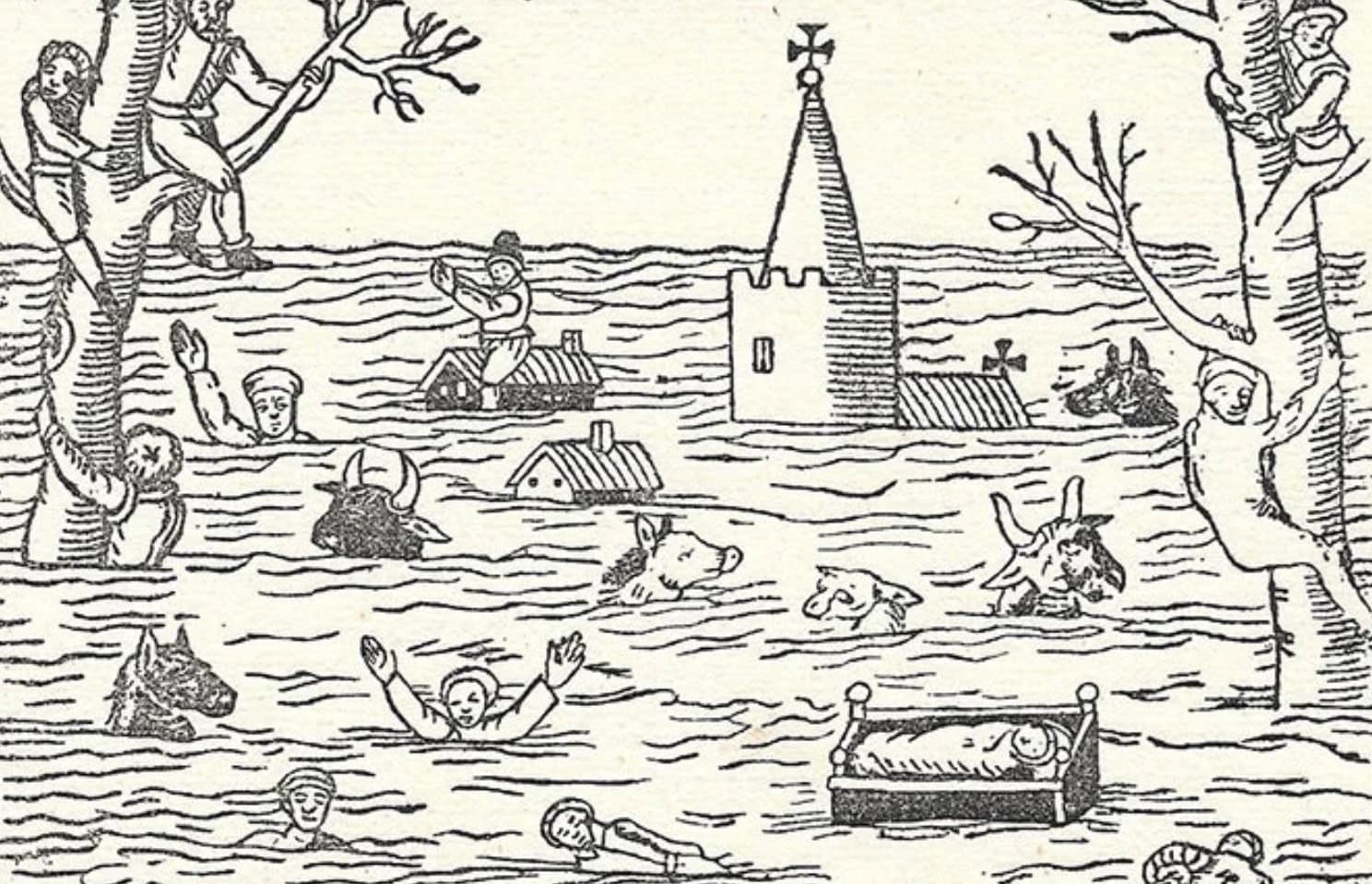
Between the autumn of 1341 and the end of 1343, much of Europe flooded again and again. A study published in Nature in August 2026 counted sixteen major flood events in that short window. Four of them were so large that each, on its own, would be expected only once every 500 to 1,000 years. That clustering is what turns the episode from a curiosity into a warning. Back-to-back flooding of this kind is the scenario most modern flood risk management is not built to handle, and the floods of 1342–1343 show, in unusually well-documented detail, what happens when the water returns before a place has recovered.
The year 1342 saw more great and outstanding floods than any single year in the past seven centuries, and 1343 ranks among the top ten.
What were the floods of 1342–1343?
They were a sequence of extreme river floods across central and southern Europe. For centuries they were remembered as a single event, the St Mary Magdalene's Flood of July 1342. The new research shows that famous flood was only one peak in a much broader run. A team led by TU Wien, with co-authors including Professor Neil Macdonald at the University of Liverpool, reconstructed the sequence from more than a thousand original medieval sources: chronicles, annals, legal and church records, and physical flood marks. What they found was not a famous one-off. It was a two-year emergency.
The Magdalene Flood itself is still the largest documented flood in central Europe of the last thousand years. Along the Rhine and the Main it reached levels expected somewhere between once a century and once a millennium. The rainfall that drove it has been estimated as close to a 10,000-year event. It killed thousands, swept away most of the bridges and settlements along the Middle Rhine and Main, and stripped so much soil from the land that it is still counted as the most severe erosion event in Europe since the last Ice Age. Around it, the record names three more floods of comparable rarity.
- The Candlemas Flood struck western and central Europe in February 1342, after a hard winter and a sudden thaw, hitting Prague and the Danube.
- The Magdalene Flood followed in late July 1342 across southern Germany, above all in the Main valley.
- The Jacob Flood came almost exactly a year later, in late July 1343, across the northern and central Alps and the Carpathians.
- The Bartholomew Flood arrived weeks after that, in late August 1343, along the Rhine, Lake Constance and the Tisza.
Five extreme floods in two years: the string of pearls
The researchers describe the sequence as a "string of pearls". A wet autumn in 1341 set the scene, and then one outstanding flood followed another, spaced by months rather than the decades a single such event would normally take. Each of the four rarest floods would, in isolation, count as a once-in-many-lifetimes catastrophe. They fell inside about twenty-four months.
The wet prelude
A soaked autumn and early floods set the scene across east-central Europe.
Candlemas Flood
A hard winter and sudden thaw. Prague and the Danube are hit hard.
Magdalene Flood
The most severe. Southern Germany and the Main; rainfall near a 10,000-year event.
Jacob Flood
A year on, the northern and central Alps and the Carpathians flood.
Bartholomew Flood
Weeks later, the Rhine, Lake Constance and the Tisza flood again.
Four of the sixteen floods were so large that each would be expected only once every 500 to 1,000 years, yet all four struck within roughly two years.
The timing matters more than any single record level. When floods arrive in quick succession, the ground stays saturated, rivers stay high, and the damage from one event becomes the starting point for the next. Across large areas the water never really drained away between floods, so what might have been recoverable events turned into a prolonged crisis of ruined harvests, famine and disease. The Franciscan friar Johann von Winterthur recorded some 6,000 deaths along the Danube alone. Venice was inundated. Salt production failed in Italy. Bridges and roads were wrecked so widely that historians count the floods among the pressures that helped tip the great Italian banking houses into collapse in 1343.
The one flood we remember, and the ones we forgot
For nearly seven centuries, only the Magdalene Flood stayed in the public memory. The others, every bit as large, faded from the story almost completely. The reason is disarmingly simple. People carved the Magdalene Flood into the walls of their churches and bridges, and left the rest unmarked.
Throughout the whole universe, in the four elements, at different times, there was confusion and disturbance.
A contemporary chronicler, on the years 1342–1343 (translated from Latin)
The floods of 1342 were the first time, in the German-speaking lands, that communities fixed flood marks and memorial plaques to prominent buildings as a warning to the future. Those marks did their job. The Magdalene Flood became the benchmark against which later floods were measured. The floods without marks were quietly written out of history, and with them went the more alarming truth: the great flood had not come alone.
There is a lesson in that for anyone who has been told a site is safe because no one can remember it flooding. Human memory is short. Institutional memory is not much longer. Both tend to settle on a single dramatic event and lose the rest. That is exactly why a proper assessment does not rely on living memory at all. If you have ever wondered why a property can sit in a flood zone when it has never flooded in anyone's lifetime, this is part of the answer. The gap between what communities remember and what the record actually holds runs right through flood risk.
What causes a cluster of floods like this?
No single trigger explains the run. The study points instead to several factors lining up at once, in a way that loaded the dice towards extreme rainfall for years on end.
- Volcanoes cooled the planet. An unusually high number of eruptions in 1340 and 1341, including Iceland's Hekla and several tropical volcanoes, pushed sulphate high into the atmosphere and dimmed the sun.
- The Arctic lost sea ice. From the mid-1330s, sea ice in the Barents Sea and the wider Arctic was in retreat, warming the northern seas against the cooling land.
- The jet stream buckled. Those two changes together weakened the polar vortex and made the jet stream meander and stall. That favours slow-moving, moisture-laden low-pressure systems that sit over one place for days.
- The rain fell on ground that was already full. With storms parked over central Europe and soils saturated from the last flood, each new downpour ran straight off into rivers that were already high.
The particular storm pattern behind the worst of these floods draws warm, wet air up from the Mediterranean and swings it back across central Europe. Meteorologists still watch for it today. It belongs to the same broad family of set-up that produces some of Europe's most destructive modern floods, and it is closely related to the stalled, rain-dumping systems we describe in our explainer on the weather bomb.
Floods here, droughts there
The upheaval was not confined to Europe. The same climatic disturbance shows up on the other side of the world. There were extreme summer rains and flooding along China's Yangtze in the same years, bad enough to damage the Grand Canal, alongside deep droughts in Central America and the American Southwest. Floods in one region and droughts in another, driven by the same wobble in the global system, is not a purely medieval phenomenon. It is the kind of swing between extremes that recent UK research on climate whiplash has flagged as a growing risk here at home.
Why back-to-back floods are the blind spot in modern flood risk management
Here is the uncomfortable part. Modern flood risk management is built, for the most part, around a single design flood of a chosen size. Usually that is the flood with a 1% chance of happening in any given year, plus an allowance for climate change. The approach is sensible, and it is the backbone of how development gets assessed. But it quietly assumes that extreme floods arrive one at a time, with years or decades in between for defences, drainage and land to recover.
Clusters of extreme floods occurring within a few months are rarely considered in flood risk management, yet 1342–1343 shows they are entirely possible.
The 1342–1343 record breaks that assumption. Here is a documented case of several once-in-many-centuries floods stacking up inside two years, and the authors are blunt about what it means. Current flood management leans on the experience of recent decades and the occasional isolated historical flood, and it is not necessarily ready for sequences like this. The "500-year flood" label is part of the confusion, because it sounds like a timetable when it is really a probability. It says nothing about whether a second one might follow the next year. Our explainer on flood return periods and annual probability unpacks why.
How defences and assessments handle, and don't handle, successive events
A flood defence is designed to a standard, often the 1% annual chance river flood. Everything above that standard, or that arrives when the defence is breached, overtopped or worn down, is residual risk. Successive flooding goes straight for that residual margin. A wall that performs perfectly against one design flood may be undermined, saturated or damaged by the time the next one arrives. A compensatory flood storage scheme that relies on emptying between events has no time to empty. A drainage system sized for a storm assumes the ground beneath it can still take water away.
None of this makes the standard approach wrong. It means the single-event mindset has a blind spot, and that resilience matters at least as much as resistance to one modelled peak. Resilience is the ability to take a hit, keep functioning and recover quickly. Climate change sharpens the point, because the science suggests a future with more of the slow-moving cyclones and intense downpours that drive these events. The Environment Agency already requires future rainfall and river flows to be built into assessments through its climate change allowances. Planning for floods that arrive in quick succession is the harder frontier.
The medieval paradigm shift: the disaster that rewrote flood engineering
The people of the fourteenth century had no return periods and no climate models. What they had was a visceral understanding of what repeated flooding meant, and they changed how they built because of it. The 1342–1343 floods set off what the researchers call a real shift in flood mitigation across Europe.
When Prague rebuilt after the floods, the new Charles Bridge was made far more massive, with sharply pointed ice-breaking piers, and the riverbanks beside it were raised by as much as nine metres.
Towns built stronger walls designed to hold back water, not just enemies. Rivers were regulated. Dykes went up along the Danube and the Vistula. Bridges were rebuilt in stone rather than timber, so the next flood could not simply carry them off. The response was not to out-muscle the river with one bigger barrier. It was to build in a way that expected the water to win occasionally, and to survive it when it did. That is a recognisably modern idea, arrived at seven hundred years early.
What flood-resilient design looks like today
The medieval instinct was to accept that water will sometimes get in, and to design so that it does the least harm. That instinct is the foundation of modern flood resilience. The measures have changed. The logic has not.
| Medieval response | The underlying idea | Modern equivalent |
|---|---|---|
| Riverbanks raised, key structures set higher (Charles Bridge, up to 9 m) | Lift what matters above the water | Raised finished floor levels and freeboard |
| Ice-breaking piers, bridges rebuilt in stone | Build to survive the flood, not only resist it | Flood-resilient construction and "build back better" |
| Stronger town walls, dykes, river regulation | Hold water back where it counts | Flood defences and compensatory storage |
| Vulnerable settlements abandoned or raised | Get living space out of harm's way | Floodable voids, undercrofts and amphibious homes |
| Flood marks cut into churches and bridges | Record and warn against the largest known flood | Flood mapping, historical records and flood risk assessments |
Property flood resilience is now a recognised part of planning and recovery. It runs from flood-resilient construction and "build back better" to raising living space above the flood level on floodable voids and undercrofts, and even amphibious homes designed to rise with the water. For homeowners, much of it comes down to practical, well-understood steps to protect a property before the water arrives.
Could a run of floods like this happen again?
The honest answer is yes, and possibly more easily than in the medieval past. The specific chain of volcanoes and Arctic change that set off 1342–1343 was unusual. The underlying mechanism was not. A stalled jet stream parking heavy rain over saturated ground is well within reach of a warming climate, and the science points towards more of the storm systems that cause it. The UK has already had a taste of successive events in recent winters, with named storms arriving only weeks apart. The Great Flood of 1968 and the lessons drawn from the Severn floods of 2000 are, in their own way, reminders that the water tends to come back.
The value of a 700-year-old disaster is that it stretches the imagination past living memory. It shows that the largest plausible flood is bigger than anything the last few decades have served up. It shows that "worst case" should allow for two or three severe floods in a row, rather than one. Adaptation to that reality tends to be slow, held back by cost, politics and simple inertia. The record is clear that it needs to be faster.
If you are planning development on or near a flood-risk site, a properly scoped flood risk assessment is where these questions get answered for your specific location. It looks past the headline flood level to the residual risk, the drainage, and the resilience measures that keep a building safe when the water does arrive. If it would help to talk it through, we are glad to.
Frequently asked questions
Was 1342 really the biggest flood in a thousand years?
The Magdalene Flood of July 1342 is generally regarded as the largest documented flood in central Europe of the last millennium, and the most severe soil-erosion event in Europe since the last Ice Age. What the 2026 study added is that it was not alone. It was one of sixteen major floods in 1341–1343, four of them in the same once-in-500-to-1,000-year class.
How can anyone know how big floods were nearly 700 years ago?
Historians and hydrologists reconstruct past floods from contemporary written records, such as chronicles, legal disputes over land, and church and town accounts, and from physical evidence such as flood marks cut into buildings and layers of river sediment. Where those match a modern reference point, like a known church-floor level or bridge height, researchers can estimate how high the water rose and roughly how rare that would be. The 2026 study drew on more than a thousand such original sources.
Does a flood risk assessment consider more than one flood?
A standard assessment is built around design events of a given probability, plus a climate change allowance, rather than an explicit sequence of floods in quick succession. A good assessment also examines residual risk, meaning what happens when a defence is overtopped or breached, or when drainage is overwhelmed. That is where the vulnerability to repeated flooding really sits, which is why residual risk and resilience matter as much as the headline flood level.
What can homeowners do about repeated flooding?
The most effective response is resilience: measures that let a property take on water with minimal damage, then dry out and recover quickly. That ranges from raised electrics and flood-resistant materials to barriers and, in some designs, living space lifted above the flood level. For an existing home, a practical preparation plan makes a real difference. For new development, the resilience thinking should be built in from the design stage.
Latest news


One of our experienced Flood Risk Consultants will get back to you within 60 minutes
