BESS Flood Risk Assessment: What a Battery Storage Application Needs
Estimated reading time 21 minutes
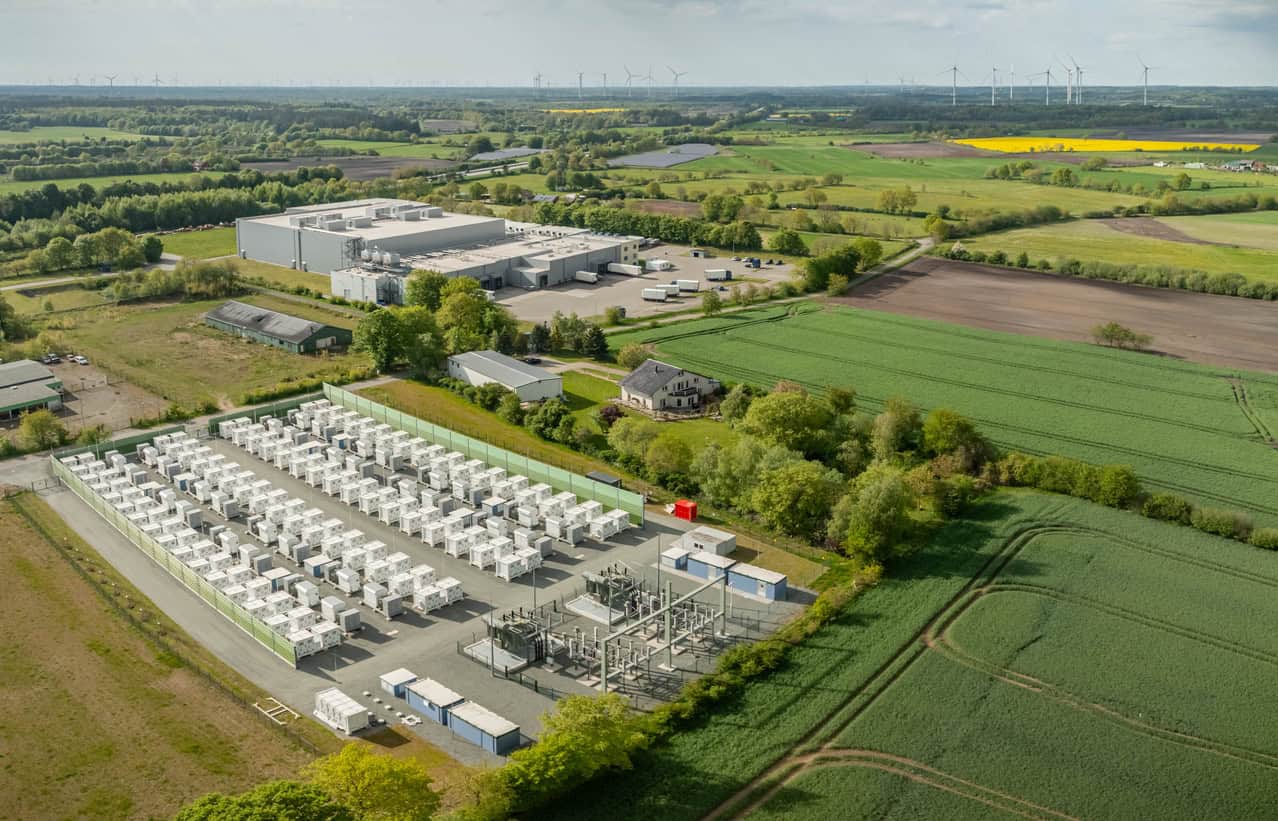
A BESS flood risk assessment is the site-specific report a battery energy storage scheme submits with its planning application, and since 17 August 2026 it has been a harder document to write. Annex F of the August 2026 National Planning Policy Framework treats electricity storage as essential infrastructure. That brings the Exception Test in Flood Zone 3a, a duty to stay operational in a flood, and a drainage problem nobody in England has published a method for: the fire-water a battery site has to contain and the surface water the national standards say it should infiltrate cannot use the same system.
The pipeline makes this worth getting right. The Department for Energy Security and Net Zero puts UK grid-scale battery capacity at 7.5 GW at the end of 2025, with a record 2.3 GW energised in 2025 alone, and every one of those schemes went through a local planning authority.
This article is about standalone grid-scale storage: a site whose reason for existing is the batteries. If yours sit inside a solar development, the assessment is a different animal, and our solar farm flood risk assessment and drainage page covers co-located compounds, panel-array conveyance and the floodplain-storage argument the Environment Agency runs on solar schemes.
Annex F, Table 2 names solar farms, wind turbines, data centres and EV charging stations in their own right. Battery storage is not named. It is covered by the category wording, and that difference changes how the argument has to be run.
When does a battery storage scheme need a flood risk assessment?
A battery scheme needs one whenever Policy F4 is triggered: in Flood Zones 2, 3a and 3b as a matter of course, and in Flood Zone 1 where the site is a hectare or more, sits in a critical drainage area, or is at risk from any other source. The August 2026 rewrite dropped the old "more vulnerable use" qualifier from the Zone 1 trigger, so a Zone 1 battery site now qualifies on area alone. Our guide to the 2026 NPPF flood risk and drainage changes sets out what else moved.
In practice almost every grid-scale scheme is caught, and the ones that argue their way out usually get there by measuring the wrong thing. Where the trigger is met, a BESS flood risk assessment has to be site-specific: a screening note against the national maps will not discharge it.
- The hectare rule is site area, not compound footprint. A 0.6 ha battery compound inside a 1.4 ha red line is over the threshold, and it usually is once the access track, the substation bay and the landscape buffer are inside the line.
- Critical drainage areas cut across the flood zones. A Zone 1 site inside one is caught whatever its size, and the designation sits with the lead local flood authority rather than on the national map. Our guide to Flood Zones 1, 2 and 3 covers the probability side.
- Any-source risk is the trigger most often missed. Surface water is the usual culprit on the flat, low-lying, grid-adjacent land these schemes are drawn to.
- Proximity to a main river brings the Environment Agency in. Standing advice requires consultation within 20 metres of a main river.
- The drainage work travels alongside it. Policy F8 makes the 2025 National Standards mandatory, and on a battery site a surface water drainage strategy usually carries more weight than the flood risk assessment does.
Where a scheme sits in Flood Zone 1 with surface water risk only, Policy F5's surface water sequential test exemption may take the Sequential Test off the table. It does not take the assessment off the table.
Is a BESS essential infrastructure under Annex F?
Yes, but by category rather than by name. Annex F, Table 2 places within essential infrastructure "essential utility infrastructure which has to be located in a flood risk area for operational reasons, including for electricity generation and storage, electricity network infrastructure". A grid-scale battery is electricity storage, so it sits inside that wording. What it does not have is a row of its own.
That gap matters more than it looks. Solar farms and wind turbines are each named separately, and data centres, EV charging stations, hydrogen production, carbon capture and heat networks were all added by name in August 2026, as our guide to the flood risk vulnerability classification sets out. Battery storage sits inside a phrase describing a class. So where a solar applicant points at a row and moves on, a battery applicant has to argue the site is essential utility infrastructure that has to be in a flood risk area for operational reasons, and the words "has to be located" are doing real work in that sentence.
| Use | How Table 2 reaches it | Category |
|---|---|---|
| Solar farm | Named in its own right | Essential infrastructure |
| Wind turbine | Named in its own right | Essential infrastructure |
| Data centre | Named, added August 2026 | Essential infrastructure |
| EV charging station | Named, added August 2026 | Essential infrastructure |
| Grid-scale battery storage | Covered by "electricity generation and storage" | Essential infrastructure |
| Substation | Covered by "electricity network infrastructure" | Essential infrastructure |
None of this is a change of category. The December 2024 wording read "infrastructure for electricity supply including generation, storage and distribution systems", so storage has been essential infrastructure throughout. What changed is that the table now sits in the Framework rather than in guidance, so a "refused" outcome is policy rather than a judgement an inspector can weigh away.
The commonest error we still see in battery assessments is a compound classified as less vulnerable on the reasoning that nobody sleeps there. Vulnerability describes the consequence of flooding, not the occupancy.
Two neighbouring pieces cover the plant a battery site shares its red line with: flood risk assessments for electrical substations deals with the network operator's own standards, which run alongside planning and satisfy nothing in it, and our data centre piece works through the same operational-in-flood duty on a use that has people in it.
What the Exception Test asks of a battery storage site
Essential infrastructure is appropriate in Flood Zones 1 and 2 without an Exception Test, and needs one in Flood Zone 3a and again in the functional floodplain. That is the bargain the classification strikes. It opens Zone 3b to a battery scheme where housing would be refused outright, and it attaches an operational duty ordinary commercial development never carries.
The Sequential Test comes first, under Policy F5. Here a battery applicant is in an unusually strong position, because a scheme has to connect where there is grid capacity and Policy F5 now caps the area of search to the development's likely catchment. A connection offer at a named substation is the best evidence in the file. Put it in the Sequential and Exception Test report rather than in a covering letter, where it will not be read; our explainer on how the two tests work covers the three limbs the exception test now runs to.
The footnotes to Table 3 are where the design consequences sit.
Essential infrastructure in Flood Zone 3a "should be designed and constructed to remain operational and safe in times of flood". In the functional floodplain it must additionally "result in no net loss of floodplain storage" and "not impede water flows and not increase flood risk elsewhere".
NPPF, August 2026, Annex F, notes to Table 3
Remaining operational is not the same as surviving. A compound whose transformers sit above the design flood level but whose access track is under 400 millimetres of water has not remained operational, and neither has one whose fire-water containment is full of floodwater when the fire starts. A BESS flood risk assessment that stops at "the batteries are above the flood level" has answered a different question from the one Policy F7 asks.
Which climate change allowance applies to a 40-year permission?
The Environment Agency's peak river flow and rainfall allowances are selected by the development's lifetime, and battery storage has an awkward one. Planning practice guidance sets a starting point of at least 75 years for non-residential development, but allows a shorter period where a time-limited condition controls the development. Battery permissions are routinely granted for 40 years.
Forty years is a convention, not a policy figure. The Hawkchurch and Axminster appeals both concerned 40-year schemes, and Boston Borough Council's Bicker Fen permission carried a condition expiring "40 years from the date when the Battery energy Storage System first becomes operational". The equipment does not last that long either: government guidance puts a lithium-ion module's operating life at around ten years, and the Axminster inspector worked on battery replacement at roughly year 15.
A 40-year permission granted in 2026 runs to about 2066, straddling the boundary between the Environment Agency's 2050s and 2070s epochs. A 75-year lifetime would sit firmly in the 2070s epoch and, for peak rainfall, a higher allowance.
Take the lifetime position deliberately and write down why. An assessment that quietly adopts the 40-year condition to reach a lower allowance, on a use the same Framework says must remain operational in a flood, hands the objector an argument for nothing. Our note on which climate change allowance to use walks through the epoch and percentile choices.
Fire-water containment versus the discharge hierarchy
This is where most battery drainage strategies come apart. The 2025 National Standards for SuDS put infiltration to ground at priority 2 of the five-tier discharge hierarchy and require evidence that every higher priority has been used to the maximum extent practicable. The fire and rescue service expects a battery compound to hold on to its water instead.
Both positions are right. They are describing different water. The standards apply to runoff that is "essentially uncontaminated and consists predominantly of rainwater", and fire-water off a lithium-ion battery is not that.
- Standard 1.2 sets the hierarchy. Reuse, infiltration, a surface water body, a surface water sewer, then a combined sewer. Higher cost alone is not a reason to drop down it.
- Standard 4.8 carves out the worst cases. Some land uses carry a pollution risk "so high that it is unlikely to be appropriate for them to drain to surface water or groundwater using a 'SuDS approach'", and need self-contained storage or treatment instead. Battery storage is not among its examples, so applying 4.8 to a compound is an argument to be made rather than a rule to be quoted.
- Standard 4.11 is the clause containment actually hangs on. The drainage design must be able to "intercept and contain a pollution incident" while allowing contaminated water to be removed, with penstocks or other proprietary measures where the risk is high.
- The water quality method cannot see the problem. The Simple Index Approach in CIRIA C753, which the standards adopt by reference, indexes suspended solids, metals and hydrocarbons, and it was built for routine runoff rather than for an incident.
That last point deserves stating plainly, because it is the one most likely to be waved through. Research published in Batteries in 2024 measured lithium-ion firefighting run-off and found fluoride at up to 142 mg/l, ethylene carbonate above 1,000 mg/l and, scaled to a realistic release, cobalt at roughly 2,450 times the predicted no-effect concentration for freshwater. Fluoride, lithium and the carbonate electrolyte solvents appear nowhere in the index a compliant treatment train is designed against. A battery yard can score as a high-hazard industrial surface, get a textbook treatment train, and still be unassessed for everything that characterises a battery fire.
Battery storage scheme in a flood zone?
We write the flood risk assessment and the drainage strategy together, so the containment case and the levels agree with each other before an officer finds they do not.
Get a fixed quoteHow big does the fire-water containment need to be?
Nobody in England publishes a method. The National Fire Chiefs Council's December 2025 guidance gives a water supply figure, hydrants achieving at least 25 litres per second or a static supply of roughly 180,000 litres sustaining that for two hours, then says containment "capability/capacity should be based on anticipated water application rates". It never states a volume. It also tells local planning authorities not to treat it as a mandatory set of recommendations, and the fire and rescue service is not a statutory consultee, so a well-founded objection can arrive late and unanswered.
That matters for a BESS flood risk assessment because the containment volume is the number a reviewer will ask for, and there is no method to point at.
The gap runs deeper. The Environment Agency withdrew PPG18, its own fire-water containment guidance, in December 2015 and has published nothing since. GPP18, the current containment guidance, was issued in November 2024 by the Scottish and Northern Irish regulators and says on its own front matter that it is "not endorsed by the Environment Agency as regulatory guidance in England, or Natural Resources Wales as regulatory guidance in Wales". On this one question, Scotland and Northern Ireland are better served than England.
"In many instances, where fire is a credible scenario, local containment of firewater is unlikely to be a feasible option and therefore either tertiary containment, or for larger sites, remote secondary containment will be necessary."
CIRIA C736, Containment systems for the prevention of pollution, 2014
What is left is CIRIA C736, which is sound, free and carries no regulatory status, together with the volume methods it draws from ISO/TR 26368. Those methods size containment from tonnes of stored flammable material or from fire area. None is keyed to megawatt-hours, so turning a battery site into a containment volume is currently judgement dressed as calculation.
The volumes make that uncomfortable.
| Source | Volume or duration | What it represents |
|---|---|---|
| A UK pumping appliance | 1,800 to 2,000 litres | Exhausted in under five minutes |
| NFCC static supply recommendation | About 180,000 litres | Two hours at 25 litres per second |
| Hawkchurch, containment proposed | 1,153 m³ | Around 11 hours of firefighting |
| Carnegie Road, Liverpool, 2020 | 59 hours | Defensive firefighting, one container |
| Victorian Big Battery, 2021 | About 900,000 litres | Disposed of after a six-hour, two-unit fire |
The Australian number is the one to sit with. Two of 212 Megapacks were damaged, the fire service deliberately did not apply water into either unit, visible flames subdued in about six hours, and roughly 900,000 litres still had to be taken off site. That is five times the supply the NFCC treats as adequate provision, from an incident that went about as well as a battery fire can go.
England's own precedent is blunter. At Carnegie Road in Liverpool in September 2020, the run-off went into a gravel soakaway under the containers because there was nothing else for it to go into. Merseyside Fire and Rescue Service recorded that the run-off contained hydrofluoric acid, confirmed by laboratory analysis, and notified the Environment Agency at 02:46. Contaminated water infiltrating to ground, on a site with no containment designed for it, is not a hypothetical risk here. It has already happened once.
What the drainage strategy has to set out
A battery site needs two water systems that never meet, and the drainage strategy has to show both of them and the switch between them. Treating the compound as ordinary hardstanding with an attenuation basin is the failure mode that surfaces late, usually once the connection agreement is signed and a redesign costs real money.
- Separate the catchments on the drawing. Roofs, tracks and landscape drain to the sustainable drainage system; the battery compound and its transformer bays drain to a sealed route. The boundary between them should be a line an officer can point at.
- Show the isolation. Penstocks or equivalent valves close the compound's outfall on activation so nothing reaches the attenuation feature or the watercourse during an incident. Say who closes them, how, and how long it takes.
- Size the containment and show the working. State the water application rate assumed, the duration, the rainfall running at the same time and the freeboard. Name the method, because the reviewer's first question is which one you used.
- Rule infiltration out under the compound, and say why. Infiltration testing may still be needed for the clean catchment, and BRE 365 is the method for it. The argument for the battery yard is that priority 2 is unavailable there on water quality grounds, evidenced against Standard 4.
- Design for removal as well as retention. Contaminated water leaves by tanker, so the strategy needs hardstanding, a turning head and an access route that works when the site is otherwise closed. The Hawkchurch inspector found off-site removal impractical partly because of what the tanker movements meant on rural roads.
- Reconcile the levels. One drawing carrying existing ground levels, the design flood level, finished compound levels, plinth levels and the containment invert, all in metres above ordnance datum, settles more reviewer queries than any amount of text. A topographical survey is usually the cheapest way to get there.
Where the compound sits in Flood Zone 3a or 3b, a below-ground containment tank is also a loss of floodplain storage, and the no-net-loss footnote catches it. Containment volume against compensatory flood storage is the interaction battery drainage strategies most often leave unresolved, and it is worth resolving on paper before an officer finds it.
If you are weighing up whether the scheme needs both documents, our note on the flood risk assessment and the drainage strategy covers where the line falls.
England, Wales and Scotland take different routes
The consenting route diverged in 2020 and again in 2025, and the flood document changes name with it. In England, the Infrastructure Planning (Electricity Storage Facilities) Order 2020 took electricity storage other than pumped hydro out of the nationally significant infrastructure regime from 2 December 2020, so a battery scheme of any size is determined by the local planning authority.
| England | Wales | Scotland | |
|---|---|---|---|
| Consenting route | Local planning authority at any capacity | LPA below 50 MW; Welsh Ministers 50 to 350 MW under the Infrastructure (Wales) Act 2024, from 15 December 2025 | Section 36 Electricity Act consent above 50 MW |
| Flood policy | NPPF Chapter 18 and Annex F | TAN15 | Scottish planning policy |
| Flood document | Flood risk assessment | Flood consequence assessment | Flood risk assessment |
| Separate drainage approval | None, Schedule 3 never commenced | SuDS Approving Body approval required | None |
| Fire-water containment guidance | None currently endorsed by the regulator | None currently endorsed by the regulator | GPP18, with fire-water outside SEPA's general binding rule for site run-off |
Wales is the trap. A 50 to 350 MW scheme now goes to Welsh Ministers, needs a flood consequence assessment written to TAN15 rather than a flood risk assessment, and needs separate SuDS Approving Body sign-off on the drainage design. England has no equivalent of that last consent, and teams used to English programmes routinely underestimate it.
Six things a BESS flood risk assessment needs beyond a template
Most of a battery flood risk assessment reads like any other. These six are the parts a generic template will not have, and they are what a reviewer looks for first.
- A reasoned vulnerability position. Not "essential infrastructure" asserted, but the Annex F wording quoted and the operational-reasons case argued, because there is no named row to point at.
- A stated lifetime, and the allowance that follows from it. Name the 40-year condition or the 75-year default, say which epoch it puts you in, and show the allowance you used.
- One reconciled levels drawing. Ground, flood, compound, plinth and containment invert, in mAOD, on a single sheet.
- Two drainage systems, drawn separately. The clean sustainable drainage train and the sealed fire-water route, with the isolation point marked.
- An exceedance route that avoids the electrical assets. Where water goes when the design event is exceeded, and why that path misses the transformer bay and the containment.
- A continuity position rather than an evacuation plan. An unmanned site has nobody to evacuate. The Framework asks whether it remains operational and safe, which is a different question needing a different answer.
Regulation is moving underneath all of this. There is still, as the House of Commons Library puts it, no single dedicated legislation for battery storage. Defra confirmed in April 2026 that it will take forward work on bringing battery storage into environmental permitting, and the Environment Agency plans an evidence-gathering project on the sector. Nothing has commenced. Until it does, the containment case is made in the planning application or it is not made at all.
Frequently asked questions
What water consents does a battery site need alongside planning permission?
There is no battery-specific environmental permit in England yet, but the ordinary consents still apply. Crossing or culverting an ordinary watercourse for an access track or a cable route needs ordinary watercourse consent from the lead local flood authority, which takes two months to determine. Work within eight metres of a main river or its defences needs a flood risk activity permit. Both sit outside the planning application and both are routinely left until too late.
Who actually assesses fire-water containment on a planning application?
In practice, nobody with a duty to. The lead local flood authority comments on drainage but is looking at rainfall, not incident water. The fire and rescue service is not a statutory consultee, and the National Fire Chiefs Council has said it is not seeking to become one, so its comments carry no obligation on anyone to respond. The Environment Agency has been largely absent from battery casework. That leaves the case officer, working from whatever the applicant chose to submit.
What happens to the flood risk assessment when the batteries are replaced?
Usually nothing, and that is worth thinking about. A 40-year permission typically sees the cells replaced around year 15, on an assessment written to the allowances current at the original application. Replacement inside the approved footprint is unlikely to need a fresh application, so the design flood level a site is built to can end up 25 years older than the equipment standing on it. Where a scheme is marginal on levels, building in headroom at the outset costs far less than revisiting it later.
Does the Environment Agency object to battery schemes on flood risk grounds?
Rarely, on the published record. The Agency's objections dataset has no battery category, and in both the Hawkchurch and Axminster inquiries, where fire-water pollution was the deciding issue, it either did not comment or did not respond substantively. Battery schemes have been failing on water pollution rather than on flood risk, with the Agency largely absent from the casework.
Do we need a separate fire-water assessment as well as a drainage strategy?
Usually the containment case belongs inside the drainage strategy rather than beside it, because both systems share a site, a rainfall event and a set of levels. What matters is that the containment volume, the method behind it and the isolation arrangement all appear on the submitted drawings, and that the flood risk assessment and the drainage strategy agree with each other on levels.
Our scheme was refused. Is flood risk usually the reason?
Not on the recent record. The two battery appeals that have turned on water both turned on pollution of groundwater from fire-water, not on flood risk. Where drainage has been a main issue, inspectors have generally accepted it can be handled by condition. If a refusal cites water, read carefully which water it means, because the evidence that answers one does not answer the other.
Getting a battery scheme through planning turns on evidence a template does not carry: a vulnerability position you have reasoned rather than asserted, a lifetime you have argued rather than inherited, and two drainage systems shown to be separate. Unda prepares flood risk assessments for planning and drainage strategies for renewable and energy infrastructure across England and Wales, and will look at a scheme before it goes in or after an objection has landed. Call 01293 214444 or email enquiries@unda.co.uk for a fixed quote within the hour.
About the author. Jesy is a Flood Risk Consultant specialising in property purchase, insurance and due diligence. Unda has been trading since 2014, is a CIWEM Business Partner with CIWEM member and chartered (C.WEM MCIWEM) consultants, and has delivered 5,000+ flood risk assessments and drainage strategies across England and Wales.
Jesy Ferry · MSc, BSc (Hons), GradCIWEM
Latest news



One of our experienced Flood Risk Consultants will get back to you within 60 minutes
