How to Drive Through Flood Water
Estimated reading time 27 minutes
Knowing how to drive through flood water safely comes down to one rule above all others: if you can avoid it, don't drive through it at all. The Environment Agency advises drivers not to enter water that is moving or more than 10cm deep, because just 30cm of flowing water can move a car and 60cm can float it. When crossing is genuinely unavoidable, drive slowly in a low gear, hold a steady bow wave, and test your brakes the moment you are through.
At Unda we assess and reduce flood risk for homeowners, businesses and local authorities across the UK, which means we spend a good deal of time looking at why particular roads flood and what the water does to them afterwards. This guide draws on the work our flood risk consultants do to explain what to do at a flooded road, why flood water behaves the way it does, and, more usefully, what it is hiding. Most driving advice stops at depth. Depth is the one variable you can reasonably estimate from the driver's seat, whereas the road surface underneath, and whatever the flow has carried onto it and dumped there, stays unknowable until you are already committed.
Driving through flood water is the leading cause of death during a flood, according to the Environment Agency, yet most drivers say they would still risk it.
Flood water depth & danger
How deep is too deep?
Depth is only half the story, because moving water is far more dangerous than the same depth standing still. These are the numbers that catch drivers out.
Should you drive through flood water at all?
In almost every case, no. The safest decision is to turn around and find another route, even where that adds an inconvenient half-hour to the journey, because flood water conceals its depth, its velocity and whatever state the carriageway underneath is in, and those three unknowns are what catch drivers out. A short detour is always cheaper than a written-off car or a rescue.
Despite this, survey after survey finds most drivers would still chance it. A joint Environment Agency and AA study published in February 2018 found that 68% of motorists would drive through flood water, with fewer than a third saying they would turn around. A follow-up survey published in December 2019 put the figure at 74%, against just 24% who would find another route. The same survey found that 23% of drivers judge whether a flooded road is passable by whether they can still see the kerb, and 12% simply wait to see whether another vehicle makes it across.
Both of those methods fail for the same reason. The kerb tells you nothing about the crown of the road or the gully beside it, and the car in front tells you only that the road held up for one crossing, which on a scoured surface it may not do twice. If your route floods often enough that this has become a regular decision, it is worth checking the flood risk at your postcode before you set off rather than at the water's edge. The Environment Agency's own mapping changed in May 2026, when surface water climate-change layers were added for the first time.
Surface water flooding is often deeper than it looks, and just 30cm of flowing water is enough to float your car. Never drive through flood water. Turn around and find another route.
Caroline Douglass, Environment Agency · via GOV.UK
What depth of water is safe to drive through?
As a general rule, do not drive through water more than 10cm (4 inches) deep. Larger 4x4s and SUVs with a higher air intake may manage more, but you can never be sure of the depth until you are already in it, and the ground beneath may have washed away. For an ordinary car, anything above the bottom of the doors is too deep.
The reason these numbers matter is the sheer force of moving water, combined with the speed at which surface water flooding can turn a familiar road into a hazard after heavy rain. In built-up areas it is the dominant cause of flooded carriageways, and surface water risk in England's cities is now the largest single flood-risk category by property count. It is also why so much current drainage thinking is about giving rainfall somewhere to go other than the road. The table below sets out what each depth does to a vehicle, and why moving water changes the arithmetic entirely.
| Water depth | What it does | What to do |
|---|---|---|
| Up to 10cm | The safe limit for an ordinary car; roughly the bottom of the doors. | Cross only if standing, slow and checked. |
| 15cm (flowing) | Fast-moving water can knock an adult off their feet. | Do not wade; turn back. |
| 30cm (flowing) | Enough to move an average family car. | Never enter; find another route. |
| 60cm (standing) | Floats most vehicles; you lose all control. | Never enter under any circumstances. |
One piece of physics explains the jump between those rows. Force rises with the square of velocity, so when the speed of the water doubles, the force pushing sideways on your car roughly quadruples. A depth that is trivial in a still puddle becomes irresistible in a stream running across the carriageway.
What is under the water that you cannot see?
The road you drive onto is not the road you can see. Flood water conceals three things that matter more than depth: a carriageway that may have been scoured out from beneath, drainage covers that pressure may have displaced, and whatever the flow has carried downstream and deposited along the way. All three are invisible from the driver's seat. None of them is solved by having a large car.
- The surface may have gone. Fast flow scours material out from under the road, leaving a void or an open hole where the carriageway looks continuous. This is how an apparently shallow crossing drops a wheel a foot or more.
- Covers lift. Pressure in a surcharged sewer or drain can push a manhole cover off its frame and leave an open shaft under the water. A displaced cover is neither visible nor marked.
- Gullies and verges disappear. The edge of the road, the kerb line and the gully all vanish under a flat sheet of water, so drifting wide finds the ditch rather than the carriageway. A gully that is silted up or blocked is often why the water is there in the first place.
- Debris travels and lands. Branches, fence panels, wheelie bins and silt are carried by the flow and deposited where it slows, which is usually the low point everyone drives through.
This is not theoretical. When Somerset Council declared a major incident on 29 January 2026, with the A361 closed between East Lyng and Burrowbridge and around fourteen minor roads impassable, the warning issued alongside it was explicit: even where the water had dropped, there might be hidden hazards of debris or damaged surfaces. The hazard outlasts the flood.
Silt and grit left on the road after the water drops behave like ball bearings under braking, and a surface that has spent days submerged is where potholes open first.
That material has to come from somewhere. The first flush of a storm strips the accumulated silt, rubber and oil off every hard surface in the catchment and carries it downhill, and the flooded low point of the road is where the flow slows down enough to drop it.
Nor is any of this rare. England recorded 112.5mm of rain in February 2026, which is 170% of the 1991 to 2020 average, closing a winter in which England took 342.1mm and recorded its eighth wettest since 1836, part of the swing between extremes UK river research is now measuring. Cornwall, Leicestershire and the West Midlands all had their wettest winter on record. Roads that flood repeatedly are roads whose surfaces are being taken apart from underneath, which is why the way UK rainfall is changing shows up in the aftermath of a wet winter as potholes hidden in puddles rather than as flooding. Where a whole area floods this reliably, the council may already have designated it a critical drainage area. It is also worth understanding what a 1-in-100-year flood actually means, because the phrase describes an annual probability rather than a timetable, and flash flooding can put water across a road in under an hour with no river involved at all.
How should you drive through standing flood water?
If you have judged the water shallow enough and the road safe, cross slowly and deliberately. Standing water is the only flood water you should ever consider driving through, and even then only after checking the depth.
- Check the depth first. Where it is safe, get out and measure with a stick, or watch another vehicle cross before you commit. If a car ahead stalls, do not follow.
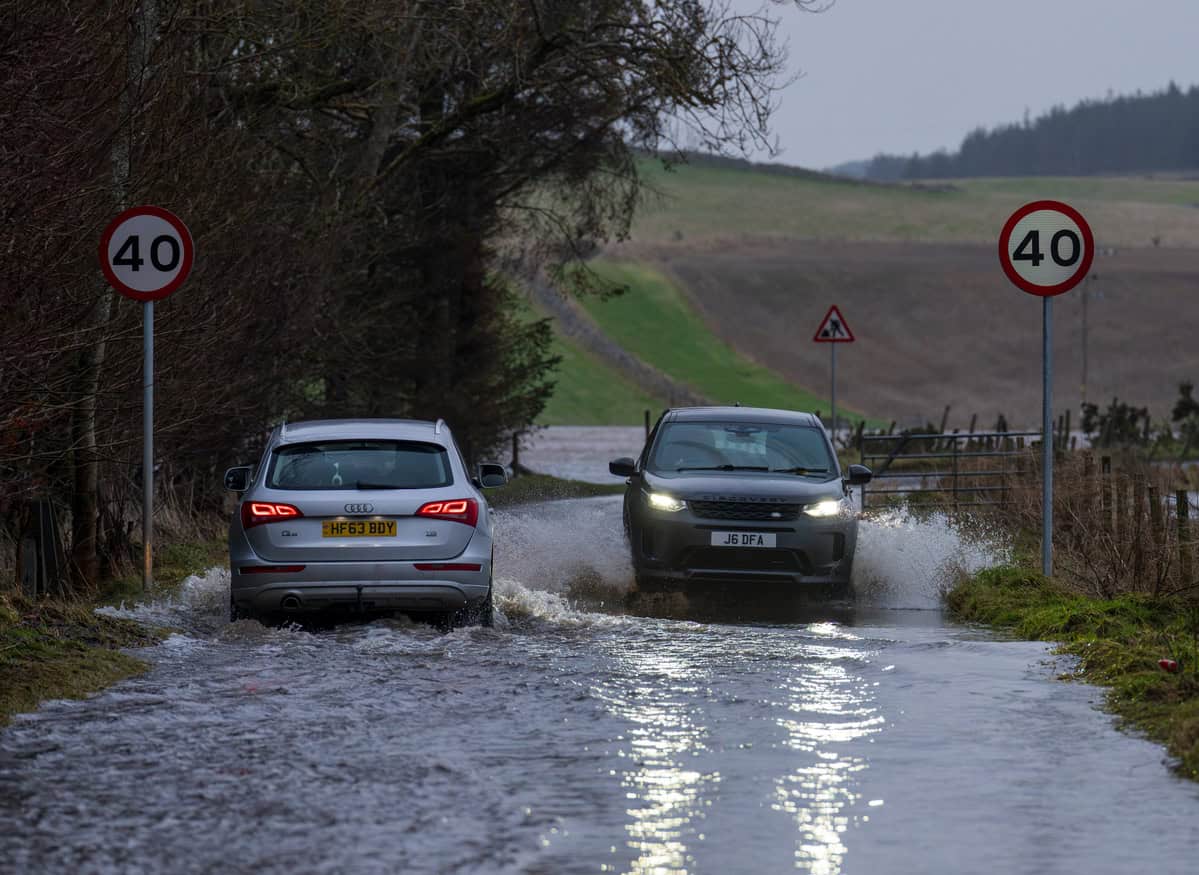
- Wait your turn. Let approaching traffic clear. Two vehicles crossing at once push a wave over each other's bonnets, and the oncoming car's bow wave is deeper than the water you measured.
- Drive in the middle. Roads are usually highest, and therefore shallowest, along the crown. Verges hide deeper water, soft ground and dislodged drain covers.
- Keep it slow, around 3 to 4 mph. A crawl creates a small bow wave in front of the car that pushes water away from the engine bay, while going faster forces water up into the air intake.
- Don't stop and don't change gear mid-crossing. A steady, continuous crawl prevents stalling and keeps the exhaust clear.
- Dry your brakes on the far side. Once clear, apply the brakes gently several times to restore full braking.
Why step two matters more than it sounds
Crossing at the same time as an oncoming vehicle is one of the commonest ways a careful driver ends up with a flooded engine. The two bow waves meet in the middle, and the water arriving over your bonnet is deeper and faster than anything you assessed from the bank.
It also pushes both drivers off the crown of the road towards the verges, which is exactly where the hidden depth, the soft ground and the displaced covers are.
The Driver and Vehicle Standards Agency gives the same method: stop and assess rather than driving straight in, keep to the shallowest part because the water is deepest near the kerb and shallowest at the crown, and drive in first gear as slowly as possible while keeping engine speed high and steady by slipping the clutch.
What gear should you use, and how do you drive an automatic through flood water?
Stay in a low gear with the engine revs high. In a car with a manual transmission, select first gear and slip the clutch to hold higher-than-normal revs without gaining speed, which keeps the exhaust pressurised so water cannot flow back into it. In an automatic, manually select the lowest gear, usually marked "1" or "L" or available as a low setting on the paddle, which achieves the same effect and stops the gearbox changing up mid-crossing. This is the answer driving instructors are asked for when a pupil in a manual car meets shallow flood water: first gear, clutch slipping, revs high, no gear change until the far side.
The goal in either case is the same: move slowly over the ground while the engine turns quickly. High revs and a steady bow wave protect the engine and the exhaust, and a low gear is simply how you hold those revs at a walking-pace crawl.
Why is flowing flood water so dangerous, and when should you turn back?
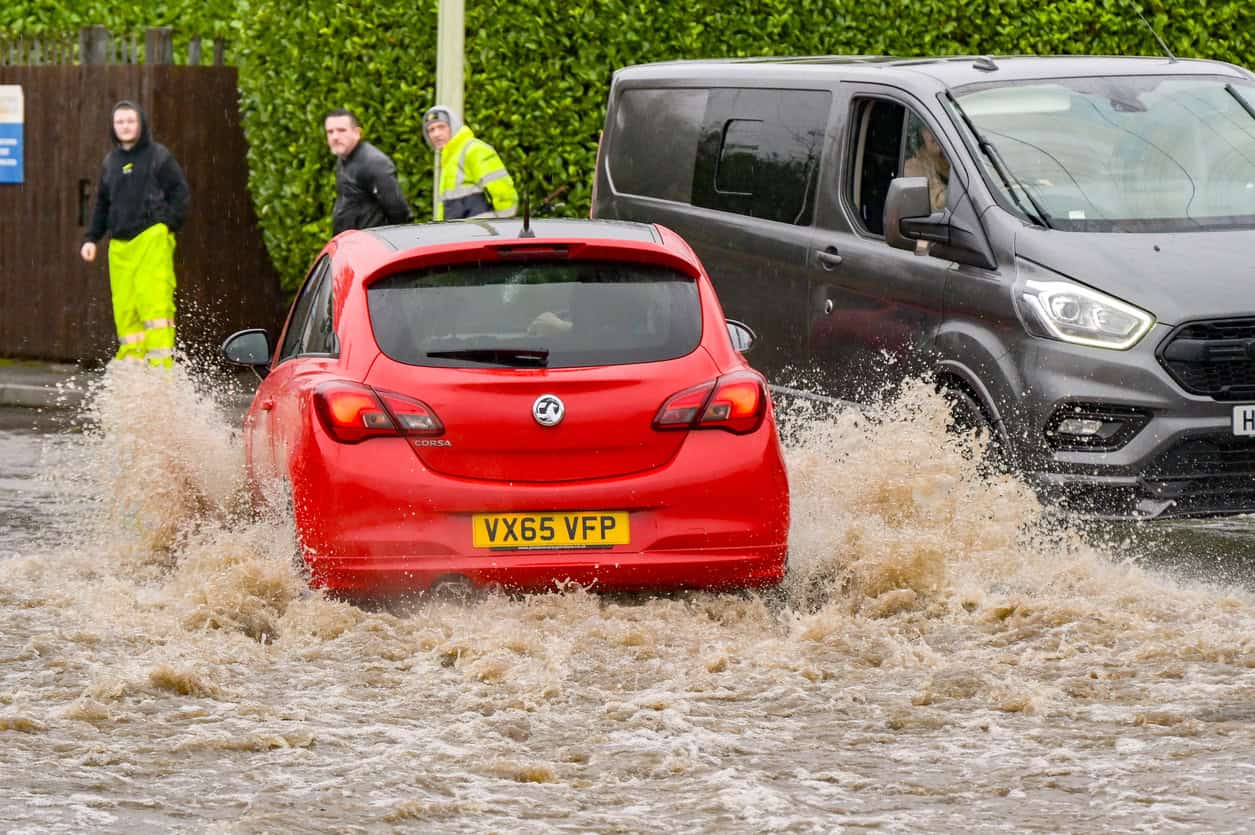
Never drive into water that is visibly moving. Flowing flood waters belong in a different category of danger to standing water, because even a shallow, fast-moving stream can sweep a car sideways, and once the tyres lose grip you have no control at all. Around 30cm of flowing water can shift a vehicle, and deeper or faster flows can carry it off the road entirely.
- It hides what it drags. Moving water carries branches, rocks and wheelie bins, any of which can strike or trap a vehicle.
- It scours the road away. Fast flow washes out the surface beneath, leaving hidden holes you cannot see.
- Fords are the worst offenders. Barriers and closed-road signs are placed using local knowledge of where water runs fastest and deepest, so ignoring them is how serious accidents happen.
- Wading is not the safe option. As little as 15cm of fast-flowing water can knock an adult off their feet, so leaving the car is rarely safer than staying with it.
A ford is a road crossing a watercourse, which makes it the point where the water runs fastest, the bed is least stable and the level changes quickest. Environment Agency and AA figures reported by the BBC put UK flood rescues at 21,687 since 2009, with three rural lanes accounting for 202 call-outs in five years between them: Watery Gate Lane in Leicestershire, Rufford Lane in Nottinghamshire and Houndsfield Lane in Solihull. Leicestershire went on to record its wettest winter on record in 2025 to 2026, so the two facts belong together. A ford is also usually an ordinary watercourse with a riparian owner rather than a piece of road drainage, which is part of why nobody is going to smooth it out for you.
What do the Highway Code and the theory test actually say?
The Highway Code deals with flood water in a single rule, and that rule is about brakes rather than crossing. Rule 121 states that if you have driven through deep water your brakes may be less effective, that you should test them at the first safe opportunity by pushing gently on the brake pedal, and that if they are not working fully you should apply light pressure while driving slowly to dry them out. That is the rule most people are reaching for, and it is routinely mis-cited to the adverse weather section, which covers rain, aquaplaning, ice and fog rather than floods. Nothing else in the Highway Code tells you how to cross a flooded road, which is why the DVSA guidance below carries the technique.
The theory test asks the same material in a handful of fixed forms. These are the questions people search for word for word, so here they are answered plainly.
| The question | The answer |
|---|---|
| To avoid damage to a car, what is the maximum depth at which you should travel through flood water? | 10cm, or 4 inches. |
| You've just gone through flood water. What should you do to make sure your brakes are working properly? | Test them at the first safe opportunity, then dry them by driving slowly with light pressure on the pedal. |
| What should a driver do where a section of road ahead has a shallow flooded area? | Slow down, keep to the crown where the water is shallowest, drive through in first gear with high revs, and test the brakes afterwards. |
| You've driven through a ford. What should you do when you're out of the water? | Test the brakes before you build up speed. |
| If you must drive through a flood, what is the best approach? | Slowly, in a low gear, with the engine speed kept high, and without stopping. |
The pattern behind all five is worth more than the individual answers. The examiner is testing one thing: whether you understand that the crossing is not finished when you reach dry road.
What should you do after driving through flood water?
Test your brakes as soon as it is safe. Water makes brakes far less capable of stopping the car, so the first thing to do after any crossing is dry them out under Rule 121: drive slowly and apply light brake pressure to generate heat and evaporate the moisture, checking they bite normally before you rely on them.
Once the brakes feel right, stay alert to anything else that has changed. Listen for new grinding or knocking noises, watch for dashboard warning lights, and notice any pulling, vibration or sluggish response in the steering or the acceleration. If a warning light appears or the car feels wrong, stop and call for assistance rather than driving on. In the days afterwards, check for damp in the cabin, because moisture trapped under carpets can cause mould and electrical faults weeks later.
How do you know if water has got into your engine?
The warning signs of water in the engine are usually obvious. The most common cause of serious flood damage is water drawn in through the air intake, and it takes very little to do it. An egg-cupful is enough to wreck an engine, in the words of the AA's Patrol of the Year. This is known as hydrolock, and it often means a replacement engine rather than a repair.
- It won't fire, or cuts out. The engine cranks or whirrs fast but won't start, or starts briefly then dies.
- A strong smell of fuel. Particularly noticeable near the exhaust.
- Rough running or knocking. Lumpy idling, knocking noises, or the car refusing to start at all.
If you suspect water has reached the engine, do not keep trying to start it, because turning the engine over can turn a recoverable situation into a destroyed one. Switch off and call roadside assistance.
What should you do if your car stalls or gets stuck in flood water?
If your engine stalls in flood water, do not try to restart it. Restarting draws water through the air intake and can cause catastrophic engine damage. Leave the car in gear, assess whether the water is rising, and decide quickly whether it is safer to stay or to get out.
If the water is rising or the car is being moved by the current, get out immediately, leave your belongings, move to higher ground, then call 999 if anyone is in danger. Never wade into fast-moving or deep water to escape or to push a car; your life is worth far more than the vehicle.
If the water is still, shallow and not rising, it is usually safest to wait in the vehicle and call for help. Knowing how the emergency services respond to flooding, including the RNLI's flood rescue teams, is a reminder that rescue is a last resort rather than a plan.
Can you drive an electric car through flood water?
Electric vehicles are no safer in deep flood water than petrol or diesel cars, and the same 10cm rule applies. Their battery packs and electrical components are sealed and waterproofed for rain and shallow standing water, and there is no engine air intake to flood, but deep water can still reach connectors, motors and cabling and cause expensive faults. Crossing beyond the manufacturer's stated wading depth risks system damage just as it would in any other car.
After any flood crossing in an EV, check the brakes, which still rely on friction and still need drying, and watch for warning indicators. If anything reads abnormally, have it inspected before driving further. The electric drivetrain removes the hydrolock risk, but it does not make the car amphibious.
Are some vehicles more at risk than others?
Yes. Ground clearance and air-intake height decide how much water a vehicle can take. Small, low cars are the most vulnerable, because their intakes sit close to the road surface and even shallow standing water can be drawn straight into the engine. Larger SUVs and vans have more clearance and a correspondingly greater wading depth, but the additional weight confers no immunity whatsoever once water has reached the intake or the electronics.
- Small, low cars. Air intakes sit close to the road, so even shallow water can be drawn in.
- Classic and historic cars. Often low-slung and lacking modern sealing, so keep them away from flood water entirely.
- Commercial and fleet vehicles. Time pressure tempts drivers to chance a crossing, so operators should give clear guidance, real-time flood alerts and alternative routes.
- Every vehicle. Know its wading limit before you set off, not at the water's edge.
Manufacturers' wading depths are worth understanding properly, because they are routinely misread. A published wading depth is a controlled figure, measured in still or slow-moving water over a known firm bed, at a steady speed, with an exit the driver has already checked. Land Rover's own guidance puts it plainly and tells owners to check the route and the exit before wading. None of those conditions holds on a flooded road, where the depth is unmeasured, the bed may be scoured out and the flow is not still. Treat a wading depth as what the vehicle can survive in ideal conditions rather than as permission to enter a flood.
Can you be fined for driving through a flooded road?
Yes. Driving through flood water carelessly can land you with a fine and penalty points. Splashing pedestrians by driving too fast through standing water is an offence under section 3 of the Road Traffic Act 1988, which makes it an offence to drive "without due care and attention, or without reasonable consideration for other persons using the road or place". Losing control on a flooded stretch, including aquaplaning at speed, falls under the same section.
The penalty is more serious than the figure usually quoted. Section 3 carries an unlimited fine in the magistrates' court, along with 3 to 9 penalty points under Schedule 2 to the Road Traffic Offenders Act 1988 and a discretionary disqualification. The £5,000 cap that still appears in a good deal of motoring advice was removed in March 2015.
Most insurers treat engine damage caused by deliberately driving into flood water as avoidable, so a claim can be reduced or refused. The law, your insurer and physics are all lined up against it.
What does it cost when it goes wrong?
More than most drivers expect, and the largest costs are the ones insurance is least likely to cover. Three-quarters of flood-damaged cars are written off, according to figures published by the Environment Agency and the AA, because water reaches the electronics, the interior and the engine at the same time and the repair bill quickly exceeds what the car is worth.
- The engine. Hydrolock usually means a replacement engine rather than a repair, and it is the single most expensive outcome of a crossing that went wrong.
- The electronics. Modern cars carry control modules low in the body and behind the bumpers, and corrosion in a connector can produce intermittent faults months later, long after the claim is closed.
- The interior. Water under carpets and in door cavities causes damp, mould and corrosion, and is the reason many otherwise sound cars are written off rather than dried.
- The excess and the premium. Even a claim that pays leaves you the excess and a flood claim on the record, which follows the vehicle and the driver into the next renewal.
The same distinction runs through property cover. A car that was flooded where it stood is an insurable event; a car that was driven into a flood is a decision. Where flooding is a live issue at home rather than a one-off on a route, a flood risk assessment for insurance is the way to reach a properly evidenced position, and most homes built before 2009 remain eligible for support through Flood Re. Where that ends, flood performance certificates are the mechanism being built to replace it.
How to check flood risk and flooded roads before you travel
The best way to drive through flood water is to know about it before you leave. The Environment Agency's check for flooding service shows live flood warnings, a five-day flood forecast and river, sea, groundwater and rainfall levels for England. Sign up for flood warnings if you live in or commute through a flood-prone area, and let navigation apps reroute you around closures. How those warnings are issued is changing, and Lincolnshire is trialling a more local approach. Floodline is staffed around the clock on 0345 988 1188.
- Check before you set off. Live flood warnings and the five-day forecast are free on GOV.UK, the Met Office publishes rain warnings a few days ahead, and Floodline takes calls 24 hours a day. A flood warning means flooding is expected, which is a step beyond a flood alert.
- Surface water forecasting is improving. The Surface Water Flooding Forecasting Improvement Project is building towards useful warning lead times for exactly the kind of rainfall that floods a road without a river bursting its banks.
- Watch the river as well as the sky. Live river levels near you tell you whether a ford or a low bridge is rising or falling, which a rainfall forecast cannot.
- Know your own route. Unda's flood risk map by postcode shows which parts of a regular commute sit in a flood zone, which is more useful than checking a warning on the morning it matters.
- Know who manages the risk. Understanding who is responsible for managing flood risk in your area helps you anticipate where roads flood, and reporting a flooded road is what gets a blocked gully looked at.
- Prepare your property too. If you live somewhere exposed, our guide to preparing for a flood covers the steps that matter most, alongside the Environment Agency's own flood plan guidance.
- Check your position before you buy. A flood risk survey before you buy a property is the point at which a road that floods four times a winter stops being a surprise, and it goes well beyond what a CON29DW drainage and water search covers. Our guide to checking flood risk before a purchase sets out the order to do it in.
Frequently asked questions
Is it better to reverse through a flood or drive forward?
Drive forward, never reverse. Reversing points the exhaust into the deepest, most disturbed water and makes it far easier for water to flow back up the tailpipe and stall the engine. If you cannot see a safe way forward, the right move is not to enter at all: stop before the water and turn the car around on dry ground.
Does four-wheel drive make it safe to cross deeper water?
No. Four-wheel drive gives more grip, but it does nothing to stop water entering the air intake or floating the vehicle. A 4x4's higher intake may allow a deeper wading depth than a small car, but 60cm of standing water will still float most vehicles regardless of drivetrain, and once you are afloat the extra traction is worthless.
Will my insurance cover driving through flood water?
Not reliably. A comprehensive policy may cover flood damage that happens to your parked or moving car, but most insurers treat damage caused by deliberately driving into flood water as avoidable, and can reduce or refuse the claim on those grounds. Hydrolock repairs often run into thousands of pounds, so the financial risk of chancing a crossing is real even before you consider the danger to life.
How long after a crossing can water damage show up?
Some faults appear immediately, but others take days or weeks. Water trapped under carpets and in door cavities can cause damp, mould and corrosion, and moisture in electrical connectors can trigger intermittent warning lights or failures long after the crossing. If you have driven through any depth of water, check for cabin damp and keep an eye on the dashboard for a fortnight afterwards.
Why do so many flood rescues happen at fords?
Fords are, by definition, points where a road crosses a watercourse, so they flood first, flow fastest and rise most unpredictably. Drivers also treat them as routine, which is exactly the complacency that catches people out. Rural lanes and fords such as Watery Gate Lane in Leicestershire have repeatedly appeared among the country's worst spots for flood-related rescues.
How long does it take for a flooded road to clear?
It depends entirely on why it flooded. Water sitting on a road because a gully is blocked will drain within minutes of the blockage being cleared. Water on a road because the ground is saturated and the watercourse is out of bank will stay until the river level drops, which can take days after the rain has stopped. A road that clears slowly and repeatedly is usually telling you the drainage is undersized rather than blocked.
Is it safe to drive through a flooded road once the water has gone down?
Not automatically. Silt, grit and debris left behind reduce grip under braking, drainage covers may have been displaced without being visible, and the surface itself may have been scoured from beneath. Where a road has been closed, the closure often stays in place after the water clears for exactly this reason.
How many inches of water does it take to float a car?
About 24 inches of standing water, which is the 60cm figure in imperial. Moving water needs far less: roughly 12 inches, or 30cm, is enough to shift an average family car sideways, and a small light car goes at less than that. The working limit for driving is 4 inches, or 10cm, which is a fifth of the depth that floats you.
Who is responsible for a road that floods every winter?
It depends on the source. Water running off the highway is the highway authority's; water from a blocked ordinary watercourse or ditch is usually the riparian owner's; and surface water flooding across an area is the lead local flood authority's to manage strategically. Reporting it to the right body is what gets it investigated.
Is it the road outside your home that keeps flooding?
A road that floods several times a winter is usually telling you something about the catchment around it. Our experienced consultants can establish what is driving it, and what your options are, with a free no-obligation quote.
Start a quoteFlood water is among the most consistently underestimated hazards on the British road network, and the safest way to drive through it is almost always to avoid it altogether. When that is genuinely impossible the rules are short: never enter moving water or anything more than 10cm deep, crawl through standing water in a low gear with the revs high, and dry the brakes on the far side. What lies under the water is the part no driver can assess from behind the windscreen. It is also the part that does the damage. If your property, site or business is affected by flooding, Unda's consultants can carry out a flood risk assessment for planning, or start with what a flood risk assessment covers if you are not yet sure which one you need.
About the author. Charlotte is Unda's Marketing Manager, and is completing an MSc in Marketing at the London School of Economics. Unda has been trading since 2014, is a CIWEM Business Partner with CIWEM member and chartered (C.WEM MCIWEM) consultants, and has delivered 5,000+ flood risk assessments and drainage strategies across England and Wales.
Charlotte Stone · BSc (Hons)
Latest news
One of our experienced Flood Risk Consultants will get back to you within 60 minutes
