Who Rescues You in a Flood? How England’s Flood Response Actually Works

Estimated reading time 16 minutes
When floodwater reaches the doorstep, flood rescue in England is carried out by whoever is closest, trained and available — usually the local fire and rescue service, supported by volunteer boat crews, Coastguard teams, the RNLI, mountain and lowland rescue and, in the worst events, the military. What surprises most people is that no organisation in England is legally required to come.
That single fact shapes everything else on this page, and it matters well beyond the night of the flood. If you are designing a development, commissioning a flood risk assessment for planning or writing a flood warning and evacuation plan, the assumption that someone will turn up with a boat is not one the planning system lets you make.
England is the only UK nation whose fire and rescue services have no statutory duty to respond to flooding. Scotland gained one in 2005, Northern Ireland in 2012 and Wales in 2017.
The reason the answer is hard to find is partly that nobody publishes it in one place. The pages that rank for flood rescue are a charity's fundraising site, a Defra operations manual written for responders, and a handful of individual fire service pages. This article sets out the whole picture: who attends, who is obliged to, how a rescue is escalated from a flooded street to a national asset, and what all of it means for a site-specific flood risk assessment.
Who turns up when a flood happens?
Emergency flood response in England is delivered by a mix of statutory responders and volunteers working under a single command structure. The fire and rescue service is almost always the lead for rescue on the ground, the police coordinate the wider multi-agency response, and specialist boat teams are drawn in as the event outgrows local resources. Major flood responses are run as one operation with several organisations inside it, not as several organisations turning up separately. Each brings a different capability, and none of them is a complete service on its own.
- Fire and rescue services. The default responders for rescue from water and the operational lead at most flood incidents. English services attended 16,594 flooding incidents and 1,946 rescues or evacuations from water in the year to March 2025.
- The police. Category 1 responders under the Civil Contingencies Act 2004, and the agency that normally chairs the Strategic Coordinating Group when a flood becomes a major incident.
- Local authorities. Rest centres, road closures, welfare and the recovery phase, alongside their day job as lead local flood authority.
- HM Coastguard. Tidal and estuarine flooding, and the route to search and rescue helicopters.
- The RNLI. Inshore lifeboat crews and dedicated flood rescue teams, deployable inland well away from the coast.
- Voluntary rescue organisations. Lowland rescue, mountain rescue teams, the RSPCA and independent flood rescue charities, most of them registered on the national asset register.
- The armed forces. Requested through Military Aid to the Civil Authorities, and a genuine last resort rather than a planning assumption.
The Environment Agency sits alongside all of this rather than inside it. It forecasts the flood, issues the warnings, operates the defences and, once the event is over, may be the body that funds the scheme built in response — but at no point in that sequence does it put a boat in the water or take anyone out of a house. It does not perform rescue. If you want the wider map of who does what before, during and after a flood, our guide to who is responsible for managing flood risk in England covers the management side that this article deliberately leaves out.
Is anyone legally obliged to rescue you from a flood?
In England, no. Sections 7 and 8 of the Fire and Rescue Services Act 2004 give fire and rescue authorities core functions for fires and road traffic collisions. Flooding is not among them. Section 9 lets the Secretary of State add functions relating to other emergencies by order. That power has been used in the devolved nations. It has never been used in England. Fire services attend floods because they choose to, and because the public expects it. Not because the law says they must.
| Nation | Statutory duty | In force since |
|---|---|---|
| Scotland | Yes | 2005 |
| Northern Ireland | Yes | 2012 |
| Wales | Yes, via the Fire and Rescue Services (Emergencies) (Wales) (Amendment) Order 2017 | 2017 |
| England | No | No order made |
This is not a new argument. The Pitt Review, Sir Michael Pitt's inquiry into the 2007 floods, made 92 recommendations in 2008 and called for a fully funded national capability for flood rescue underpinned as necessary by a statutory duty. Successive governments have declined, reasoning that fire services already turn out and are already funded to do so, a position the House of Commons Library has tracked for a decade. The National Fire Chiefs Council has never accepted it, and returned to the argument in January 2026 as Storm Chandra crossed the country.
It is no longer credible for this life-saving work to sit outside a clear statutory framework.
National Fire Chiefs Council, January 2026
The consequences are about consistency, not refusal. Without a duty there is no national standard for how much flood rescue capability a service must hold, no ring-fenced funding for boats and training, and no requirement that a service in one county maintains what its neighbour maintains. The NFCC's published position is that flooding incidents have risen roughly 23% in five years while the capability to answer them has been left to local discretion.
How a flood rescue is actually called out
The escalation route is defined in the Flood Rescue Concept of Operations, published by Defra as the lead government department for flooding. It is the national framework for flood and water rescue, first written after the 2007 floods and reissued most recently in December 2025. It sets out asset standards, training, command arrangements and the sequence by which a request travels from a flooded street to a national resource. The sequence is deliberately local-first.
- The 999 call reaches the local fire and rescue service, which sends whatever water rescue capability it holds.
- Local assets identified in the Local Resilience Forum's multi-agency flood plan are committed next. The framework is explicit that these must be used before anything national is requested.
- If the event outgrows them, a Strategic Coordinating Group forms and decides that national assets are needed.
- The request goes through the local fire and rescue service control room to National Resilience, using the M/ETHANE major incident format.
- National Resilience selects assets from the Defra Flood Rescue National Asset Register and contacts them directly.
- A contacted asset has 30 minutes to confirm, and must be available for a minimum of three consecutive days from arrival.
Flood rescue operations run under a single incident command whichever organisation supplies the boat, and none of that waits for the water. Multi-agency flood plans are normally put on standby by the Flood Forecasting Centre's daily Flood Guidance Statement and by Met Office severe weather warnings, sometimes days before the first 999 call.
A national flood rescue asset has 30 minutes to say yes, and must then be available for at least three consecutive days from the moment it arrives.
Two things follow. Help arrives in tiers, and the tier that reaches you first is whichever one your own county happens to fund. And a national asset is measured in days rather than minutes, so by the time the register is in play the rescue phase in your street has usually already happened. In a fast, steep catchment the whole event can be over inside two hours, as it was at Boscastle in 2004.
The four types of flood rescue asset
The Concept of Operations types every registered asset by what it can safely do, so a controller mobilising at three in the morning knows what is actually arriving. Only Type B and Type C teams are pre-declared on the national register; Type A and Type D exist but are assembled or held locally rather than listed centrally.
| Type | What it is | What it can do |
|---|---|---|
| A | Amalgamation | An ad-hoc combination formed during an incident, such as embedding a health care professional, police officer or RSPCA member into a B or C team |
| B | Water and flood rescue boat team | Technical water rescue, in-water operations, search within the water environment and powered boat operations |
| C | Water and flood rescue technician team | Technical water rescue, in-water operations and search, using non-powered boats |
| D | Water and flood rescue first responder team | Support operations, limited in-water work, and bank-based safety and search |
Typing is underpinned by the framework's own training, equipment and continuing professional development standards, so a Type B boat team is not simply a boat and some willing people: it is a declared crew whose competencies and equipment schedule are specified nationally. The December 2025 revision tightened several of these, replacing river grading with descriptive criteria matched to spate flooding conditions and requiring continuing development to take place in water.
The distinction matters more than it looks. A Type D team can hold a bank, run a cordon and throw a line. It cannot come and get you out of a first-floor window in a current. So when a local plan says water rescue is available, the type is the question worth asking.
The environments differ as much as the assets do. Urban flood rescue, in a street where manhole covers have lifted and vehicles are submerged, is a different problem from river flood rescue in a fast, debris-laden channel, and river rescue operations are planned differently again from work in static floodwater. Type is a shorthand for which of those a crew is competent and equipped to do.
Where the RNLI fits into flood rescue
The RNLI is a charity, not an emergency service, and it holds no statutory rescue function inland. It is named in the Concept of Operations as one of the organisations contributing assets to the national register, alongside fire and rescue services, the police, mountain rescue, lowland rescue and the RSPCA. Its inland capability grew out of a single night in Sussex.
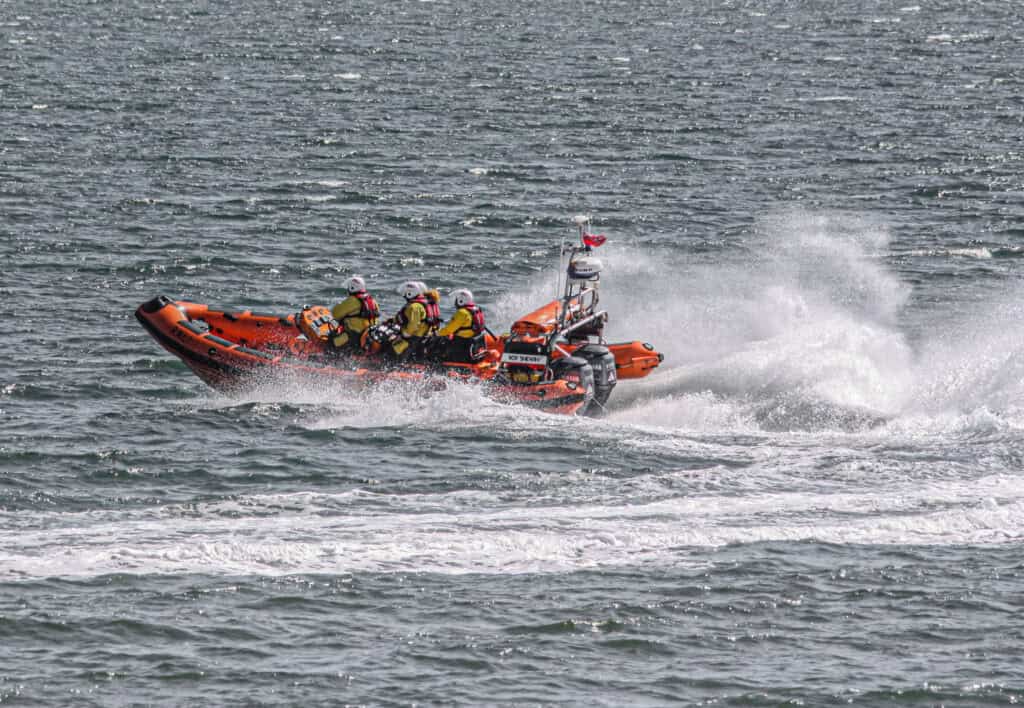
On 12 October 2000 the River Ouse burst its banks and the River Uck flooded, in what the RNLI describes as the worst floods in living memory for the community. The fire service asked for help, and volunteers from Shoreham, Brighton, Eastbourne and Hastings took inflatable lifeboats to Lewes and Uckfield, evacuating residents and businesses, searching for missing people and livestock, and recovering pets. At Cliffe bridge, debris and current pulled a lifeboat under the arch and the crew climbed out onto the railings. The charity's own regional office in Uckfield had to be evacuated. That experience is what prompted the RNLI to train dedicated flood rescue teams nationally.
The autumn of 2000 was a national event rather than a Sussex one. The same months brought flooding to the Severn catchment, to York and the Yorkshire Ouse, and to Crawley and Gatwick — three very different rescue problems in three very different catchments.
Twenty-five years later the same pattern repeats on a smaller scale. On the night of 8 April 2024 the River Arun overtopped at Rope Walk and Ferry Road in Littlehampton, and the RNLI launched its Atlantic 85 at around one in the morning, working alongside HM Coastguard, the Littlehampton Coastguard Rescue Team and West Sussex Fire and Rescue Service until four. Crews searched the river for anyone caught in the current while volunteers on foot helped move residents and animals out of flooded property.
Sussex is not the limit of it. RNLI flood rescue teams have supported responses far inland, including in Cumbria and on the Somerset Levels, in events where roads and conventional access had already failed.
As of August 2026 the RNLI's own flood rescue pages redirect to its main What We Do page, which is part of why a straight answer about flood rescue is so hard to find online.
The RNLI remains listed in Defra's framework, and its crews clearly still turn out to inland flooding. But the charity is funded by donations, deploys at its own discretion and prioritises life at sea. Treating an RNLI flood rescue team as a local resource attached to a particular site is not a position any planning authority will accept, and it is not one the RNLI itself claims.
The volunteers who make up the rest of the register
Strip out the fire services and a large share of England's flood rescue capability is volunteer-run and donation-funded. That has consequences the planning system rarely looks at.
- Funding is uneven. Government grant support has historically favoured mountain rescue over lowland rescue, and some teams run on monthly overheads of a few hundred pounds while a national charity raises nine figures a year.
- Availability is not guaranteed. Registered assets volunteer to join the register and to maintain availability. Nobody is compelled to be free on the night.
- Animals matter operationally. The framework notes that people frequently will not leave a property without their pets, which is why the RSPCA holds a typed capability of its own.
- Geography decides response times. A rural site behind a failed access road may be a long way from the nearest Type B boat team, whoever holds it.
None of this reflects on the people involved, who are unpaid and, in the accounts of everyone who has worked alongside them in a flood, very good at it. It is simply that a rescue capability assembled from goodwill cannot be treated as infrastructure.
What flood rescue means for a flood risk assessment
This is where the emergency response story turns into a planning one. Under the August 2026 NPPF, policy F7 requires safe access and escape routes as part of an agreed emergency plan, and it is refusal-worded: development should be refused unless the test is met. Planning Practice Guidance is blunter still, stating that it will not be appropriate to rely solely on emergency plans to mitigate residual risk. Rescue is what happens after the design has failed.
The technical version of the same point sits in the flood hazard rating used to judge an escape route, HR = d × (v + 0.5) + DF. Above a hazard rating of 2.0 the water is classed as dangerous for all, including the emergency services. A route that only works if somebody wades or boats into it is not a safe route, and describing it as one invites exactly the objection the assessment was meant to avoid.
Above a flood hazard rating of 2.0 the water is dangerous for everyone in it, rescuers included. A scheme that depends on rescue has not demonstrated safe access. It has described a rescue.
So the order of work runs one way. Get the levels, the layout and the access right in the flood risk assessment. Then, where residual risk to people remains, commission a flood warning and evacuation plan for your planning condition that proves occupants can leave under their own steam, on a route assessed in the design event with climate change allowances applied, triggered by warnings that actually cover the site — the Environment Agency's service covers rivers and the sea, not surface water. Where water will still reach the building despite all of that, property flood resilience reduces what it costs rather than whether it happens. The emergency services belong in that plan as contacts. Not as mitigation.
Can your site be evacuated without help?
Send us the site and the condition wording. Our experienced consultants assess the hazard along the actual escape route in the design event, with climate change applied, and tell you plainly whether it works. Quote within 60 minutes.
Start a quoteFrequently asked questions
Should I call 999 or Floodline?
Call 999 if anyone is in danger, trapped or in the water, and say clearly that it is a flooding incident so the right assets are mobilised. Floodline, on 0345 988 1188, is for flood warning information and advice rather than rescue. Reporting the flooding to your council afterwards is a third, separate step, and it is what can eventually trigger a Section 19 flood investigation.
Can a fire and rescue service in England refuse to attend a flood?
In law, yes, because no statutory duty compels attendance. In practice it does not happen: every English service holds some water rescue capability and turns out to flooding. The real effect of the missing duty is variation in how much capability each service holds and how it is funded, not a refusal at the point of the call. It shows up in the accounting rather than in the response: the Home Office counts flooding among non-fire incidents rather than as a statutory function, which is a small but telling reflection of where it sits in the legislation.
Does anyone charge for a flood rescue?
No. Rescue by the fire and rescue service, the RNLI, the Coastguard or a registered voluntary team is free at the point of use. The volunteer organisations recover their costs through donation and grant funding, which is precisely why their capacity varies by area. Fire and rescue authorities themselves are funded through the local government finance settlement and the council tax precept rather than through any flooding-specific allocation, and that absence of a dedicated funding line is the point the National Fire Chiefs Council has been pressing since 2024.
Will anyone rescue livestock or pets?
Animals are dealt with, but by different assets and at a different priority to people. The RSPCA holds a typed flood rescue capability specifically for animals, and the national framework recognises that occupants often refuse to evacuate without their pets. An evacuation plan for a site with animals should say where they go, because leaving that blank is a common reason people stay put. Our guide to protecting your home from flooding covers the household side.
If the council approves my evacuation plan, have the emergency services agreed to attend?
No. Discharging a planning condition is a local planning authority decision, taken with advice from its emergency planners. It is not an undertaking by the fire service, the Environment Agency or anyone else to respond in a particular way. The plan has to work on the assumption that occupants get themselves out — on foot, early, and never by driving through flood water.
About the author. Charlotte is Unda's Marketing Manager, and is completing an MSc in Marketing at the London School of Economics. Unda has been trading since 2014, is a CIWEM Business Partner with CIWEM member and chartered (C.WEM MCIWEM) consultants, and has delivered 5,000+ flood risk assessments and drainage strategies across England and Wales.
Charlotte Stone · BSc (Hons)
Latest news



One of our experienced Flood Risk Consultants will get back to you within 60 minutes
