The Pitt Review: impact, legacy and the gaps that remain

Estimated reading time 19 minutes
The 2007 floods turned the wettest summer on record into the most destructive inland flooding Britain had seen in modern times. Thirteen people died, more than 55,000 properties went under, around 7,000 people were rescued, and the bill came to roughly £3.2 billion. The inquiry that followed, led by Sir Michael Pitt, made 92 recommendations and rebuilt the way England manages flood risk. Nearly two decades on, most of that programme is law. Two pieces of it are not, and one of those two has now missed its own deadline by more than a decade.
Of the 92 recommendations, 43 were recorded as implemented when the government closed its progress reporting in January 2012. The two that mattered most to new development were still open, and both remain open in 2026.
This article sets out what happened in the summer of 2007, what the Pitt Review found, which of its recommendations were delivered, and exactly where the unfinished ones stand today. If you are submitting a planning application, that last part is the part that costs money.
What were the 2007 floods?
The 2007 floods were two waves of exceptional rainfall across England and Wales in June and July 2007 that flooded more than 55,000 homes and businesses, killed 13 people and caused around £3.2 billion of damage. The Environment Agency's cost study puts the best estimate at £3.2 billion within a range of £2.5 billion to £3.8 billion, in 2007 prices.
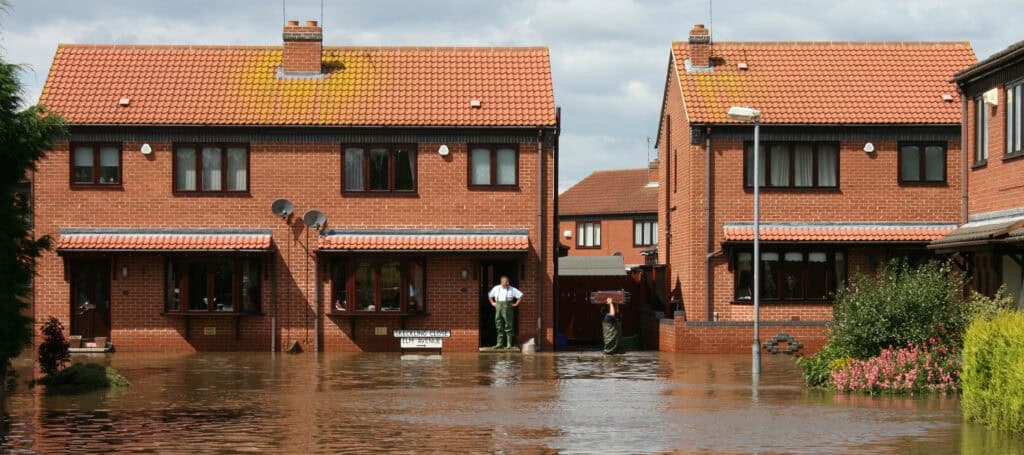
The first wave arrived in late June, when torrential rain crossed Yorkshire, Humberside and the Midlands. Hull, Sheffield and Doncaster were hit hardest, and in Hull the water came from the drains rather than the river. The second wave broke in late July over Gloucestershire, Worcestershire, Oxfordshire and the Thames valley. Tewkesbury, where the Severn meets the Avon, was photographed from the air as an island with its abbey standing clear of the water. That picture fixed the summer in the public memory.
| Measure | Figure | Source |
|---|---|---|
| Lives lost | 13 | Pitt Review, 2008 |
| Properties flooded | More than 55,000 homes and businesses | Environment Agency |
| People rescued | Around 7,000 | Environment Agency |
| Total economic cost | £3.2bn best estimate, range £2.5bn to £3.8bn | EA cost report SC070039, 2010 |
| Households' costs met by insurance | 76 per cent | EA cost report SC070039, 2010 |
For the households and businesses outside that 76 per cent, recovery ran into years rather than months. The insurance fallout was severe enough to shape the negotiations that eventually produced Flood Re, the industry-and-government scheme that now backs cover for high-risk homes.
People often ask whether 2007 was the worst flood in UK history. By property count and cost it sits among the worst inland events on record, but it is not the deadliest: the 1953 east coast storm surge killed more than 300 people in England alone. What makes 2007 significant is not its place in a ranking. It is that the water came from a source the system had never been built to manage, and the country has been rebuilding around that discovery ever since, through 2013–14, Storm Desmond in 2015, the winter of 2019–20 and every major flood since.
Why the 2007 floods were different from earlier UK flooding
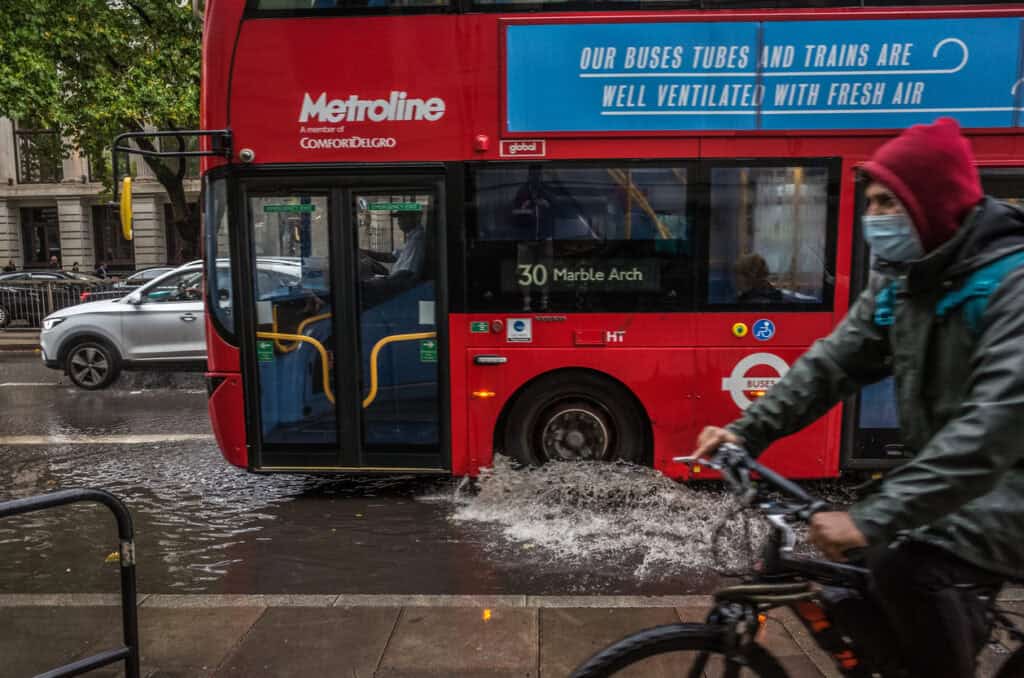
Earlier UK flood policy had been built around rivers and the sea. The summer of 2007 was dominated by surface water flooding: rainfall so intense that it overwhelmed drains and ran across the ground before it could ever reach a watercourse. England had already had a warning: the flash flood that tore through Boscastle in 2004 came from the same mechanism at a smaller scale, and nothing structural changed after it. That is why densely built towns took the worst of 2007, and why nobody could say who was responsible for managing it.
In 2007, no organisation in England held a clear statutory duty for surface water flooding. That single gap accounts for more of the Pitt Review's programme than any other finding.
The distinction still governs practice. A river or coastal flood arrives along a mapped route from a known source. A surface water flood can appear on ground with no watercourse anywhere near it, which is exactly why owners and occupiers so rarely see it coming. Surface water is now the most widespread flood source in England, and it is the source a new development has to prove it will not make worse. Proving that is the job of a surface water drainage strategy for planning, and the reason one is asked for at all traces straight back to June and July 2007.
The scale of the exposure has only become clearer since. The Environment Agency's second National Assessment of Flood and Coastal Erosion Risk, published in December 2024, put 4.6 million properties in England in areas at risk of surface water flooding, 43 per cent more than the previous assessment. The Agency is careful about what that means: the rise "doesn't reflect a real-world increase in risk. It is almost entirely due to improvements in data, modelling, use of technology." In other words, the risk was always there. In 2007 we simply could not see it.
How close England came to losing water and power
The 2007 floods came within hours of taking out infrastructure serving millions of people. Three near-misses in Gloucestershire and South Yorkshire did more to shape the Pitt Review's thinking on resilience than the property damage did.
- Mythe water treatment works, Tewkesbury. The works flooded on 22 July. Reporting to the Commons two days later, the Environment Secretary said 140,000 properties remained without mains water, with Severn Trent estimating seven to fourteen days to full restoration. The works supplies more than 350,000 people.
- Walham switching station, Gloucester. Temporary barriers, thrown up by the Army and the Environment Agency as the Severn rose, held the site. Had they failed, the Environment Secretary told the Commons, hundreds of thousands of people would have lost power.
- Ulley reservoir, Rotherham. High-velocity flow destroyed the masonry spillway walls and eroded the embankment to the point where engineers judged the dam might fail. Several hundred residents of Whiston, Treeton and Catcliffe were evacuated and the M1 closed for around 40 hours.
None of these was a flood defence failing. Each was an essential service discovering that its own site had been designed without extreme flooding properly in mind. Pitt drew the obvious conclusion: a flood can cascade a long way beyond the water's edge, and nobody should assume water, power and transport will keep running through one.
What was the Pitt Review, and how was it carried out?
The Pitt Review was the independent inquiry into the summer 2007 floods, commissioned by the government in August 2007 and led by Sir Michael Pitt, then a senior public official with a background in local government and the NHS. It reported in three stages: an interim report in December 2007, a progress report on the most urgent actions in April 2008, and the final report, Learning Lessons from the 2007 Floods, on 25 June 2008. That report ran to 505 pages and made 92 recommendations.
What made it durable was its method. Rather than a desk study, it built its evidence from the ground up.
- Written evidence. More than a thousand written submissions from flood victims, local authorities, emergency responders, environmental bodies and infrastructure operators.
- Public meetings. Sessions across the affected areas, so residents and business owners could describe the response, the insurance process and the recovery in their own words.
- Technical scrutiny. Specialists in hydrology, urban drainage, emergency planning and climate resilience tested the findings against the science.
- Operational review. It examined how agencies handled evacuation, communication and resource allocation, and where coordination between them broke down.
- Infrastructure assessment. A hard look at how exposed defences, drainage networks and critical assets such as power and water sites really were.
Setting community experience alongside technical evidence gave the review a fuller picture of UK flood risk than any previous inquiry, and that is a large part of why its recommendations survived a change of government two years later. The government's responses to the review remain published on GOV.UK.
What did the Pitt Review recommend?
The Pitt Review made 92 recommendations covering national leadership, local responsibility, forecasting, the drainage of new development, infrastructure protection and emergency response. Six of them carry most of the weight, and they are worth reading in their original numbering, because the numbering is how their progress was later tracked.
- Recommendation 2. The Environment Agency "should progressively take on a national overview of all flood risk, including surface water and groundwater flood risk".
- Recommendation 6. The Environment Agency and the Met Office "should work together, through a joint centre, to improve their technical capability to forecast, model and warn against all sources" of flooding.
- Recommendation 10. "The automatic right to connect surface water drainage of new developments to the sewerage system should be removed."
- Recommendation 14. "Local authorities should lead on the management of local flood risk, with the support of the relevant organisations."
- Recommendation 20. The government "should resolve the issue of which organisations should be responsible for the ownership and maintenance of sustainable drainage systems".
- Recommendation 39. "The Government should urgently put in place a fully funded national capability for flood rescue with Fire and Rescue Authorities playing a leading role, underpinned as necessary by a statutory duty."
Around those sat a wider planning agenda: tighter control of development in flood-risk areas, resilience built into new housing, and flood risk assessment made routine for major proposals. Running through all of it was a call for sustained climate adaptation, through engineered defences and natural flood management together.
Pitt's central insight was that flooding could not be treated as an emergency belonging to nobody in particular. It needed a named owner, nationally and locally, all of the time.
What the Pitt Review actually changed
The Pitt Review replaced a reactive system with a proactive, risk-based one in which named bodies answer for named sources of flooding. Three of its structural recommendations were delivered in full, and they are why flood risk management in England looks the way it does today.
The Environment Agency took the strategic national lead for flood and coastal erosion risk. County and unitary councils became Lead Local Flood Authorities, accountable for surface water, groundwater and ordinary watercourses, which was precisely the gap 2007 had exposed. With the role came the duty to investigate significant local flooding, which is the power behind every Section 19 report published since. Both changes were written into law by the Flood and Water Management Act 2010, which received Royal Assent on 8 April 2010 and remains the backbone of the system in England and Wales. How duties divide between the Agency, the LLFA, water companies and councils is set out in our guide to who is responsible for managing flood risk in England.
Forecasting is the clearest success of the three. Recommendation 6 became the Flood Forecasting Centre, opened jointly by the Environment Agency and the Met Office in April 2009 and now based at the Met Office in Exeter. It brought real-time surface water modelling, a single national picture of severe weather and flood risk, and the tiered flood alert, flood warning and severe flood warning system that reaches households and responders far earlier than anything available in 2007. More than 1.6 million users are now registered for the flood warning service, and the Centre's 2025–2027 strategic plan commits to folding a new Rapid Flood Guidance service into its round-the-clock operation by March 2027.
The reforms did not stop the floods. What they gave households, businesses and responders was the one thing entirely absent in 2007: time.
The two recommendations that were tracked, then quietly dropped
When the government published its final progress report on the Pitt Review on 27 January 2012, it recorded 43 of the 92 recommendations as implemented, 40 as implemented with work still running, and six as on track. One was recorded as not completely implemented, one as not for government, and one as not now being taken forward. On the face of it, that is a strong delivery record.
The interesting part is what the report said about the two recommendations still open, because in both cases it gave a date.
On sustainable drainage, the report noted that a consultation had launched on 20 December 2011, and that the government intended to "commence Schedule 3 as soon as possible thereafter". The completion date recorded against it was the end of December 2014. Schedule 3 of the Flood and Water Management Act 2010 is the machinery that would have delivered Recommendations 10 and 20 together: a SuDS Approving Body that design-checks and adopts drainage in new development, and the end of the automatic right to connect surface water to the sewer.
On flood rescue, the report recorded that a £2.5 million grant scheme had raised the number of specialist teams from 39 to more than 120, but that "discussions are ongoing concerning a statutory duty for Fire and Rescue Authorities", with a decision promised in the government's response to the Exercise Watermark report, due that March.
Neither date was met. Progress reporting stopped in January 2012, and with it went the mechanism that would have made the slippage visible.
Where the two gaps stand in 2026
Neither Recommendation 10 nor Recommendation 39 has been delivered in England, and on both the government's current position is that it does not intend to deliver them as Pitt framed them. Wales has done both. England has done neither.
| Recommendation | What Pitt wanted | Status in 2026 |
|---|---|---|
| Rec 2: strategic leadership | Environment Agency to hold a national overview of all flood risk | Delivered. In force since the 2010 Act |
| Rec 6: forecasting and warnings | A joint Met Office and Environment Agency centre | Delivered. Flood Forecasting Centre, April 2009 |
| Rec 14: local surface water role | Councils accountable for local flood risk | Delivered. Lead Local Flood Authorities created |
| Recs 10 and 20: mandatory SuDS | Drainage approved and adopted in all new development | Not delivered in England. Schedule 3 uncommenced |
| Rec 39: flood-rescue duty | A funded national flood-rescue capability, with a statutory duty | Not delivered in England |
On drainage, the pressure to act has been steady and the answer has been consistent. Wales commenced Schedule 3 on 7 January 2019, and SuDS Approving Body sign-off has been mandatory there ever since. In England, the December 2024 revision to the National Planning Policy Framework expects sustainable drainage on major development, and the National Standards for Sustainable Drainage Systems published in June 2025 set out what good looks like, but as guidance rather than statute. Sir Jon Cunliffe's Independent Water Commission recommended on 21 July 2025 that England make SuDS mandatory for new development. The Environmental Audit Committee went further in October 2025, telling the government to commence Schedule 3 "without further delay".
The government declined. Answering a written question on 29 January 2026, the water minister set out the current position:
Better delivery of SuDS may be achieved by continuing to improve the current planning policy-based approach and looking at ways of improving the approach to adoption and maintenance, rather than commencing Schedule 3 to the Flood and Water Management Act 2010. A final decision on this matter will be made in due course.
Emma Hardy MP, Parliamentary Under-Secretary of State for Water and Flooding, 29 January 2026
Eighteen years after Recommendation 10, and eleven years after the government's own completion date, "a final decision will be made in due course" is where mandatory sustainable drainage in England has come to rest. The SuDS discharge hierarchy that a scheme is judged against is now carried entirely by planning policy and guidance.
On flood rescue the position is quieter and no better. Fire and rescue services attend flooding and are often first on the water, but in England they do so without any legal obligation to. Scotland gave its services a statutory duty in 2005, Northern Ireland in 2012, and Wales in February 2017. England has not, and the National Fire Chiefs Council continues to press for one, while making the point that a duty imposed without dedicated funding would simply move the pressure onto services already stretched.
Two further weaknesses sit underneath both. Lead Local Flood Authorities were handed real responsibilities without consistent funding or specialist staff, so delivery of local strategies varies widely between councils. And the physical defences are under strain: the Environmental Audit Committee found in October 2025 that the proportion of high-consequence flood defence assets kept at their required condition had fallen from 98 per cent in 2018–19 to 93 per cent in 2024, an estimated decline in protection for around 200,000 properties. The National Audit Office had already reported in 2023 that the defence programme would protect far fewer homes than promised.
What the 2007 floods mean for a planning application today
Almost every flood risk requirement a developer meets today can be traced to the Pitt Review. The Lead Local Flood Authority is a statutory consultee on your drainage strategy because of Recommendation 14. Surface water has to be assessed alongside rivers and the sea because of Recommendation 2. Your site needs sustainable drainage at all because of Recommendations 10 and 20, even though the statutory machinery behind them was never switched on.
That last point has real consequences. Because England chose planning policy over Schedule 3, no SuDS Approving Body stands behind the planning system to catch a drainage scheme that does not work. The planning application is the only check there is. A weak drainage submission is not picked up later by a separate technical regime. It is picked up by an LLFA objection, or it is not picked up at all until it has been built.
In practice a modern application carries evidence the 2007 system never asked for: a flood risk assessment that considers every source of flooding, a drainage strategy that keeps runoff within agreed rates, and, where development is being steered away from higher-risk land, the sequential and exception tests. Getting the drainage evidence right at application stage matters more in 2026 than it did in 2014, when Schedule 3 was still expected, and the August 2026 NPPF changes have tightened the drainage expectations again.
No SuDS approving body means the application is the only check
We prepare the flood risk and drainage evidence that clears an LLFA objection first time. Tell us about your site and we will come back within 60 minutes.
Start a quoteInvestment has followed the argument, if not the legislation: £1.4 billion is committed for flood defences in 2026/27 within a £10.5 billion settlement running to 2036. But money buys defences, and Recommendation 10 was never about defences. It was about not making the problem worse, one development at a time. Until Schedule 3 is commenced or replaced with something equivalent, that job belongs to the planning application, and to the evidence you put in it.
If you are working through flood risk or drainage on a development site, speak to our team about a flood risk assessment for planning or a sustainable drainage strategy, and we will tell you what your evidence needs to show before you submit.
Frequently asked questions
Who was Sir Michael Pitt?
Sir Michael Pitt is a British public official who had led both local government and NHS organisations before the government appointed him to run the independent review of the 2007 floods in August 2007. The inquiry took his name, and his name is now shorthand for the reforms it set in motion.
How many of the 92 recommendations were implemented?
Forty-three were recorded as implemented in the government's final progress report of January 2012, with a further 40 implemented but with work continuing. The word "implemented" did a lot of work in that count: a recommendation could be marked off once a policy or a consultation existed, whether or not the thing Pitt asked for was in place. Recommendation 10 is the clearest example. It was being actively tracked in 2012, and it is still not delivered in 2026.
What is the difference between the Pitt Review and the Flood and Water Management Act 2010?
The Pitt Review diagnosed the problems and recommended solutions; it carries no legal force of its own. The Flood and Water Management Act 2010 is the legislation that turned many of those recommendations into law, creating Lead Local Flood Authorities, giving the Environment Agency a national strategy duty, and setting up the SuDS machinery in Schedule 3. The review proposed and the Act enacted. In the case of Schedule 3, the Act still has not been switched on.
Is the Pitt Review still government policy in 2026?
Its core principles, a risk-based approach with clear leadership and better forecasting, remain the foundation of UK flood policy, and the bodies it created are all still in place. But it is not a live policy document. Progress reporting against it ended in January 2012, and some of its recommendations have since been overtaken by decisions that ran against them, most visibly the position taken on Schedule 3 in January 2026.
Where can I read the Pitt Review report?
The final report, Learning Lessons from the 2007 Floods, is held in the UK Government Web Archive, along with the interim report and the government's responses. The archived collection on GOV.UK is the most reliable route to the documents, since the original Cabinet Office site was retired years ago.
Did the Pitt Review apply to Scotland, Wales and Northern Ireland?
The review examined the 2007 flooding across the UK, but flood risk management is devolved, so its recommendations were addressed principally to the UK government and to England. Wales took a different path and has since gone further than England on both unfinished recommendations, commencing Schedule 3 in 2019 and giving its fire and rescue services a statutory flood duty in 2017.
About the author. Edward is a co-founder and Director of Unda with 20+ years in flood risk and drainage, and a national-press commentator on flooding. Unda has been trading since 2014, is a CIWEM Business Partner with CIWEM member and chartered (C.WEM MCIWEM) consultants, and has delivered 5,000+ flood risk assessments and drainage strategies across England and Wales.
Edward Bouët · BSc (Hons)
Latest news



One of our experienced Flood Risk Consultants will get back to you within 60 minutes
